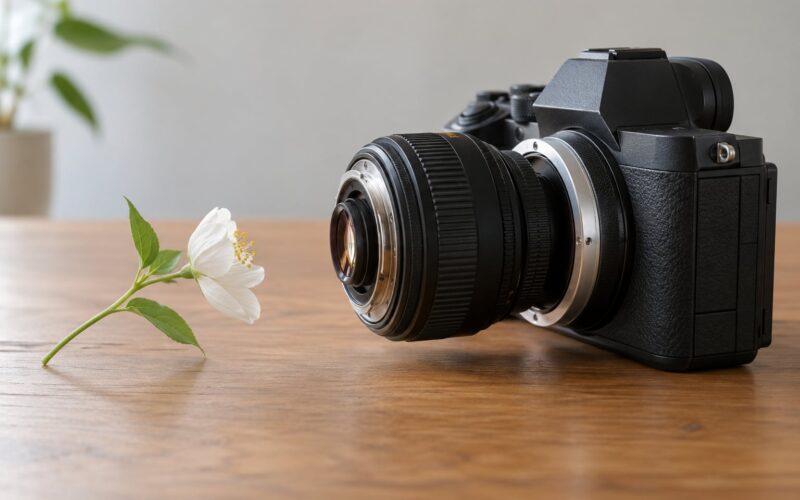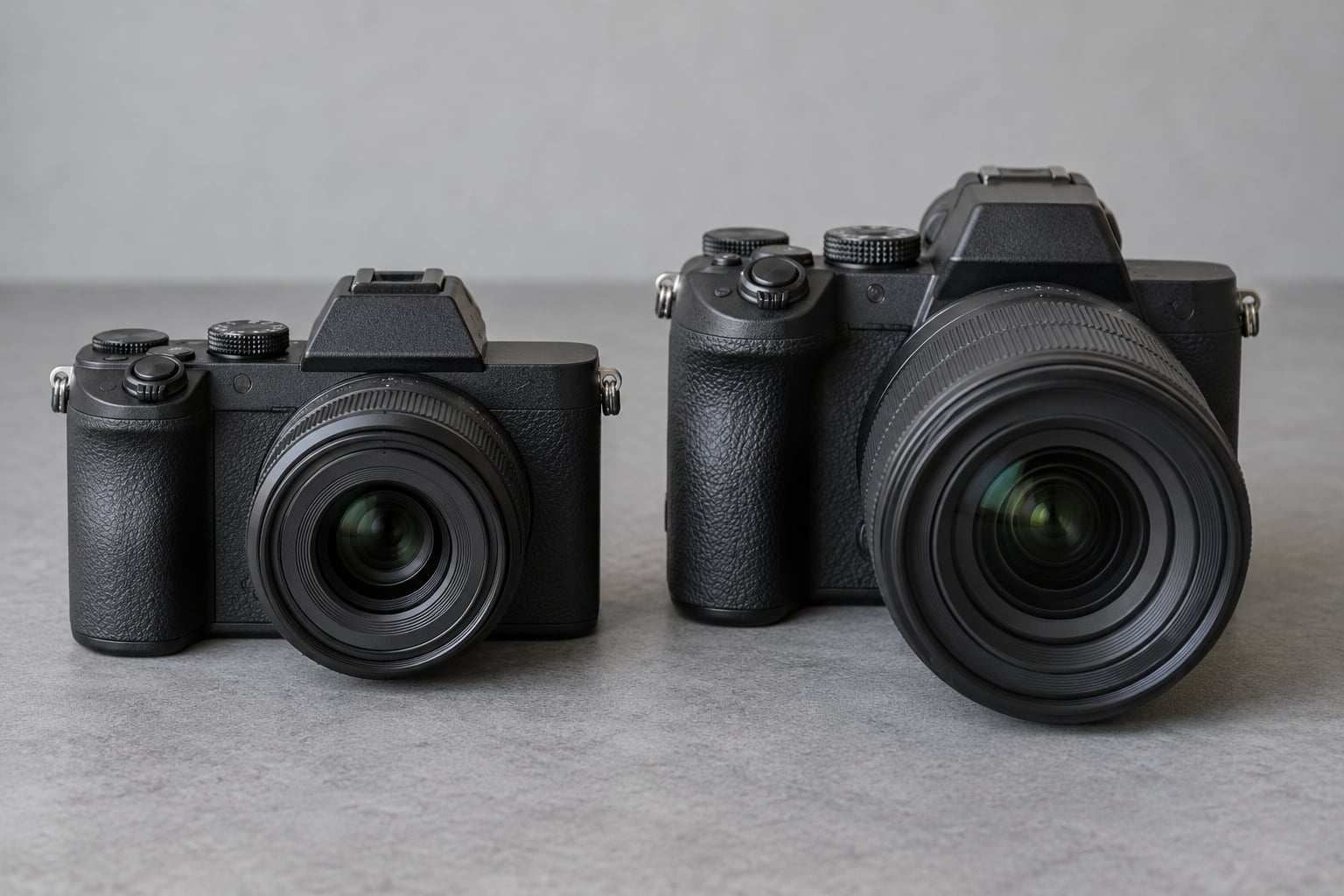
A DSLR bounces light off an internal mirror up into an optical viewfinder, then flips that mirror out of the way to expose the sensor. A mirrorless camera drops the mirror entirely, so light reaches the sensor continuously and you compose on a rear screen or an electronic viewfinder.
Most searches for what is a mirrorless camera vs DSLR end up buried in spec sheets, so here is the short version. That single mechanical difference decides everything else: how the camera feels in your hands, how long the battery lasts, what the autofocus can lock onto, and whether your existing lenses still fit. For a first-time buyer, the format matters far less than the sensor size, the lens you will actually use, and whether you already own glass.
The honest summary is that a modern mirrorless body is the safer default purchase in 2026. A suitable used DSLR still makes plenty of sense, though, particularly if you own Canon EF or Nikon F lenses already or you simply prefer looking through glass instead of a screen.
Table of Contents
- What Is a Mirrorless Camera vs DSLR? At a Glance
- How Mirrorless and DSLR Cameras Work
- What is a mirrorless camera vs DSLR in one sentence?
- Image Quality and Sensor Choices
- Autofocus, Burst Speed, and Tracking
- Lenses and Compatibility
- Size, Weight, and Everyday Portability
- Battery Life and Weather Sealing
- Video Features
- Controls, Viewfinders, and Shooting Experience
- Price, Used Options, and Total Cost
- Is a DSLR a dead system?
- Used options and what a DSLR really saves
- Which Should You Choose?
- Frequently Asked Questions
- Is a mirrorless camera better than a DSLR for beginners?
- Do mirrorless cameras have worse image quality than DSLRs?
- Can you use DSLR lenses on a mirrorless camera?
- Are DSLRs cheaper than mirrorless cameras?
- Is an optical viewfinder better than an electronic viewfinder?
- Do professional photographers use mirrorless or DSLR?
- Conclusion
What Is a Mirrorless Camera vs DSLR? At a Glance
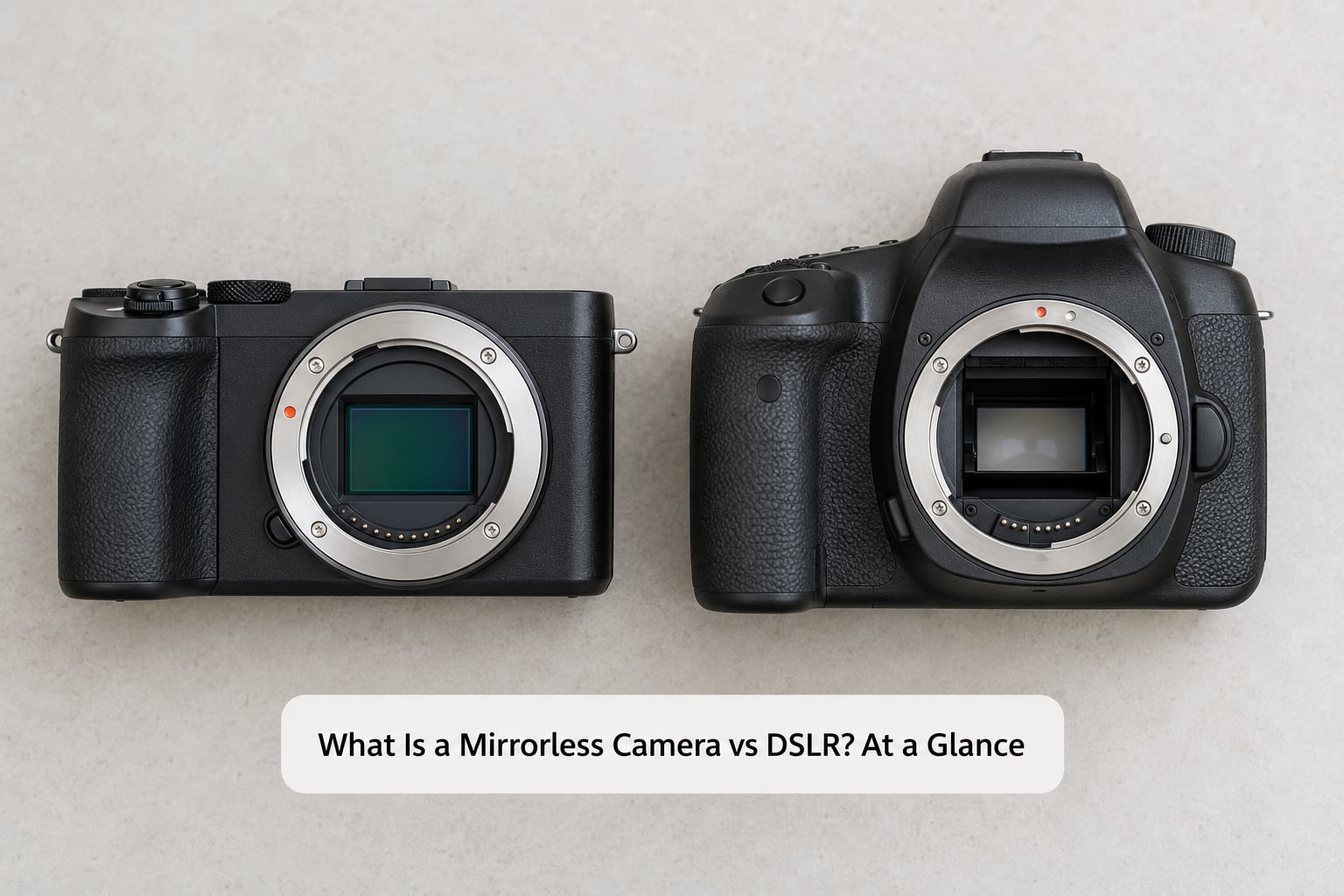
That question laid out side by side, one criterion per row. Read the size row first, because for a beginner carrying a camera on a day out, that row changes behaviour more than any specification.
| Criterion | Mirrorless | DSLR |
|---|---|---|
| Size and weight | Smaller and lighter bodies, especially with compact lenses | Larger bodies, deeper grip, heavier with any zoom |
| How you compose | Electronic viewfinder or rear screen, live preview | Optical viewfinder through a mirror and pentaprism |
| Autofocus | One system used for both screen and viewfinder, with subject detection | Separate phase-detect module for viewfinder, contrast detect for live view |
| Burst shooting | High frame rates, often blackout-free with stacked sensors | Good rates, with a brief blackout each shot from mirror and shutter |
| Video | 4K, high bitrate, log profiles, HDMI streaming | Often 1080p or cropped 4K, limited on older bodies |
| Battery life per charge | Typically around 350 to 500 shots, depending on the model | Typically 1,000 shots or more, which is the standby advantage |
| Lens choices | Native mirrorless glass, plus adapters for older DSLR lenses | A huge second-hand market of Canon EF and Nikon F lenses |
| Sensor dust | Sensor exposed when the lens comes off, easier to clean | Protected behind a closed mirror chamber, but harder to access |
| Future-proofing | Where every maker is putting new development | Mature, well supported, but a shrinking product line |
Quick picks, if you want the decision before the detail. Choose mirrorless if you are starting fresh, care about the size of the bag, shoot any video, or want the newest autofocus features. Choose a DSLR if you already own compatible lenses, your budget is genuinely tight, or you prefer an optical viewfinder and want something that feels mechanical.
How Mirrorless and DSLR Cameras Work
Both cameras start the same way: light passes through the lens and lands on the sensor at the back. What happens on the way there is the whole difference.
What is a mirrorless camera vs DSLR in one sentence?
A DSLR uses a 45-degree reflex mirror to route light upward into an optical viewfinder, and a mirrorless camera sends that same light straight to the sensor and displays it electronically instead.
In a DSLR, the mirror sits at a 45-degree angle and bounces light up to a focusing screen and a pentaprism, which flips the image the right way round and sends it to your eye. The viewfinder shows a real optical image, not a screen. When you press the shutter, the mirror swings up out of the light path and the shutter opens, which means the viewfinder goes dark for a moment.
- How a DSLR works: lens, then a 45-degree mirror, then a pentaprism and focusing screen, then your eye. The mirror flips up to expose the sensor, and it produces a short blackout plus a mechanical shutter sound.
- How a mirrorless camera works: lens, then straight to the sensor, then a small electronic viewfinder or the rear screen. Nothing mechanical moves, so shooting is silent and the screen never goes dark.
Two consequences follow straight from that. Because there is no mirror to swing, mirrorless bodies can be shorter, and because there is no dedicated optical path, the autofocus hardware is not split across two systems any more. The trade is that an electronic viewfinder is a screen running on battery, and that screen is the main power drain.
There is a third consequence people forget. On a DSLR you get a mirror slap sound when the mirror returns, which is part of why a DSLR sounds like a camera. On a mirrorless body you can use the fully electronic shutter and shoot in complete silence, which is genuinely useful at weddings, in galleries, and when photographing sleeping children.
Image Quality and Sensor Choices
Mirrorless wins nothing here by default. Image quality is set by the sensor and the lens in front of it, not by whether a mirror sits inside the body.
A current DSLR and a current mirrorless body of the same sensor size produce files that are, in practical terms, indistinguishable. You get the same dynamic range, the same latitude at high ISO, the same colour rendering in the files. If you compare a 24-megapixel APS-C DSLR against a 24-megapixel APS-C mirrorless body, the deciding factor will usually be the lens.
Sensor size is the real lever, and it works the same way in both formats:
| Sensor | Crop factor | What it suits |
|---|---|---|
| Full frame (35mm) | 1.0x | Portrait work, low light, shallow depth of field, wide vistas |
| APS-C | 1.5x on Canon, Nikon, Sony and Fujifilm, around 1.6x on older Nikon entry bodies | The best balance of size, price and quality for most beginners |
| Micro Four Thirds | 2.0x | Smallest lenses and bodies, long effective reach for wildlife |
The crop factor matters when you compare lenses. A 50mm on APS-C gives the framing and depth of field of an 85mm on full frame. That is useful to know before you blame a camera for a lens feeling too tight.
What changed recently is where you find which sensor. Full frame used to be DSLR-only, and now most entry and enthusiast full frame bodies are mirrorless. That is why a used full frame DSLR is a bargain and a new one barely exists. For a beginner, APS-C in either format gives you the same pictures at a fraction of the cost.
Autofocus, Burst Speed, and Tracking
This is where mirrorless has genuinely moved ahead, and it is the area where the answer matters most for a beginner shooting people or animals.
A DSLR carries a dedicated phase-detection module behind the mirror. That module focuses through the optical viewfinder. Switch the camera to live view on the rear screen and the camera has to fall back on contrast detection, which is slower and hunts more. The result is two autofocus systems of different quality, and the viewfinder one is normally better.
A mirrorless camera has one autofocus system, built into the sensor itself, and it works identically whether you are shooting through the viewfinder or the screen. Newer bodies layer subject detection on top, so the camera can recognise a face, an eye, an animal or a vehicle and hold it. If you shoot children, pets, birds or anything that moves unpredictably, that feature alone can justify the format.
Burst rates follow the same pattern. Mirrorless bodies fire far more frames per second, and models with stacked sensors can do it with no blackout at all, so you keep seeing the scene. Older or entry-level DSLRs are still fine for basic photography, and an older D7500 or a modern Rebel still handles a static portrait perfectly well. They simply do not have the tracking and the frame count.
Two honest caveats. The electronic shutter used for silent shooting on many mirrorless bodies warps fast-moving subjects, an effect called rolling shutter, so sports shooters usually switch to the mechanical shutter. And older entry mirrorless cameras can lag behind a DSLR on continuous autofocus, so a very cheap mirrorless body is not automatically the better buy.
Lenses and Compatibility
This is where a surprising number of beginners get stuck, and the advice repeats across every forum thread: pick a mount, not a format, because lenses outlive bodies.
Every brand has its own lens mount, and switching mounts later means buying glass again. Mirrorless mounts are newer, which means fewer native lenses exist, and it means an adapter if you own older DSLR glass.
| Brand | DSLR mount | Mirrorless mount | Adapting old glass |
|---|---|---|---|
| Canon | EF | RF | EF to RF adapters work well, and Canon tuned the EF ones for autofocus |
| Nikon | F | Z | FTZ adapter works; older screw-drive lenses focus slowly or not at all |
| Sony | A | E | Mount adapters exist and autofocus is usually fine |
| Fujifilm | None in production | X | No DSLR history to bring across |
| OM System | None in production | Micro Four Thirds | Micro Four Thirds glass also fits Panasonic bodies |
| Pentax | K | KPR | The one brand still committing to new DSLR bodies |
Adapters are not a free pass. Autofocus with adapted lenses is usually slower and less certain, and manual-focus options depend on having a focus peaking or magnification aid in the viewfinder or screen. The other half of the problem is money: the second-hand pool of Canon EF and Nikon F lenses is enormous and cheap, while native mirrorless lenses are newer and pricier.
If you already own three DSLR lenses, that changes the maths completely, and adapters often make staying in your current mount the sensible move rather than a compromise.
Size, Weight, and Everyday Portability
This is the biggest practical difference, and it is the one that decides whether you take the camera with you or leave it on the shelf.
Removing a mirror box and a pentaprism lets a mirrorless body be noticeably shorter and, with the right lens, lighter. A compact APS-C mirrorless body with a pancake lens genuinely fits in a jacket pocket, which changes how often you shoot. The equivalent DSLR plus kit zoom is a two-bag proposition, and the extra bulk on a strap is a real reason people stop bringing cameras along.
Two warnings before you assume mirrorless wins. First, a fast, bright lens like an f/1.8 prime is physically large on every mount, so a full-frame mirrorless body with one of those is not small at all. Second, Micro Four Thirds is the format that takes size savings furthest, since its lenses are designed around a shorter sensor and stay compact at long focal lengths.
Ergonomics cut against the smaller body. Many mirrorless bodies squeeze the viewfinder, two dials and a small thumb rest into a shell that leaves nothing spare, and forum complaints about cramped buttons from people with large hands are common. An older DSLR with a deep grip feels substantial in a way that a slim mirrorless body does not.
Battery Life and Weather Sealing
A DSLR wins battery life, and it is not close. A camera with an optical viewfinder draws almost nothing just to show you the scene, so a single charge typically covers something like a thousand shots. Mirrorless bodies, running a screen at full brightness all day, land in the few-hundred range on the same kind of shooting.
Two objections come up constantly, and both are fair. One is that if money is not the constraint, go mirrorless. The other is that nobody wants to carry spare batteries. In practice most mirrorless owners buy a second or third battery and stop thinking about it, and USB in-camera charging means a power bank often solves it outright.
Weather sealing is the one area where the two formats are level. Flagship bodies in either format are sealed against rain and dust, entry bodies in either format usually are not, and the difference between generations inside a single brand is bigger than the difference between formats. Check the specific model’s spec rather than the format label.
Video Features
If any video is on your list, mirrorless is not a close call. The single biggest reason is that mirrorless cameras read the whole sensor, so the entire frame is available for video with no crop on most models.
That capability is what gives you uncropped 4K, and on higher-end bodies it extends to log recording profiles, 10-bit footage, HDMI streaming to a recorder, and long continuous takes. A DSLR in the same price bracket commonly tops out at 1080p, or offers 4K that is heavily cropped and unusable for wide shots.
You also get the screen. A vari-angle or fully articulating touchscreen makes framing yourself or shooting low to the ground practical in a way a fixed rear screen does not. Stabilisation helps, either in the body or in the lens, and it smooths handheld footage and stills.
The honest limitation is heat and recording limits. Video is power-hungry, and cameras still impose clip limits or throttle in warm conditions. Modern bodies manage it far better than earlier generations, but plan on shorter takes than a dedicated video camera allows.
Controls, Viewfinders, and Shooting Experience
Working out whether a mirrorless camera vs DSLR camera feels better to hold comes down mostly to the viewfinder, and this is where the two experiences diverge most.
An optical viewfinder is a mirror image of reality with no electronics in the path. It never lags, never flickers, and never runs out in the cold. Many photographers who moved to mirrorless and later went back to an optical finder describe it as calmer, with no distracting information.
An electronic viewfinder gives you what you actually took: exposure preview, histogram, focus peaking, and a preview of the depth of field you will get. You can hold a camera at arm’s length and still frame a shot properly. Newer high-resolution EVFs are close to indistinguishable from optical in daylight, and most modern bodies refresh fast enough to feel immediate.
The complaints that remain come down to lag and blackout on cheap or older panels. Fast action through a slow EVF feels less certain than the same action through a DSLR finder, which is why sports and wildlife shooters who care about that choose carefully, or add a stacked sensor.
For exposure feedback, the electronic viewfinder wins outright because it shows your settings taking effect before you press the shutter. For physical controls, DSLRs run heavier with more dials and buttons, and mirrorless bodies keep adding them anyway to satisfy people who miss them.
Price, Used Options, and Total Cost
Compare complete kits, not body prices. That single habit prevents most of the disappointment in this format debate.
Is a DSLR a dead system?
Effectively yes, for new bodies from the main makers. Canon, Nikon, Sony and Fujifilm have all stopped launching new DSLR models, and the flagship DSLR line ended with the EOS-1D X Mark III as the last of its kind. Pentax remains committed to the K mount, so the format is not extinct, but the direction of travel is not in doubt.
Used options and what a DSLR really saves
The second-hand DSLR market is where the value sits. Bodies that were expensive a few years ago are now cheap, and the lens pool in the same mounts is deep and inexpensive. What you give up is current autofocus tracking, video capability and the future support that comes with buying into a system that is still being developed.
Build the total up honestly: the body, plus at least two lenses if you want any choice, plus a card, plus a spare battery if it is mirrorless, plus a bag. A cheap mirrorless body with three lenses can cost more than a used DSLR with three lenses, and the used DSLR also keeps resale value as it ages. Buying a discontinued body means no new batteries or firmware support from the maker, so check the battery condition carefully and assume you will replace cells.
Which Should You Choose?
Map your shooting to the format rather than to the spec sheet.
| If you mainly shoot | Choose | Why |
|---|---|---|
| Family, travel, everyday | Mirrorless | Smaller bag, better subject tracking on kids and pets, far better video |
| Portraits and landscapes | Either | Image quality is identical at the same sensor size, so choose on lens and handling |
| Wildlife and birds | Mirrorless, or Micro Four Thirds | Animal subject detection and long reach in a small package |
| Sports and fast action | Mirrorless with a stacked sensor | Faster tracking, higher frame rates, blackout-free shooting |
| Video, vlogging, content | Mirrorless | Uncropped 4K, log profiles, articulating screen, streaming |
| You already own DSLR lenses | Stay in your mount | Adapters work, and glass is the expensive part of the equation |
| Tightest budget | Used DSLR | The cheapest route to an interchangeable-lens camera with a good lens |
| Long telephoto on a small budget | Micro Four Thirds | The 2x crop makes a 600mm behave like a 1200mm |
| Astrophotography | Either | Focus is easier on a mirrorless screen; buy a lens with manual focus |
If you are still torn, run five questions before you spend anything. Do I need video? Will I carry the camera on a walk, or mostly leave it at home? Do I own lenses already? Do I shoot moving subjects? And is my battery anxiety real or theoretical?
Answer yes to the first three and mirrorless is your answer. Answer no to all of them and a used DSLR with a good lens will make better pictures for less money.
Frequently Asked Questions
Is a mirrorless camera better than a DSLR for beginners?
For most beginners buying their first interchangeable-lens camera today, yes. Mirrorless bodies are smaller, they handle video properly, and their autofocus works the same through the viewfinder and the screen. A DSLR still wins on battery life, cheaper used glass and the feel of an optical viewfinder, but those matter less than the fact that you will actually carry the camera.
Do mirrorless cameras have worse image quality than DSLRs?
Not in any meaningful way. Two current bodies of the same sensor size and resolution produce files that are practically indistinguishable in normal use. Sensor size, the lens in front of it and the light you are shooting decide quality. Where older or cheaper models differ, it is the model, not the mirror. Judging a camera by whether it has a mirror is like judging a car by whether it has a manual gearbox.
Can you use DSLR lenses on a mirrorless camera?
Usually, through an adapter. Canon EF to RF and Nikon F to Z adapters are widely available and autofocus is decent with most modern glass, though slower than native lenses. Screw-drive Nikon lenses often will not autofocus at all. The catch is money: adapters plus slower focusing plus no small adapted primes make many photographers decide to invest in native lenses instead.
Are DSLRs cheaper than mirrorless cameras?
New entry bodies are close, but the used market is where DSLRs pull clearly ahead. A discontinued DSLR body with a couple of lenses can cost a fraction of a comparable mirrorless kit, because the second-hand pool of Canon EF and Nikon F glass is enormous. Compare complete kits rather than body prices, and remember a discontinued body means no manufacturer support for batteries or firmware.
Is an optical viewfinder better than an electronic viewfinder?
It depends on what you shoot. An optical finder never lags, never flickers and uses almost no battery, which many experienced photographers prefer for calm, fast shooting. An electronic finder shows you the exposure, the histogram and the depth of field you will actually get, which makes learning and composing much easier. Modern high-resolution electronic finders are close to optical in daylight.
Do professional photographers use mirrorless or DSLR?
The large majority work with mirrorless now, and pro bodies in every major brand are mirrorless. You will still see DSLRs in use, particularly in long-term working sets where photographers already own the lenses, and in Pentax circles where the mount is still being developed. Professionals who stayed on DSLRs usually did so because they already had glass, not because the format photographs better.
Conclusion
If you are buying your first camera and you are starting from nothing, a mirrorless body is the safer choice in 2026. It is smaller, the autofocus tracks subjects better, and it handles video, which most new cameras end up doing anyway.
A used DSLR still wins in two clear situations: you already own compatible lenses, or your budget is the binding constraint. What to do first is simple. List the lenses you would actually want to own, price the complete kit, and buy into that mount rather than into a format. Bodies get replaced every few years. Lenses are the part you keep.