Start in aperture priority at f/5.6, 1/125s, ISO 1600, single-point autofocus, RAW capture and tungsten white balance. That one block handles most of a flower hall, and you only touch it when the light changes: drop the ISO in a bright pavilion, push it toward 3200 in a dim side room.
A flower show is indoor event photography with a still subject. The blooms never move, but the air currents, the footfall and the color of the light all do. Most people arrive with outdoor flower settings, get three stops less light than expected, and come home with soft, noisy, green-tinted frames.
It takes about an hour to get this right the first time. Here is the setup I work from, and the reasoning behind each number.
Table of Contents
- What You Need
- Step-by-Step: Camera Settings to Use at a Flower Show
- Start with Aperture Mode or Program Mode
- Set the Right Starting Exposure for Flower Show Lighting
- Keep Flowers Sharp Without Blurring the Scene
- Get Accurate Color Under Mixed Indoor Lights
- Focus on the Flower, Not the Display Case
- Compose for Cables, Reflections, and Busy Backgrounds
- Test and Adjust Before Moving Through the Show
- Common Mistakes
- Frequently Asked Questions
- Can I use automatic mode at a flower show?
- How do I prevent flowers from looking blurry in low light?
- What is the best white balance for indoor flower displays?
- How do I photograph flowers through a glass display case?
- Should I use a tripod or image stabilization?
- How do I capture flower colors without losing highlight detail?
- Conclusion
What You Need
Not much, and none of it expensive. The camera body matters far less here than the lighting does.
- Any camera with aperture control. A DSLR, a mirrorless body, a bridge camera or a phone all work. A phone camera with a 2x lens covers most exhibits comfortably.
- A short telephoto or a normal zoom. A 35 to 70mm equivalent keeps you far enough back to see whole arrangements in a crowded aisle. A 90 to 105mm gives you cleaner backgrounds without needing a big aperture.
- A macro lens for detail shots if you want petals filling the frame. Without one, a kit zoom will still get you closer than you think at 70mm.
- A lens hood or your own hand to shade the front element from the hall spotlights, which flare far more indoors than outdoors.
- A spare battery and a formatted card. Cold halls and long screen-reviews eat batteries, and no show ever has a spare card when you need it.
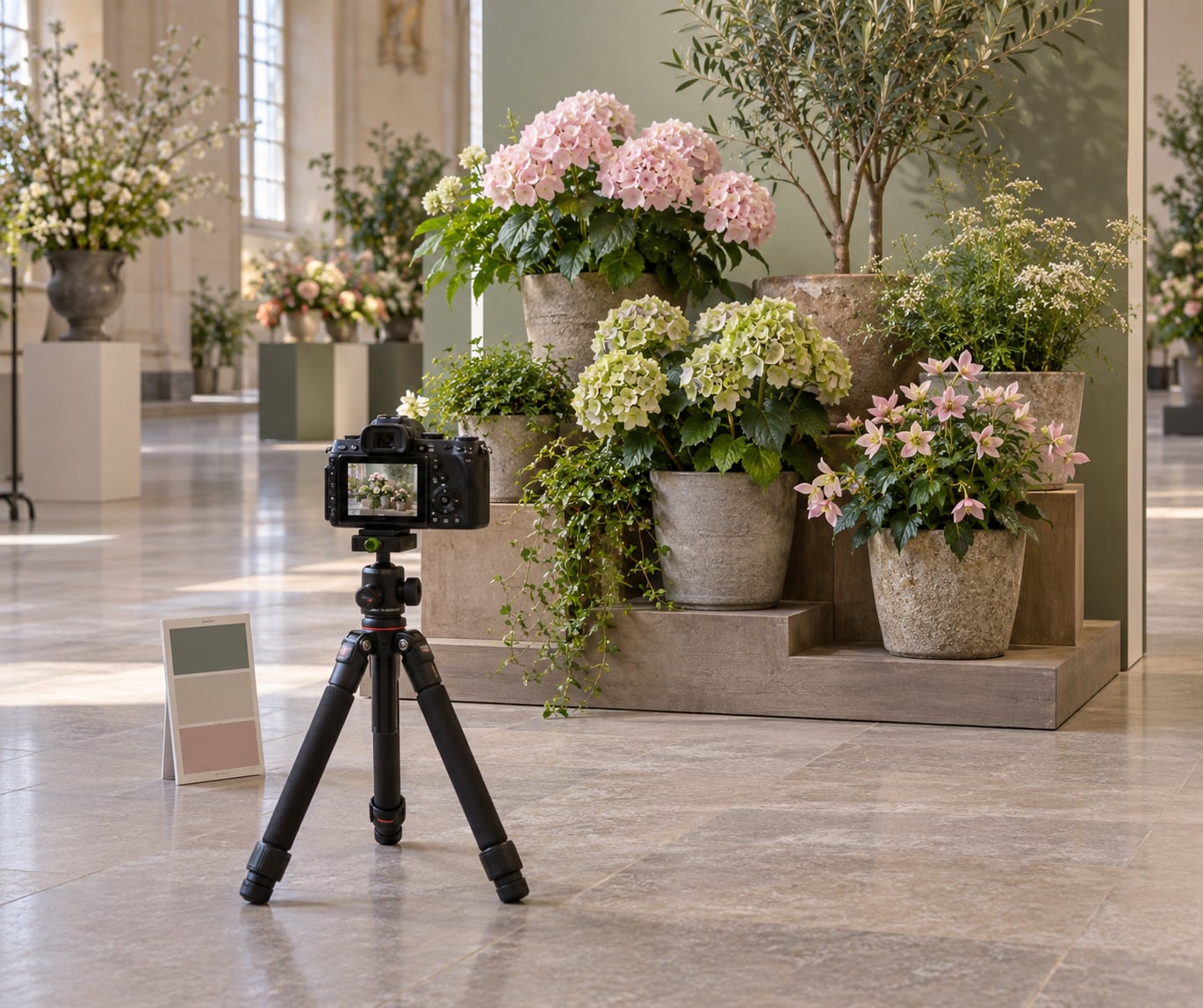
- A small grey card or a plain white card for a custom white balance in the room you are actually standing in.
- Something to brace against. A low tripod is often banned in aisles. A display plinth edge, a railing or your own forearms do the same job.
Before you unpack anything, read the show’s rules or ask at the desk. Flash is usually banned, and so are tripods and monopods in the public aisles. Knowing that in the car saves ten minutes of guessing in the entrance lobby.
Step-by-Step: Camera Settings to Use at a Flower Show
Start with Aperture Mode or Program Mode
Aperture priority (A or Av) is the right default for a show. You set f/5.6 or f/8 and the camera picks a shutter speed, which means one control handles both halves of a moving-light problem: you set the depth of field you want, and the camera balances the rest.
Switch to manual only when you are braced, the exhibit is not moving, and you want identical frames across a sequence. At that point the light is steady and the meter just adds noise to the decision.
Program mode is the underrated middle option. It picks both aperture and shutter while holding the ISO it thinks is right, which is useful on a dark hall when your fingers are cold and you would rather spend attention on composition. Just watch that it does not drift to ISO 12800.
On a phone, tap the flower once to set focus and exposure, then press and hold the screen to lock both. That lock stops the camera re-exposing every time the crowd moves past your light meter.
Set the Right Starting Exposure for Flower Show Lighting
Light in a show hall sits three to four stops below daylight, and the floor of that range depends on the room. Work out which tier you are in with a test shot, then use this table as your starting point.
| Lighting | Mode | Aperture | Shutter | ISO | AF | File |
|---|---|---|---|---|---|---|
| Bright hall or glasshouse at midday | Av | f/5.6 | 1/160s | 400 | Single point | RAW |
| Average hall, spotlit exhibits | Av | f/5.6 | 1/125s | 1600 | Single point | RAW |
| Dim side room or late-afternoon conservatory | Av | f/4 | 1/125s | 3200 | Single point or manual | RAW |
| Visitor portraits in any hall | Av | f/2.8 | 1/250s | Auto up to 6400 | Face or eye detect | RAW |
The test shot takes ten seconds. Take one frame, press the playback button, and look at the histogram: if the bars are crushed hard against the right edge, drop the ISO by a stop, and if they pile up on the far end with no detail, raise it.
If the middle is empty but both ends are pinned, the hall lighting is beyond a single frame and you are looking at a spot with a strong source behind it.
Aperture is the setting to think about before anything else, because it decides what is sharp. At f/2.8 on a normal lens a centimeter across the flower is sharp and the rest melts away, while f/8 gives you a couple of inches, enough for a whole small arrangement.
Do not go past f/11 unless you are braced, since diffraction softens fine petal detail and the noise is already there.
Keep Flowers Sharp Without Blurring the Scene
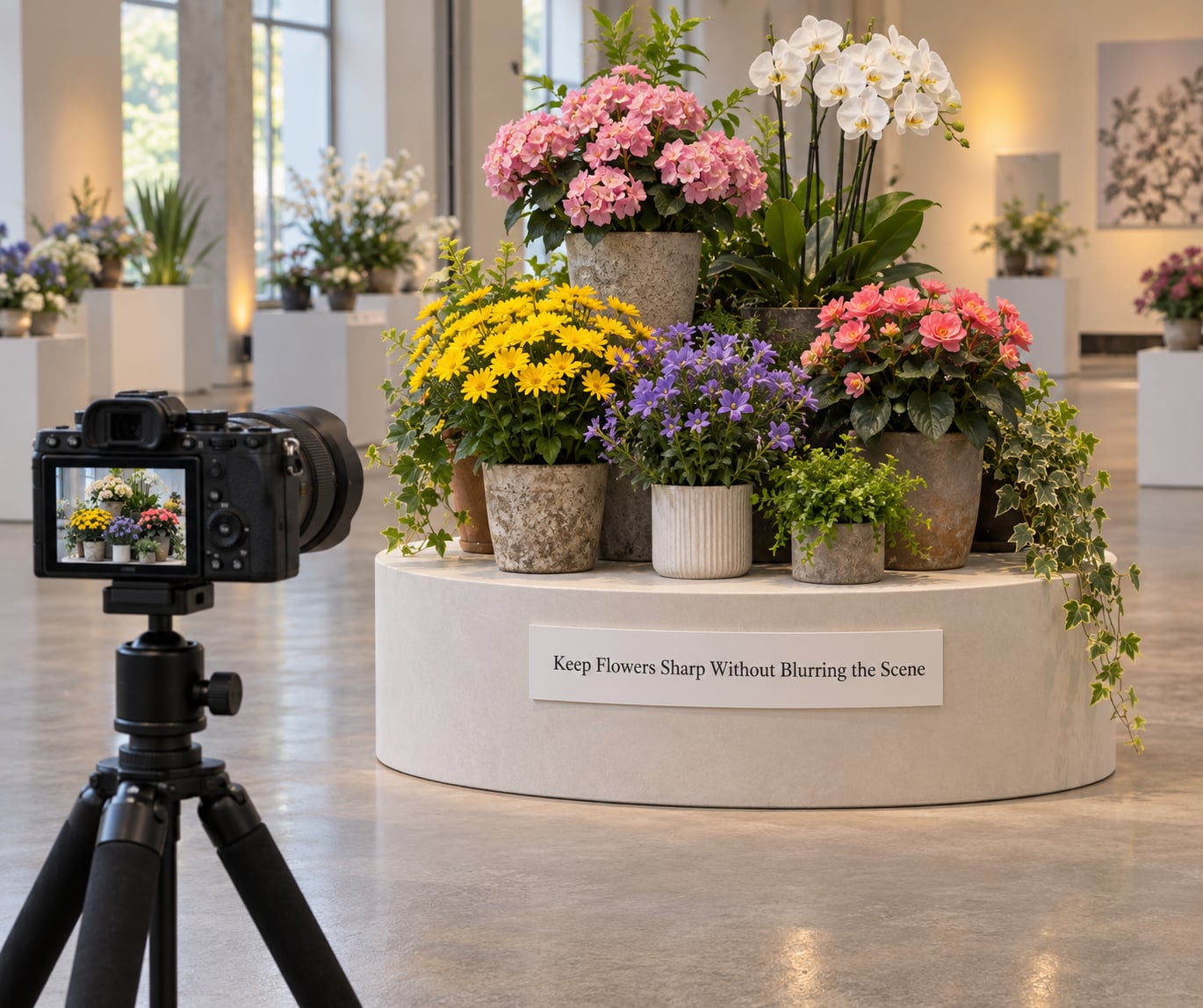
The flower is still. The problem is your hands, and the second problem is the air. Hall heating, door drafts and a visitor brushing past a table will move a petal faster than you expect.
Handheld, keep the shutter at 1/125s or faster with a normal or short telephoto lens. At f/4 on a modern body that is about as slow as you can push before camera shake shows. If the camera will not hold 1/125s at the ISO you are happy with, widen the aperture before you drop the shutter.
Braced, 1/30s and even 1/15s is workable for an arrangement nobody will touch. Turn image stabilization off when the camera is on a tripod or a solid surface. Stabilization fights a stable platform and makes the image wander at slow speeds.
Visitors are the other half of the problem. Long exposures inside a busy hall catch a ghost of everyone walking past. If you cannot get a clean frame in two or three tries, shoot slightly faster and accept a smaller aperture.
Get Accurate Color Under Mixed Indoor Lights
Show halls run tungsten spots, fluorescent tubes and LED strips within the same room, and your camera sees all three at once. Shoot RAW and deal with it afterwards; a JPEG from mixed lighting cannot be rescued because the clipped channel is already gone.
For white balance, set it manually rather than leaving it on auto. Auto will hunt every time you pan from a spotlit case to a window. The tungsten preset around 3200K suits warm halls. Overcast at 5200 to 6000K suits cool LED-lit rooms. Try both and check the petals on screen.
The reliable method is a custom white balance from a grey card or plain white paper held under the same light as the flower. One shot, then set it as your custom value, and every frame after that is close before editing.
Green and magenta casts come from mixed sources and are fixed in raw processing, not on the slider panel. Pull the green tint out of the white balance channel, then match the flower to a real bloom you know the color of. If a white petal looks grey, the color balance is off, not the exposure.
Focus on the Flower, Not the Display Case
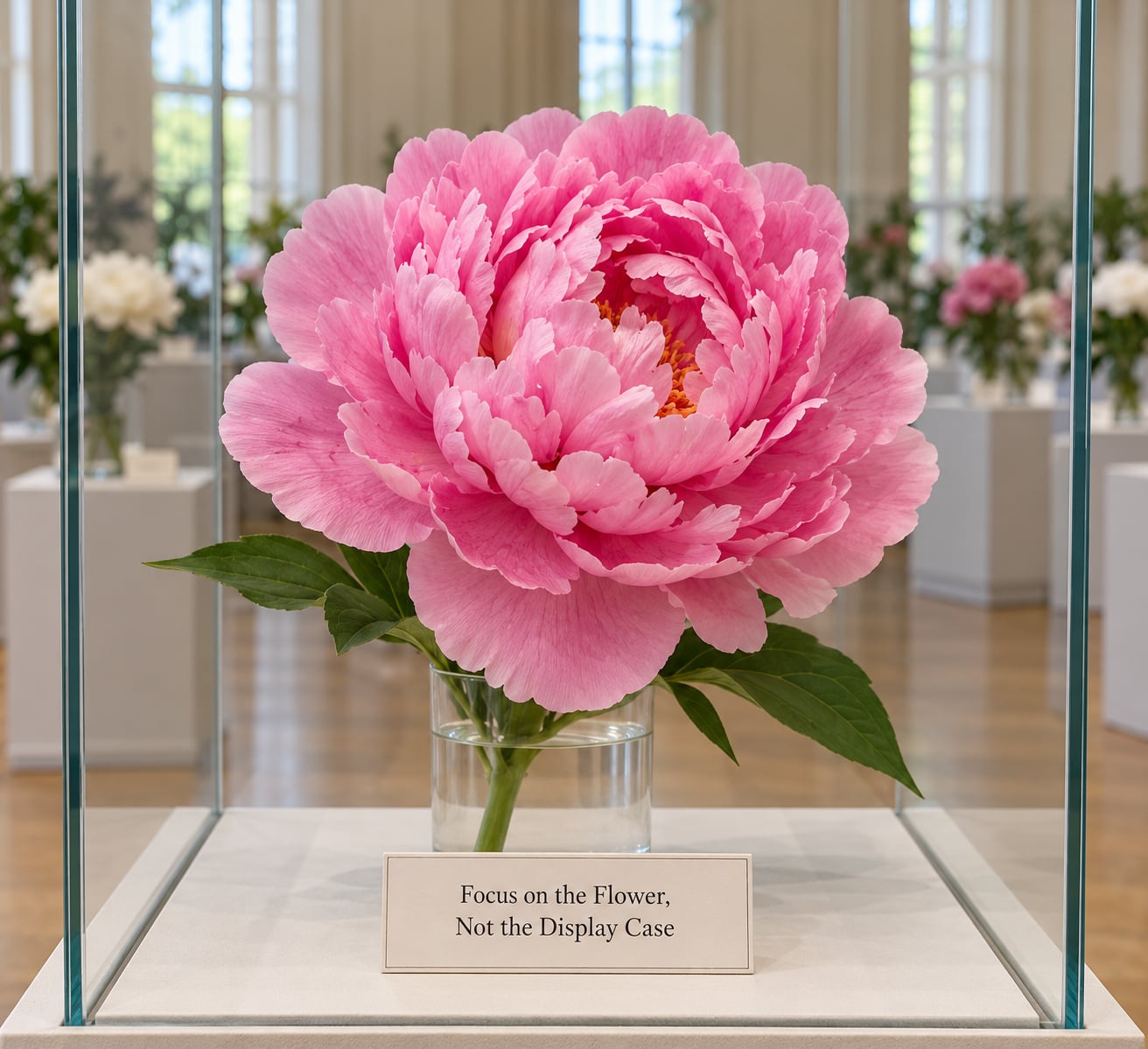
Switch autofocus to a single point and place it on a petal, a bud or a leaf edge rather than on the center of the arrangement. At close focus distances, the center of a bouquet is often a centimetre behind the front blooms, so the camera focuses on something you cannot see.
Turn face and eye detection off for flowers. It will find a visitor’s face behind the glass and focus on that instead.
For a display nobody is allowed to touch, manual focus is faster than autofocus. Focus once on the front of the arrangement, then leave it there. If you are using a tripod, a quick focus test by hand and a tape mark on the barrel will hold the setting all afternoon.
Glass is where flower show shots get lost. Reflections of the hall and of you appear as bright streaks across the petals, and they get worse the closer you stand. Move along the case rather than shooting square on, so the reflection bounces away. Press the lens hood or a cupped hand to the glass to block stray light, and shade reflections of overhead spotlights with a dark jacket held above and behind the camera.
A circular polarising filter cuts surface reflection on glass and foliage, and costs almost nothing at the slow shutter speeds you use on a braced shot. It costs light, so expect to add an ISO stop in a dim room.
The final check is haze. If the whole frame looks flat and slightly milky, you are shooting through several layers of case glass. Step closer until you can rest the lens hood against it, or ask the steward whether you may photograph a champion bloom outside its case for a minute.
Compose for Cables, Reflections, and Busy Backgrounds
Show displays come with ugly surroundings: cable runs, sponsor boards, other tables, a bin in the corner. Fix them by moving, not by zooming.
Step sideways until the background is a plain wall or a darker part of the hall. A longer focal length narrows the frame onto the arrangement and pushes the clutter out. Getting closer with the wide end and a wider aperture blurs the clutter into nothing.
Keep your back to a window where possible. A bright window behind the flowers puts you on the wrong side of the contrast and the petals go flat.
Shoot from slightly below eye level more often than you think. Most people photograph arrangements straight on, which gives a symmetrical, flat record. Lower down, the flowers overlap in a way that reads as depth.
Test and Adjust Before Moving Through the Show
The cheapest improvement you can make happens in the ten seconds between exhibits. Turn on the highlight warning in playback and look at it every frame.
If the warning is blinking on the petals, the color of an arrangement is gone and no edit brings it back. Drop the ISO a third of a stop, or open the aperture, and take the shot again. If the whole image is dark but detail sits in the shadows, raise exposure compensation by two thirds and watch the histogram.
Zoom in on playback before you walk away. Blurry at 100 percent is blurry everywhere, and you can fix it now rather than at home.
Then adjust one tier at a time. Brighter hall, so ISO down to 800 and aperture to f/5.6. Darker corridor, ISO up to 3200 and aperture to f/4. Photographing people, f/2.8 and 1/250s. Write the three settings on the back of your hand if you have to; you will stop guessing by the third hall.
Common Mistakes
Leaving white balance on auto. The camera keeps changing the color of the same arrangement as you pan across the room. Fix: set a custom white balance at the first dim corner you reach, or pick tungsten or overcast manually and adjust later.
Shooting straight through the glass. The reflection of the crowd sits on top of the petals and flattening the flower. Fix: move along the case, not at it, and put a hand or hood against the glass.
Underexposing to protect highlights. Dropping two stops to save a bright petal pushes ISO past 6400 and lifts noise everywhere, including in the same petals. Fix: bracket a stop either side and let the dark frame carry the shadow noise.
Focusing on the middle of the arrangement. The sharpest thing in the frame is often the case frame or a stem behind the front blooms. Fix: single-point AF placed on the nearest petal, or manual focus set on the front of the display.
Trying to stabilise a tripod with stabilization on. The image drifts at slow shutter speeds. Fix: switch stabilization off once the camera is braced.
Asking permission for no reason, and ignoring the ones that matter. Check flash and tripod rules before you set up, use a quiet shutter mode so you are not the reason a judge looks up, and keep the aisle clear. A still frame is not worth blocking a crowd.
Frequently Asked Questions
Can I use automatic mode at a flower show?
Yes, for a first look it is fine, but fully automatic rarely holds up in a hall. Auto white balance shifts color as you pan between warm spots and cool LEDs, and auto ISO climbs high enough to add visible noise. Aperture priority with a set f-stop and a fixed or limited ISO gives you a far more consistent set of frames.
How do I prevent flowers from looking blurry in low light?
Keep the shutter at 1/125s or faster handheld, open the aperture before you slow the shutter, and raise ISO rather than dropping the shutter speed. In a dim room that usually lands around f/4, 1/125s, ISO 3200. If the camera is braced on a plinth or railing, turn stabilization off and slow to 1/30s.
What is the best white balance for indoor flower displays?
There is no single preset that fits a show hall, because tungsten spots and LED strips are rarely in the same room at the same level. Shoot RAW, set a custom white balance from a grey card under the actual light, and correct any remaining green or magenta cast in raw processing. Auto white balance is the one option to avoid.
How do I photograph flowers through a glass display case?
Move along the case rather than shooting square on so reflections bounce away instead of back at you, and press your lens hood or a cupped hand against the glass. Stand with a dark jacket above and behind the camera to kill overhead spotlights. A circular polarising filter cuts the surface reflection, at the cost of an ISO stop.
Should I use a tripod or image stabilization?
Most show halls ban tripods in the public aisles, so stabilization is the realistic answer for handheld work. Keep it on, and keep the shutter at 1/125s or faster. If you find a permitted spot or brace on a plinth, turn stabilization off and slow the shutter to 1/30s for cleaner, lower ISO frames.
How do I capture flower colors without losing highlight detail?
Protect the brightest petals with the highlights display in playback, then get the exposure back with a lower ISO or a wider aperture rather than a slower shutter. Shoot RAW so clipped channels can be recovered. For saturated reds and yellows, keep the camera still, because motion blur destroys edge color before exposure does.
Conclusion
Arrive early, check the flash and tripod rules at the door, and find one representative display in the brightest hall. Put the camera in aperture priority at f/5.6, 1/125s, ISO 1600, single-point autofocus, RAW and tungsten white balance, then take a test shot and read the histogram.
Everything after that is one adjustment at a time: ISO and aperture for the light in the room, shutter speed for how steady you are, white balance for the color of the lamps. Move your viewpoint to kill the reflections before you change a single setting, because that fixes more bad show photographs than any exposure choice.