If you have ever wondered what is continuous autofocus vs single and which one your camera should be using, the short version is this: single autofocus finds focus once and locks it, while continuous autofocus keeps measuring and correcting for as long as the shutter button is held down. Use single for subjects that hold still, continuous for subjects that move. That is the whole rule, and everything below is just the detail behind it.
Most cameras put a small icon on the top plate or behind a dial to switch between the two, so you can test both on the same scene in about a minute. What confuses people is not the button, it is the behaviour: why one mode occasionally hunts for focus on an already sharp subject, and why the other locks onto a wrong distance and never recovers. Once you see that difference, picking a mode stops being guesswork.
Table of Contents
- What Is Continuous Autofocus vs Single? At a Glance
- How Single Autofocus Works
- How Continuous Autofocus Works
- What Is the Difference in Focus Behavior?
- Which Mode Uses More Battery and Processing Power?
- Which Autofocus Mode Is Better for Portraits?
- Which Autofocus Mode Is Better for Sports, Wildlife, and Action?
- Which Should You Choose?
- Frequently Asked Questions
- Is continuous autofocus better than single autofocus?
- Should I use single autofocus for portraits?
- When should I use continuous autofocus?
- Does continuous autofocus drain the battery faster?
- How do I switch between single and continuous autofocus?
- Which is better for taking pictures, continuous autofocus or single shot?
- Conclusion: Start With the Subject’s Movement
What Is Continuous Autofocus vs Single? At a Glance
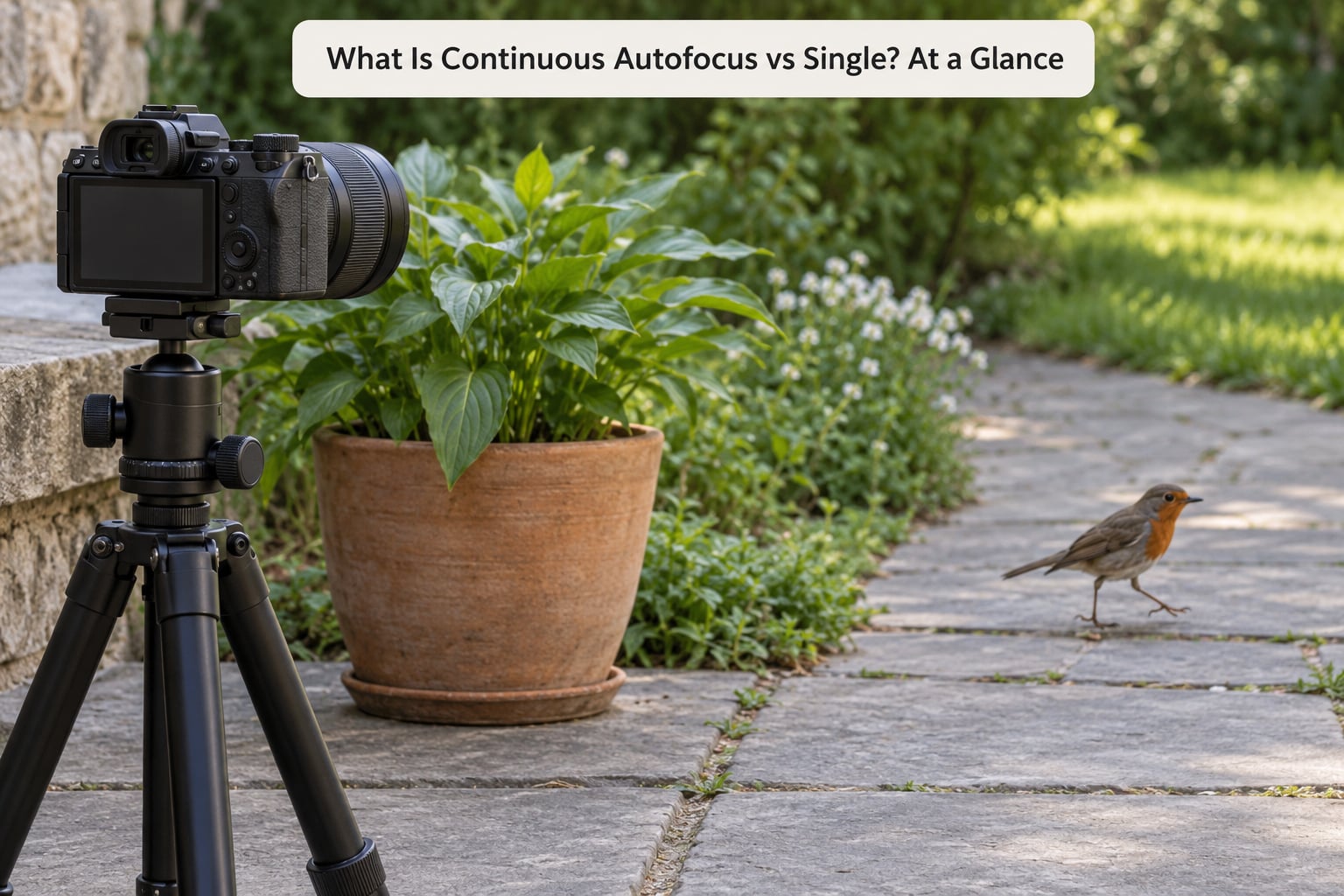
The table below sets the two modes side by side. Every row is a decision you actually face at the shooting position.
| Criterion | Single autofocus (AF-S, One-Shot, Single Servo) | Continuous autofocus (AF-C, Servo, AI Servo) |
|---|---|---|
| What it does | Measures focus once, then locks that distance | Measures and re-measures continuously while the shutter is half-pressed |
| Subject movement | Assumes the subject stays put after focus is acquired | Built for movement toward, away from, or across the frame |
| Typical scenes | Static scenery, studio and product work, still life, posed portraits | Sports, wildlife, birds, children, pets, street candids, video |
| Battery and processing cost | Lower: the drive motor rests once focus locks | Higher: the motor and sensor stay busy for the whole hold |
| Common failure | Focus stays locked on the wrong distance, so moving subjects blur | Focus hunting or drifting off a subject that was already sharp |
| Best paired AF area | Single-point AF | Tracking or dynamic-area AF |
Read that last row carefully. Choosing a focus mode and choosing an AF area are two separate decisions, and beginners usually conflate them. We come back to that below.
How Single Autofocus Works
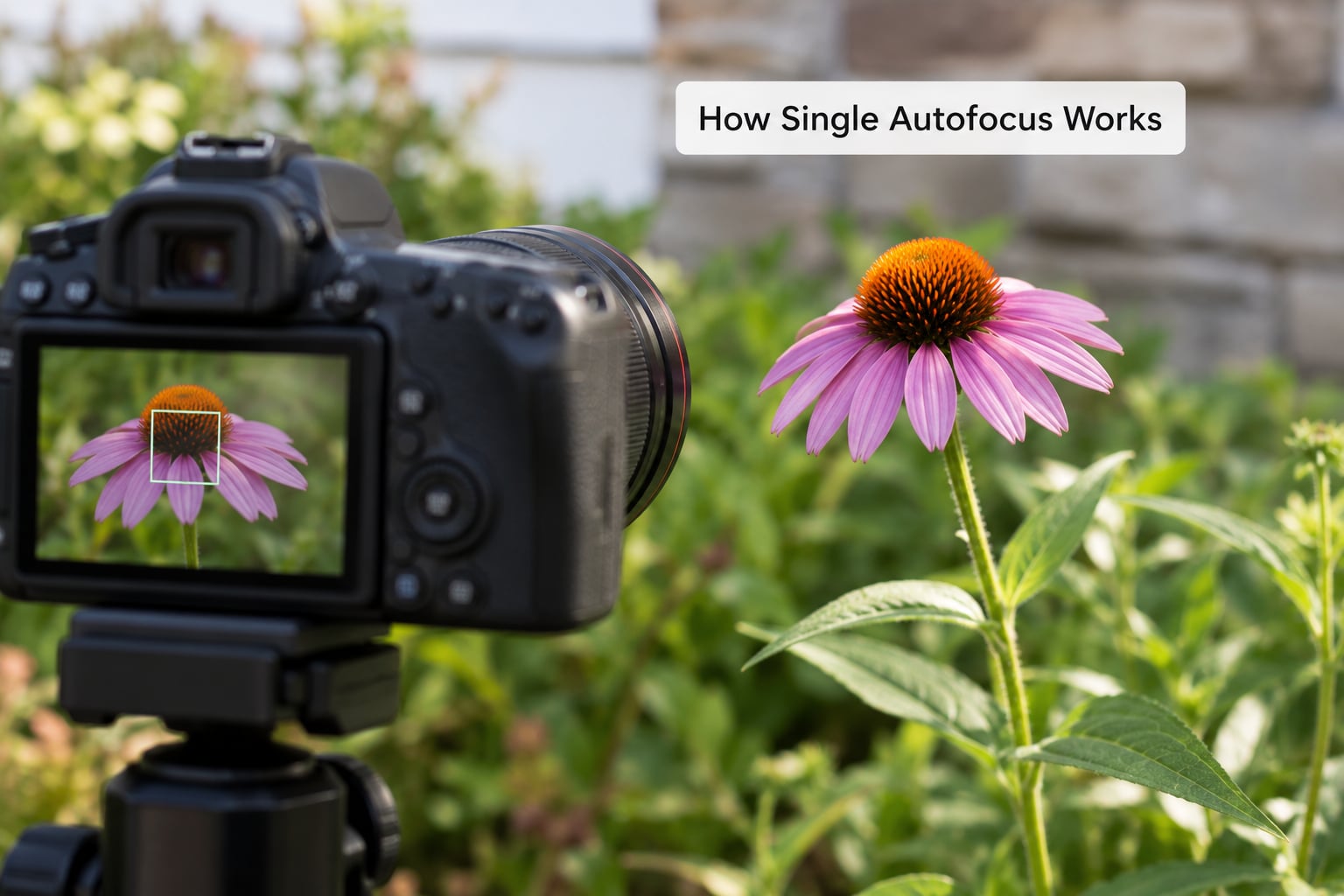
Single autofocus measures the distance to your subject once. The moment focus is acquired, the camera stops driving the lens and holds that distance, even if you or the subject shift afterwards. You get a green focus indicator, a beep on some bodies, and a picture taken at the distance the camera measured rather than the distance it last calculated.
That lock is the whole point. A locked focus point cannot be pulled off a still subject by a passer-by in the background, and it cannot wander while you slowly walk forward to improve a composition. That is why single AF tends to look more reliable on static scenes than continuous AF does, which is a slightly counter-intuitive result for a mode most people assume is the weaker option.
Photographers moving the focus point manually rather than using focus-and-recompose often find little reason to switch out of single AF for static work. Forum photographers repeatedly make this point: the shooting skill that matters is placing the point well, not which mode is active.
Two limits are worth naming. If the subject moves toward or away from you after focus locks, the recorded distance is wrong and nothing corrects it. In very low light, or on low-contrast surfaces, a single measurement can fail outright, which is why the camera may blink the focus point rather than confirm.
How Continuous Autofocus Works
Continuous autofocus never stops measuring. While the shutter button is held half-down, the camera keeps re-measuring the distance to whatever sits under the active focus point and drives the lens to match. On cameras with predictive or subject-detection autofocus, the system can also anticipate direction of travel, so the point follows a runner rather than trailing behind them.
Feedback is continuous too. On Nikon bodies, for example, the focus point sits at the edge of the frame and follows the subject, and subject-detection categories let you restrict tracking to people, animals, birds, vehicles or aircraft. The trade is equally continuous: the lens is always being driven, so focus accuracy depends on the system keeping up rather than on a single decision it can hold.
Continuous AF is what makes long bursts usable. A twelve-frame burst of a bird taking off is only worth shooting if all twelve frames are near focus, and only continuous AF attempts that. The same logic applies to a child running toward you, where the distance changes several feet between two frames.
What Is the Difference in Focus Behavior?
The difference is easiest to understand by looking at three moments: before the shutter fires, during a burst, and at the moment focus is briefly lost.
Before the shutter fires. In single AF, one measurement becomes one decision and stays in force. In continuous AF, every moment of the hold is a fresh measurement, so accuracy at the instant of exposure depends on how well the system is tracking right then.
During a burst. Frames one through twelve in single AF are effectively identical in focus, because the distance is locked. In continuous AF they are not identical at all: early frames may be slightly behind and later frames slightly ahead, or the point can drift to a background subject and back.
When focus is briefly lost. Single AF has nothing to recover from, because it never lost anything; if it acquired focus, it keeps it. Continuous AF has to reacquire. That reacquisition is where hunting comes from: the camera drops to near focus, re-measures, overshoots or undershoots, and settles. Users describe this as the camera repeatedly giving up and grabbing again on a subject that was already sharp.
The honest framing, borrowed from long-running forum consensus: no autofocus system is right a hundred percent of the time. Continuous AF spends much of its effort catching up to motion, and single AF spends none of it.
Which Mode Uses More Battery and Processing Power?
Continuous autofocus costs more, and the cost is measurable in two places. The focus drive motor runs continuously instead of stopping, and the sensor and processor keep computing distance instead of settling on a result. Shoot a long event, a full day of wildlife, or an hour of video in AF-C and you will notice the battery ending sooner than the same session in AF-S.
How much sooner varies by body, lens and how long you actually hold the shutter. What matters practically is that the difference is real, it is easy to feel on a marginal battery, and it is rarely the deciding factor on its own.
Modern cameras have made continuous AF cheap enough for everyday use, which is worth saying plainly. The setting is not a compromise for serious work. But on a static subject it is wasted effort, and on an old body or a heavy lens it is the difference between finishing a shoot and watching the battery warning blink halfway through.
Which Autofocus Mode Is Better for Portraits?
Single autofocus is the better starting choice for portraits, mainly because of the lock. A seated subject who shifts weight during a long exposure stays sharp in AF-S and can soften in AF-C, especially with a wide aperture where a few centimeters of movement matters.
There are three situations where continuous AF earns its place in portrait work. A subject breathing toward and away from the camera changes focus distance continuously, so a locked distance drifts off the eyes. Children who cannot hold a pose need tracking. And a subject walking toward you between frames simply cannot be kept in focus any other way.
One reported quirk catches people out: on some Fujifilm and Sony bodies, selecting AF-C can reduce or disable eye-detection autofocus. Portrait shooters who rely on eye AF and dislike surprise generally keep AF-S selected and turn to back-button focus instead, separating focusing from the shutter button.
The pairing matters too. Single AF paired with a wide-area AF setting can land on the nearest edge of the face instead of the eye. Single AF with single-point AF placed on the near eye is the classic studio setup, and it is still hard to beat.
Which Autofocus Mode Is Better for Sports, Wildlife, and Action?
Continuous autofocus is the practical choice here, and not by a small margin. A bird reverses direction, a runner cuts inside, a dog shakes its head: with single AF the focus stays at the distance where the subject used to be, and every frame after the turn is soft.
Mode alone does not save those frames. Shutter speed has to freeze the motion, and the AF area mode decides whether the camera is tracking the right thing. Forum advice for unpredictable subjects is to pair AF-C with 3D tracking or subject detection, and to use dynamic-area or a small zone for fast, straight-line action where a reliable subject-detection box is more valuable than a large area.
A side-by-side test I would run before a paid shoot: same light, same framing, AF-S and AF-C on the same moving subject. Most photographers find AF-C wins on tracking shots and loses on the settled frame at the end of a burst. Shoot both and you will know which failure you would rather have.
Which Should You Choose?
Start from how much your subject moves, then from how much control your camera gives you.
- Subject holds still (scenery, still life, product, a posed sitter): single AF with single-point AF. Cheapest, quietest, and it holds.
- Subject moves toward or away from you: continuous AF with subject detection or tracking. The distance changes between every frame.
- Subject moves across the frame at speed: continuous AF with dynamic-area or a small tracking zone, and a fast shutter speed.
- Children and pets: continuous AF. They break every rule about staying still.
- Video and vlogging: use continuous or full-time autofocus. Look for a body whose focusing is quiet enough for your lens.
- Low light: neither mode rescues an unlit scene on its own. More light or a wider aperture matters more than the mode. Single AF does at least stop hunting once it locks.
- Complete beginners: start with single AF and single-point AF. It fails quietly and predictably, which makes it easy to learn from.
- Camera with few autofocus controls: put it in auto AF. The camera switches between single and continuous behaviour itself, which is usually better than a wrong manual choice.
While you are in the menu, the same words mean different things across brands. This is the translation table, and it is the single most useful thing on this page if you just bought a different brand than your friend.
| Brand | Single autofocus | Continuous autofocus | Hybrid modes |
|---|---|---|---|
| Canon | One-Shot AF | AI Servo AF | AF-C switching in Servo settings |
| Nikon | AF-S | AF-C | AF-F full-time, AF-A on some bodies |
| Sony | AF-S / Single Shot AF | AF-C / Continuous AF | AF-A, plus Focus Mode in video |
| Fujifilm | AF-S | AF-C | AF-C with subject-detection options |
| Panasonic / Lumix | AF-S | AF-C | AF-A, AFC* adjustable tracking |
| Pentax | AF.S | AF.C | AF.A automatic |
One more distinction worth keeping straight, because every related search on this topic mixes them up: single autofocus is a focus mode, while single-point AF is an AF area mode. You can have single autofocus in a wide-area zone, and you can have continuous autofocus on a single fixed point. They are independent settings, and getting the area wrong is the most common reason tracking fails even when the mode is technically correct.
Frequently Asked Questions
Is continuous autofocus better than single autofocus?
Neither is better in general; they are better at different jobs. Continuous autofocus is the practical choice for moving subjects, while single autofocus is usually more reliable on static ones because a locked focus point cannot be yanked away. Pick the mode that matches how much your subject moves, and pair it with an AF area mode that suits the situation.
Should I use single autofocus for portraits?
Yes, as your default. A seated subject who shifts weight mid-exposure stays sharp when focus is locked in AF-S, and can soften in AF-C at wide apertures. Switch to continuous autofocus when the subject is a child, is breathing toward the camera, or is walking closer. Some bodies also reduce eye-detection autofocus in AF-C, which is another reason many portrait shooters stay in single AF.
When should I use continuous autofocus?
Use it whenever the distance between camera and subject changes between frames: sports, wildlife, birds, children, pets, street candids, and video. It is also the right mode when you have no idea what will happen in the frame. Pair it with subject detection or tracking for unpredictable movement, and with a dynamic or small zone for fast action, then use a fast enough shutter speed to actually freeze the motion.
Does continuous autofocus drain the battery faster?
Yes, noticeably so over a long session. The focus motor stays driven and the sensor keeps computing distance for as long as the shutter is half-pressed, where single autofocus stops once focus locks. The gap widens on older bodies, heavier lenses and long video recordings. On modern cameras it rarely decides the matter, but on a marginal battery it can end a shoot early.
How do I switch between single and continuous autofocus?
On most bodies, press the AF-ON button or hold the shutter half-way and rotate the mode dial until AF-S or AF-C appears on the top plate or rear screen. Canon users press the AF-ON button and turn the dial to One-Shot or AI Servo. If no mode appears, the dial may be locked, or a custom function may be reassigning the button. The manual for your model lists the exact path.
Which is better for taking pictures, continuous autofocus or single shot?
Single shot wins on still subjects and loses on moving ones, so the deciding factor is how much your subject moves during the exposure. For a static scene, single AF locks a correct distance and stays there. For anything in motion, single AF holds the distance where the subject used to be, while continuous AF keeps re-measuring and following. If you are unsure, set auto AF and let the camera decide.
Conclusion: Start With the Subject’s Movement
When people ask what is continuous autofocus vs single, the answer is always the same question asked about the subject. If it holds still, lock focus with single AF and single-point AF, and stop the camera working for nothing. If it moves, give it continuous AF with a tracking area and a shutter speed fast enough to match. Set auto AF if the scene is a genuine unknown, and change nothing else until those two choices feel automatic.