What is hyperfocal distance? It is the nearest focus distance at which a lens keeps everything from half that distance out to infinity acceptably sharp in a single frame. Focus there and you get the deepest depth of field any focus setting at that focal length and aperture can give you.
That is the whole idea in one line. The rest is just the arithmetic behind it, and the handful of field techniques that let you hit it without a calculator.
- Maximum sharpness range: focusing at the hyperfocal distance pushes the far limit of your depth of field to infinity.
- The range you gain: the near limit lands at exactly half the hyperfocal distance, so everything from there forward is acceptably sharp.
- The three factors that set it: focal length, aperture (f-number) and the circle of confusion, which depends on how big you intend to print or how closely you view the file.
The reason it still matters on a modern camera with a 60-megapixel sensor is that it lets you hold f/8 or f/11 and still get foreground detail, instead of stopping down to f/16 and losing the corner detail to diffraction. Whatever you end up shooting on, treat the calculated number as a starting point you verify at 100% magnification, not as a promise.
Table of Contents
- What Does Hyperfocal Distance Actually Mean?
- The half-distance rule
- Why the barrel’s infinity mark is not infinity
- How to Calculate Hyperfocal Distance
- How to pick the circle of confusion
- A worked full-frame example
- What Is Hyperfocal Distance in Practice?
- When doubling the distance is not enough
- Which Focal Lengths, Apertures, and Sensors Work Best?
- Sensor format changes the answer
- The aperture sweet spot
- How Do You Set the Hyperfocal Distance on a Camera?
- Method 1: chart or app
- Method 2: the depth-of-field scale
- Method 3: double the distance
- Method 4: the live view infinity check
- Which in-camera aids are worth trusting
- When Is Hyperfocal Focus Useful for Everyday Photography?
- When another approach is better
- What Are the Common Hyperfocal Distance Mistakes?
- Using the wrong circle of confusion
- Substituting subject distance for focal length
- Focusing at infinity and calling it hyperfocal
- Over-stopping down out of fear
- Trusting a zoom’s focus scale
- Ignoring focus breathing
- Skipping the movement check
- Frequently Asked Questions
- Does focusing at the hyperfocal distance make everything from the subject to infinity sharp?
- Why is my calculated hyperfocal distance different from the value shown in my camera?
- Is hyperfocal focusing still useful with modern autofocus lenses?
- How far in front of the hyperfocal point can a subject be and remain acceptably sharp?
- Should I use a narrower aperture to increase the hyperfocal distance?
- Does sensor format change the hyperfocal distance calculation?
- Key Takeaways
What Does Hyperfocal Distance Actually Mean?
Two definitions get mixed up constantly, so it is worth separating them. The technical definition is the closest distance you can focus at while a point at infinity still appears acceptably sharp. The practical definition is the focus setting that gives you the maximum total depth of field in your frame.
Those two only agree when you focus exactly at the hyperfocal point. Focus farther out than that and infinity stays sharp, but you give up a slice of your near limit. Focus nearer and you gain foreground, but infinity leaves the acceptable sharpness range.
The half-distance rule
Focus at the hyperfocal distance and the near limit sits at half of it. That is the elegant part and the part people remember: a 24mm lens at f/11 on full frame has a hyperfocal distance of about 1.75 metres, so everything from roughly 88cm to infinity is acceptably sharp.
Focusing beyond hyperfocal actually gives you a deeper usable zone in some cases, which is why experienced shooters park past the mark when the foreground is not important. But then infinity is the only thing holding the far end together, and the near limit moves away from you.
Why the barrel’s infinity mark is not infinity
A lens set to its infinity symbol usually focuses at somewhere around 300 metres, not at true infinity. Two reasons: the focus mechanism needs physical travel to reach infinity, and the mark is set so a slightly myopic photographer can also reach it. That leftover headroom is genuinely useful, because it means infinity focus still renders a distant view acceptably sharp on most lenses.
How to Calculate Hyperfocal Distance
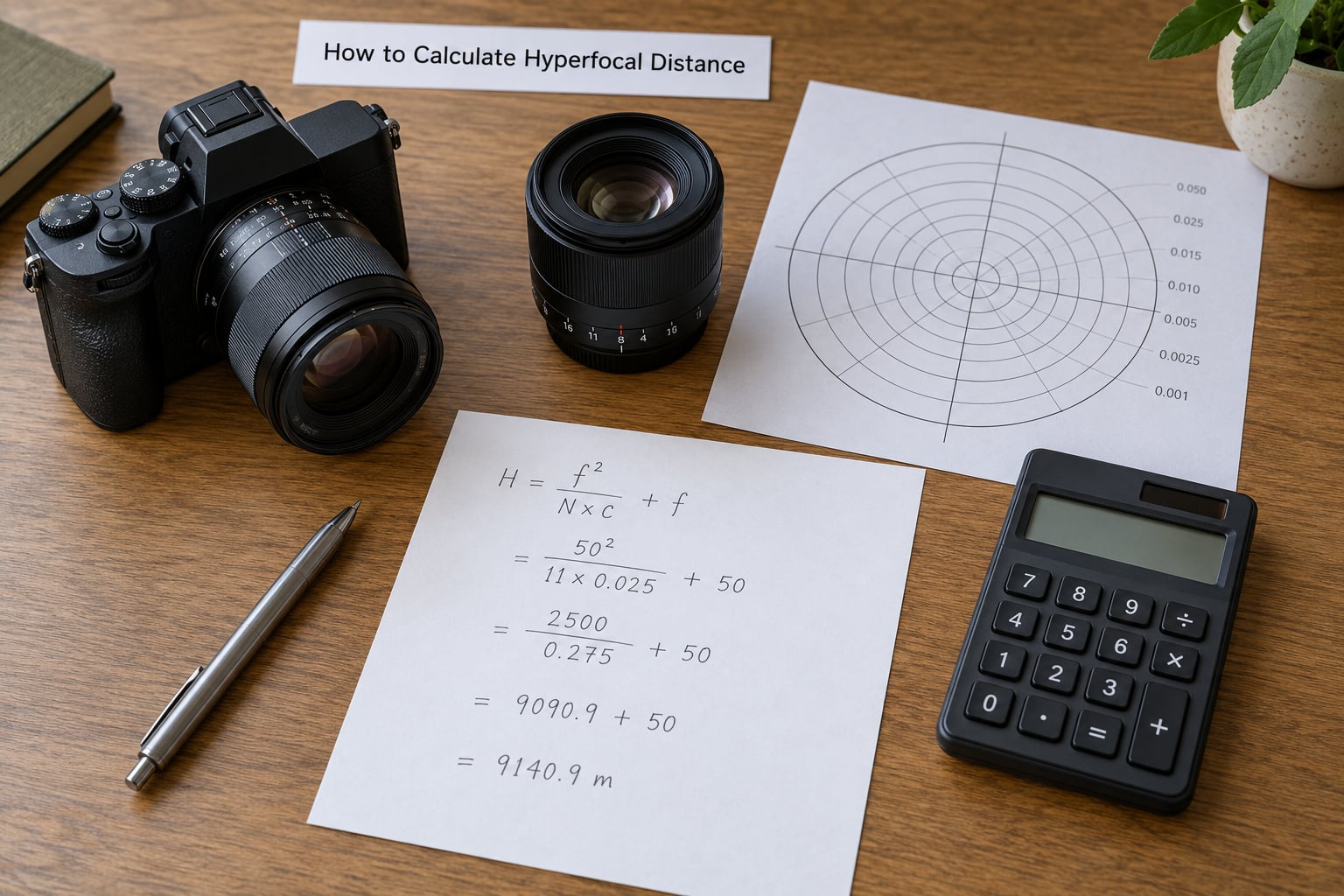
The formula is short, and every variable in it is something you can look up or read off the lens:
H = f² / (N × c)
- f is the focal length in millimetres. It is not the distance from your subject to the camera, which is the single most common substitution people make.
- N is the f-number, written as a plain number. f/11 is N = 11, not 0.09.
- c is the circle of confusion in millimetres, the diameter of the blur spot that you are willing to call sharp.
- H comes out in millimetres. Divide by 1000 for metres.
How to pick the circle of confusion
The 0.03mm circle of confusion you see on most printed charts is a film-era standard: an 8×10 inch print, viewed at roughly arm’s length. It is a fine default, but it is not a law, and the direction of the error matters more than the exact number.
Plan on viewing files on a laptop or phone and your tolerated blur shrinks to roughly 0.01mm, which pushes the hyperfocal distance three times farther out. Print an A2 sheet and view it from a metre away and the tolerated blur grows past 0.05mm, which brings the hyperfocal distance back down. Reviewers testing by varying focus at a fixed aperture report exactly this kind of measurable spread between 0.03mm and 0.01mm settings.
A worked full-frame example
Take a 16mm lens at f/11 on a full-frame body with c = 0.03mm:
- f² = 256
- N × c = 11 × 0.03 = 0.33
- H = 256 / 0.33 = 776mm, so about 0.78m
- Near limit = 0.78 / 2, so about 39cm
Everything from a shoe in the foreground to the horizon stays acceptably sharp at that setting. The same lens at f/8 gives a larger H of 256 / (8 × 0.03) = 1.07m, with a near limit around 53cm, so you gain 14cm of foreground and give up nothing, since infinity stays inside the frame at either setting.
Not every app and camera menu agrees with your calculator on the same numbers, and that is expected rather than a bug.
What Is Hyperfocal Distance in Practice?
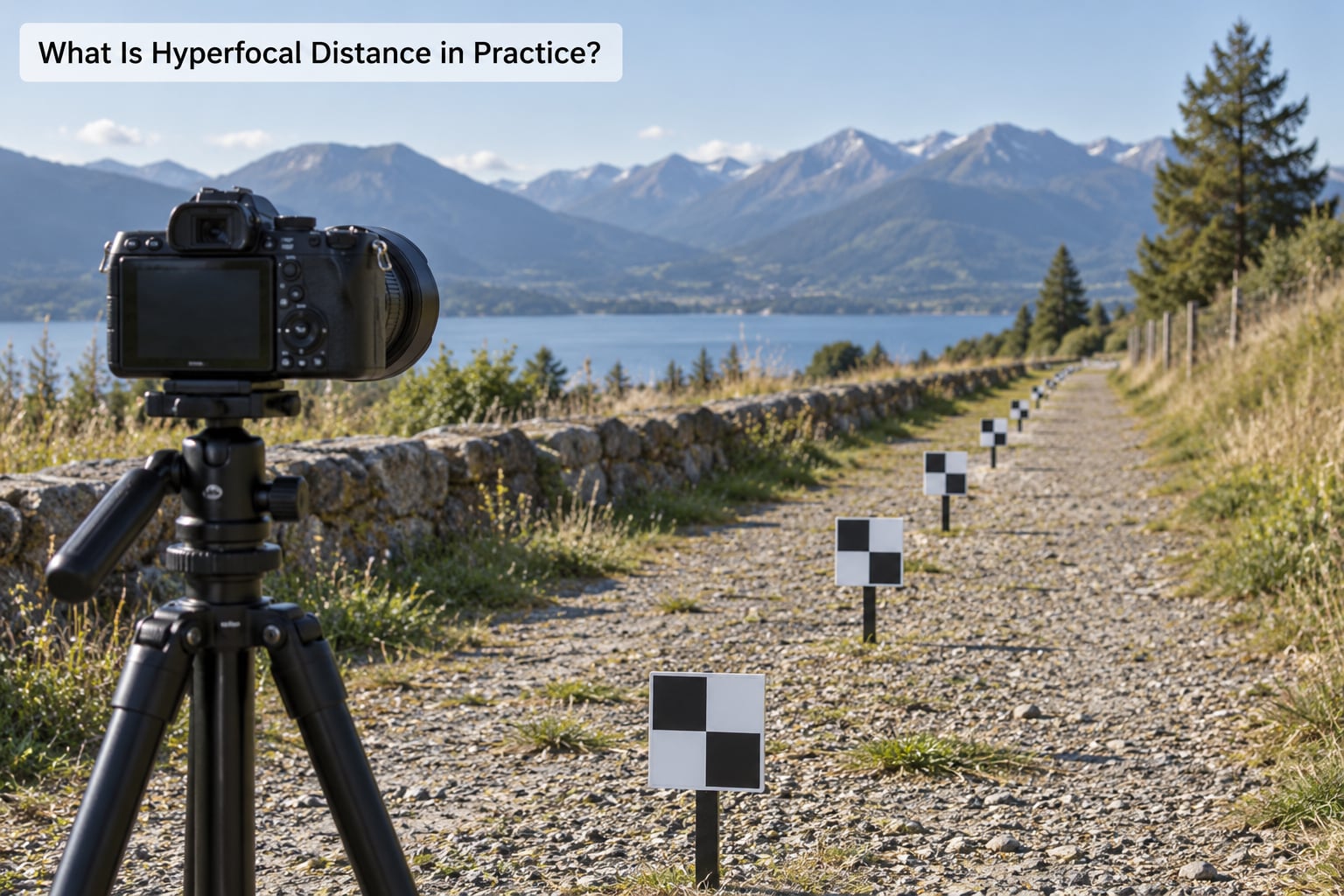
The numbers look tidy in a table, but the behaviour in a real scene is lopsided, and that asymmetry is worth understanding. Take 24mm at f/11 on full frame, where H = 1.75m, and try three focus settings in the same frame:
- Focus at 1.75m (hyperfocal): near limit 0.88m, far limit infinity. Total in-focus range is at its maximum.
- Focus at 1.2m (shorter than hyperfocal): near limit about 0.72m, far limit about 3.6m. Infinity is gone, and so is the mountains behind it.
- Focus at 3.5m (beyond hyperfocal): near limit about 1.17m, far limit infinity. You gave up 29cm of foreground to protect the background.
The pattern holds at every focal length. Depth of field grows rapidly as you approach hyperfocal from the near side, then the far limit snaps to infinity and stays there, while the near limit keeps creeping away as you focus further out. Each extra metre past hyperfocal costs more near range than the metre before it.
When doubling the distance is not enough
The old trick is simple: measure the distance to your nearest important subject, focus at twice that distance, and everything from the foreground to infinity should be acceptably sharp. It works often enough that people treat it as a law.
It fails when the foreground is closer than your aperture can cover. With a 24mm at f/11, whose hyperfocal distance is 1.75m, doubling a 4m subject distance puts focus at 8m and the near limit still lands at only about 1.4m, so the 4m subject itself is soft. The fix is to close the aperture further, which moves the near limit inward, or to accept a soft foreground.
Which Focal Lengths, Apertures, and Sensors Work Best?
Wide lenses give you surprisingly short hyperfocal distances, which is why a 10mm at f/11 lands at about 30cm on full frame with c = 0.03mm. Long lenses at narrow apertures give you figures in the hundreds of metres, where a small focus error changes very little.
Here is the same set of focal lengths and apertures on a full-frame body with a 0.03mm circle of confusion:
| Focal length | f/4 | f/5.6 | f/8 | f/11 | f/16 |
|---|---|---|---|---|---|
| 10mm | 0.83m | 0.60m | 0.42m | 0.30m | 0.21m |
| 16mm | 2.13m | 1.52m | 1.07m | 0.78m | 0.53m |
| 24mm | 4.80m | 3.43m | 2.40m | 1.75m | 1.20m |
| 35mm | 10.20m | 7.29m | 5.10m | 3.71m | 2.55m |
| 50mm | 20.80m | 14.90m | 10.40m | 7.60m | 5.20m |
| 100mm | 83.30m | 59.50m | 41.70m | 30.30m | 20.80m |
| 200mm | 333.30m | 238.10m | 166.70m | 121.20m | 83.30m |
Read across a row and you can see the aperture’s effect: stopping down from f/8 to f/16 doubles the f-number and therefore halves the distance, since each extra f-stop doubles the effective blur tolerance. Read down a column and focal length squares away fast, which is why a 200mm at f/8 gives a hyperfocal distance of about 167m.
Sensor format changes the answer
A smaller sensor is judged at a smaller output size, so its circle of confusion is smaller, so the hyperfocal distance moves out. Multiply the crop factor into the circle of confusion and the full-frame numbers scale down by exactly that factor. This is the question that draws the most argument in comment sections, and the table answers it better than any argument will:
| Setting | Full frame | APS-C (1.5x) | Micro Four Thirds (2x) |
|---|---|---|---|
| 10mm at f/8 | 0.42m | 0.28m | 0.21m |
| 16mm at f/8 | 1.07m | 0.71m | 0.54m |
| 24mm at f/11 | 1.75m | 1.16m | 0.87m |
| 50mm at f/8 | 10.40m | 6.93m | 5.20m |
Halve the hyperfocal distance again for the near limit in each cell. For a 24mm at f/11, full frame gives a near limit near 88cm while Micro Four Thirds lands around 44cm, so the smaller body puts its nearest acceptable subject twice as close to the lens. That gap matters when you are standing on a shoreline with rocks at your feet.
The aperture sweet spot
Stopping all the way down is a habit, not a rule. Many photographers report independently that their lenses are visibly sharper at f/5.6 and f/8 than at f/11, and diffraction starts eating detail somewhere past f/11 or f/16 depending on the sensor. Hyperfocal focusing gives you a way out: work out how much near range you actually need, pick the widest aperture that still covers it, and keep ISO and shutter speed in sensible territory.
How Do You Set the Hyperfocal Distance on a Camera?
Calculate the number first, then get the lens there. These are the field methods, roughly in order of how much precision each one actually gives you.
Method 1: chart or app
Pick the row for your focal length and the column for your aperture. Set the lens to that distance by eye against the distance scale on the barrel, then refine on live view. Apps and printed charts usually assume a 0.03mm circle of confusion unless told otherwise, which is the main reason two charts can disagree.
Method 2: the depth-of-field scale
Many lenses print paired distance marks for each aperture next to the focus scale. Line the f/11 mark with the red index and your focus is near hyperfocal. Treat this as a starting point: the scale cannot be accurate at both ends of a zoom range, and the mark is drawn for one focal length.
Method 3: double the distance
Measure to the nearest subject you care about, focus at twice that distance. It needs no numbers at all and it is usually accurate enough for a scenic frame with a foreground a few metres away. If the foreground is closer than the near limit the aperture allows, close down further or move in.
Method 4: the live view infinity check
Magnify to 100% on a distant object, push focus toward infinity, and stop just as it stops improving. The lens is now a little past infinity focus, which is a good practical proxy for hyperfocal on scenes with no meaningful foreground.
Which in-camera aids are worth trusting
Focus peaking, focus highlight and a manual focus distance indicator will get you close, but they read focus differently and none of them knows your circle of confusion. Split-screen or digital split image gives the truest answer because it shows the blur itself. On cameras with focus breathing, focus can shift as you magnify, so check the final frame rather than trusting a single reading.
Whichever method you use, a tripod is worth the twenty seconds it takes to set up. Any movement during the exposure ruins the sharpness the calculation was supposed to buy you.
When Is Hyperfocal Focus Useful for Everyday Photography?
It earns its place when your subject is a depth range rather than a thing. Scenic views with rocks or grass in the near corner are the classic case. Seascapes and long exposures work because the exposure itself settles on a tripod. Architecture and interiors benefit because near verticals and far walls land inside the same acceptable sharpness. Star fields need infinity focus more than hyperfocal, but a dark-sky wide shot with a foreground silhouette does better when focused slightly short of infinity.
Street and documentary work has a subtler use: set focus once at hyperfocal and keep it there as people move through the frame, rather than re-focusing on every passer-by. On a run-and-gun video setup or a walk with a camera, one decision that holds for the whole scene is worth more than any focus pull.
Close-focusing work benefits too. A 24mm at f/16 has a hyperfocal distance of about 1.2m on full frame, so your near limit is around 60cm, which means small tabletop subjects can be sharp alongside a background you never intended to render soft.
When another approach is better
Skip it for portraits with a background you want thrown out of focus, which is a depth-of-field effect rather than a sharpness one. Skip it when a subject is moving toward or away from you at speed, because focus stays fixed while the subject does not. Skip it when you need a specific subject critically sharp at a print size larger than the chart assumes: focus on the subject instead and accept the soft background.
And consider focus stacking when the scene demands more depth of field than any single frame can hold. Focus stacking beats hyperfocal on wind-blown foregrounds at macro distances, on interiors shot at very wide angles, and anywhere you need aperture freedom for exposure or diffraction control. It costs tripod time, a careful bracketed sequence, alignment work in post, and it can introduce artefacts in moving foliage. Hyperfocal focusing wins on speed, on moving scenes, and on anything that has to happen in a single frame.
What Are the Common Hyperfocal Distance Mistakes?
Using the wrong circle of confusion
Copying a 0.03mm figure into a workflow that ends in a large print, or into a workflow that ends on a laptop, gives you the wrong distance in both directions. Decide how the image gets seen before you accept a number.
Substituting subject distance for focal length
f in the formula is the focal length printed on the lens. Put 24 into that slot when your subject is 4m away and your answer comes out six times too large, pushing the focus point far past your scene.
Focusing at infinity and calling it hyperfocal
The two are not the same. Infinity focus keeps the horizon sharp and quietly throws away everything in front of it, which is the most common complaint about scenic photos shot by people who thought infinity was the technique.
Over-stopping down out of fear
Going to f/16 or f/22 to feel safe buys near range you probably do not need and pays for it in diffraction softness across the frame. Calculate what you actually need and then stop there.
Trusting a zoom’s focus scale
One set of marks cannot serve a 10mm-to-100mm range, because the same aperture delivers completely different depth of field at each end. Verify with live view.
Ignoring focus breathing
Some lenses change focal length slightly as they focus. On those, a number calculated from the marked focal length is an approximation, and close-distance work needs a check on the actual frame.
Skipping the movement check
Every one of these errors is invisible until you magnify. A tripod, a two-second timer or a shutter release and a look at 100% will catch what the calculator cannot.
Frequently Asked Questions
Does focusing at the hyperfocal distance make everything from the subject to infinity sharp?
It makes everything from half the hyperfocal distance to infinity acceptably sharp, which is not the same as critically sharp. Acceptable sharpness means the blur spot on your sensor stays under the circle of confusion you chose. Push closer than that half-distance mark and you are outside the range; focus short of hyperfocal instead and infinity drops out of the picture entirely.
Why is my calculated hyperfocal distance different from the value shown in my camera?
Usually the circle of confusion. Cameras, apps and printed charts assume different values, and yours may scale its setting by crop factor or use a stricter default for high-resolution sensors. Conversion rounding, metric against imperial units, and the lens being set at a slightly different focal length than printed all add up. Enter the same circle of confusion on both sides and the figures usually agree.
Is hyperfocal focusing still useful with modern autofocus lenses?
Yes, and for most scenic work it beats autofocus anyway. A fixed focus point saves you hunting for it in poor light and guarantees the same result every frame. Modern high-resolution sensors also reward focus slightly nearer than the chart figure, because their effective circle of confusion is smaller. Keep it in your pocket as a fallback when autofocus struggles in low contrast.
How far in front of the hyperfocal point can a subject be and remain acceptably sharp?
Exactly half the hyperfocal distance is the boundary, so at H = 2m the near limit is 1m. That 1:2 ratio is the reason doubling the foreground distance works as a field method. If your subject sits closer than half of H, focusing there pushes the far limit short of infinity, and the only way to recover it is to close the aperture down further.
Should I use a narrower aperture to increase the hyperfocal distance?
It does the opposite. Stopping down from f/8 to f/16 multiplies N by two and therefore halves the hyperfocal distance, while widening the aperture pushes the distance out. What stopping down buys is total depth of field, not a longer hyperfocal distance. So reach for a narrower aperture when your foreground is too close, and a wider one when you need the distance to sit farther out.
Does sensor format change the hyperfocal distance calculation?
Yes, and it moves in a predictable direction. A smaller sensor is judged at a smaller output size, so its circle of confusion is smaller, so the hyperfocal distance lands farther out. Divide the full-frame figure by the crop factor: a 24mm at f/11 gives about 1.75m on full frame, 1.16m on APS-C and 0.87m on Micro Four Thirds.
Key Takeaways
Hyperfocal distance is the focus setting that gives the deepest depth of field available at a given focal length and aperture, putting the far limit at infinity and the near limit at exactly half the focus distance. You calculate it with H = f² / (N × c), where f is the focal length in millimetres, N is the f-number, and c is the circle of confusion you are willing to accept.
Here is what to do on your next walk: decide how you will view the finished image, pick the circle of confusion that follows from it, calculate H for your lens and aperture, focus there, then stop down or move in only as far as the nearest subject actually requires. Check the result at 100% before you pack up.