For nature photography, a crop sensor (APS-C) gives you more telephoto reach and a lighter, cheaper kit, while a full-frame sensor gives you cleaner files at dawn, shallower depth of field and wider dynamic range. Neither format wins every genre, and the right answer comes down to which subjects you shoot, how far you walk and what light you shoot in.
Ask five wildlife photographers and you will get five answers, usually delivered with the name of an expensive lens. But the sensor debate is really a trade-off between three things: reach, light and weight. Every lens you can afford, every gram you carry and every stop of clean high-ISO detail you get flows back to those three.
I have carried both formats on the same dawn trips and the honest summary is simpler than the forums make it sound. Full frame is not a quality upgrade on its own; it is a change in which compromises you accept. A crop sensor trades low-light purity for affordability and reach. A full-frame body trades your back and your budget for the freedom to shoot in bad light.
What follows is a field-focused comparison of crop sensor vs full frame for nature photography, not a spec sheet. We look at crop factor, dynamic range, depth of field equivalence, autofocus, lens ecosystems and pack weight, then split the verdict by genre so you can find your own answer rather than somebody else’s.
Table of Contents
- Crop Sensor vs Full Frame for Nature Photography at a Glance
- Crop Sensor vs Full Frame for Nature Photography: Key Differences
- Field of View and Wildlife Reach
- Low-Light Performance and Dynamic Range
- Depth of Field and Background Separation
- Autofocus, Tracking, and Stabilization
- Image Quality, Detail, and Cropping
- Lens Choice, Compatibility, and Equipment Cost
- Weight, Battery Life, and Field Comfort
- Which Should You Choose?
- Frequently Asked Questions
- Is a full-frame camera always better for nature photography?
- Do crop sensors actually zoom in more than full frame cameras?
- Can a crop sensor produce professional-quality nature photographs?
- Which lens focal length should nature photographers choose?
- What are the disadvantages of using a crop sensor for wildlife?
- Can I use my APS-C lenses on a full-frame camera?
- Conclusion: Make the First Choice for Your Field Work
Crop Sensor vs Full Frame for Nature Photography at a Glance
Choose APS-C if birds, budget and backpack weight dominate your shooting. Choose full frame if you shoot dawn light, star fields, tight landscapes or want very shallow backgrounds with prime lenses. Here is the same split in table form.
| Criterion | Crop sensor (APS-C) | Full frame |
|---|---|---|
| Sensor size | About 23.5 x 15.6mm | 36 x 24mm |
| Crop factor | 1.5x (Nikon, Sony, Fujifilm) or 1.6x (Canon) | 1.0x |
| Field of view at 300mm | 450mm or 480mm equivalent | 300mm |
| Low light and high ISO | Noticeably noisier past ISO 3200 | Clean well past ISO 6400 |
| Dynamic range | About 12 to 13 stops | About 14 to 15 stops |
| Depth of field | Thinner at equal framing, not deeper | Blurs backgrounds more easily |
| Autofocus options | Fewer long lenses, cheaper glass | Full range plus superteleprimes |
| Stabilization | Commonly 5 to 7 stops | Commonly 6 to 8 stops |
| Battery life | Fewer frames per charge | More frames per charge |
| Body and lens weight | 300 to 700g typical telephoto kit | 500 to 1200g typical telephoto kit |
| Best for | Birding, hiking, travel, budget telephoto | Dawn light, astro, close-up detail, prime-lens work |
Crop Sensor vs Full Frame for Nature Photography: Key Differences
Both formats give you the same viewfinder, the same menus and, most days, the same photograph. The real differences are physical: a smaller sensor crops the image circle, gathers less light per pixel and pulls a smaller lens ecosystem around it. That is the whole argument, and every section below is just an expansion of those three facts.
In plain terms, the smaller format is lighter and cheaper, the larger format is cleaner in the dark and easier to blur backgrounds with. Everything else is a consequence of those.
Field of View and Wildlife Reach
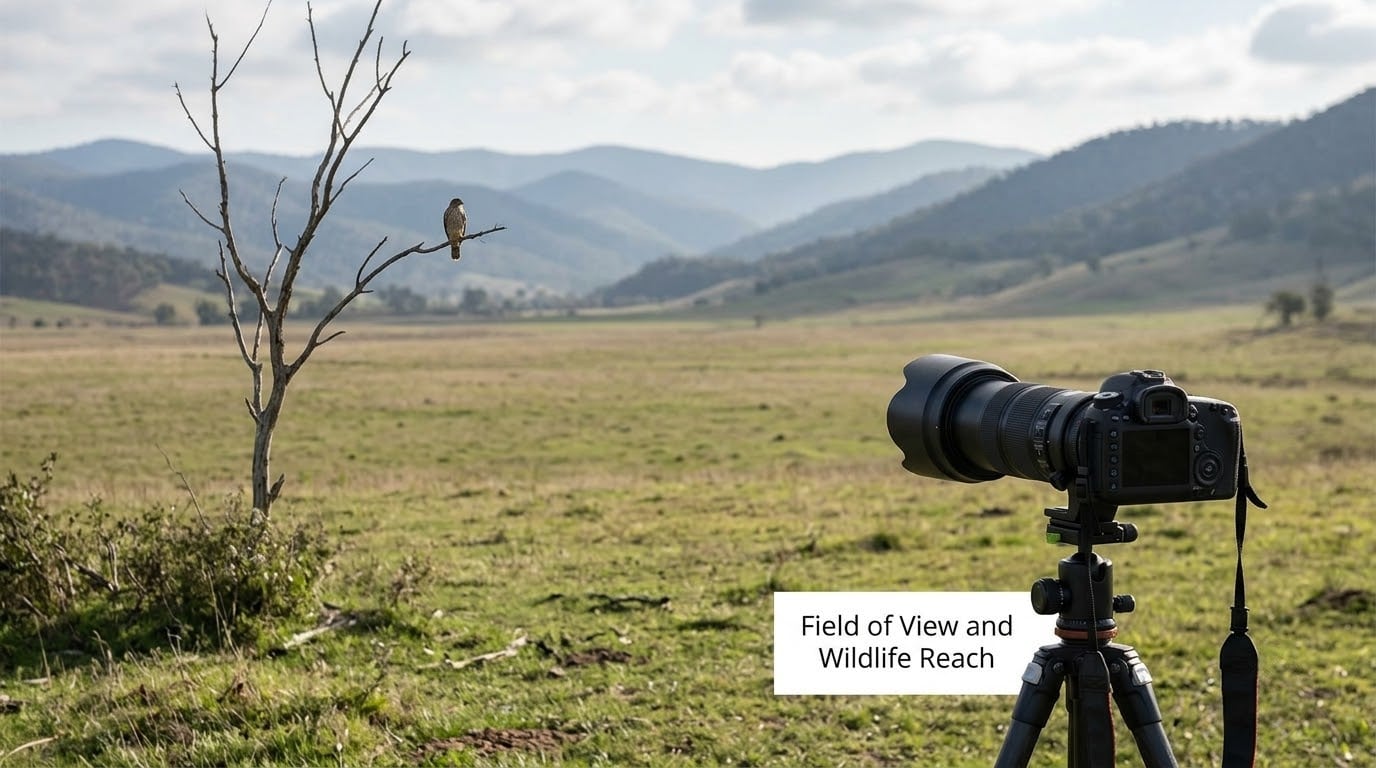
Reach is the crop sensor’s strongest argument, and it is purely a field-of-view calculation. A full-frame sensor is roughly 36 x 24mm, the size of a single frame of 35mm film. APS-C is about 23.5 x 15.6mm, so it uses a smaller slice of the same image circle and frames tighter.
Multiply your focal length by the crop factor to get the equivalent field of view. A 300mm lens frames like a 450mm lens on a 1.5x body and like a 480mm lens on Canon’s 1.6x body. This is not extra magnification and there is no hidden resolution cost beyond the smaller sensor; the lens simply covers more ground on full frame and the crop sensor throws that outer part away.
Here is the quick reference. Multiply your lens by the number in the second column.
| Actual focal length | Nikon, Sony, Fujifilm (1.5x) | Canon (1.6x) | Micro Four Thirds (2x) |
|---|---|---|---|
| 100mm | 150mm | 160mm | 200mm |
| 200mm | 300mm | 320mm | 400mm |
| 300mm | 450mm | 480mm | 600mm |
| 400mm | 600mm | 640mm | 800mm |
| 600mm | 900mm | 960mm | 1200mm |
In the field that difference shows up as money and patience. A 150-600mm APS-C supertelephoto gives a 1.5x shooter an effective 900mm on a body that fits in one hand. The nearest full-frame equivalent, a 600mm f/4 superteleprime, costs several times as much and weighs more than most people want to carry up a hillside. Forum photographers who upgraded to full frame frequently describe the same thing: losing that reach on birds they had been photographing for years.
That fear is real, and it is worth naming: switching formats feels like a downgrade for birders. In practice you claw it back with modern high-resolution bodies and the raw ability to crop, which is covered further down. For whales, distant mountain ranges and wide landscapes the same crop factor works against you, since 16mm becomes 24mm on APS-C and you lose the dramatic wide view.
Low-Light Performance and Dynamic Range
Full frame wins low light because each pixel is physically larger and collects more photons. That translates to cleaner files at high ISO, less shadow noise in RAW and better highlight recovery when you lift a dawn sky. If you shoot shaded woodland interiors, star fields or the last twenty minutes of light, that gap is the one you will actually notice.
Dynamic range is the span between the darkest shadow you can pull back and the brightest highlight you can keep uncut. Current full-frame bodies typically deliver around 14 to 15 stops, while APS-C sits near 12 to 13. Roughly a stop of latitude is not dramatic on a well-exposed daylight frame; it matters enormously when you are exposing for a bright sky and trying to keep detail in the foreground.
A few things worth keeping straight. Sensor generation has narrowed the gap, so a recent APS-C body beats an old full-frame one more often than the forums suggest. Computational noise reduction in current editing software handles APS-C high-ISO files better than it did five years ago, though it still cannot invent shadow detail that was never recorded. And pixels are not the same as quality: more megapixels on a smaller sensor means finer grain that holds up less well when you push shadows in post.
My practical rule: if you shoot daylight or overcast conditions, the ISO gap rarely decides your prints. If you shoot the first and last hour of light, it decides a lot.
Depth of Field and Background Separation
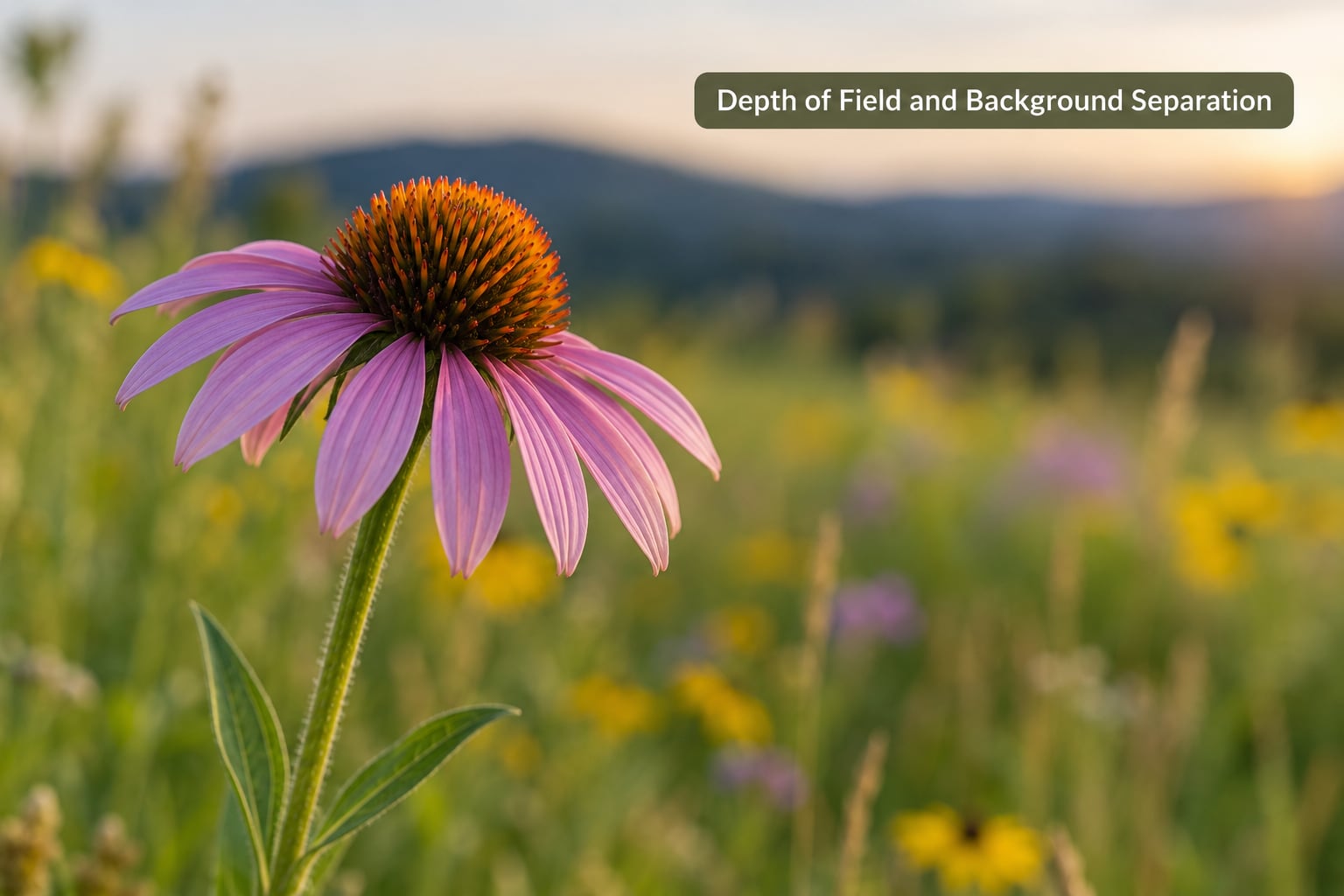
This is where most people get it backwards. At equal framing and equal subject size, a crop sensor does not give you extra depth of field for free. If a full-frame shot at f/4 and a matching distance produces a certain background blur, the APS-C shot framed the same way needs roughly f/2.5 to match it.
The table below converts full-frame f-numbers into the f-numbers that look equivalent on smaller sensors, measured against the same background. The 1.6x Canon column is only a third of a stop different from 1.5x, which is why most people round them together.
| Full frame aperture | APS-C 1.5x equivalent | Canon 1.6x equivalent | Micro Four Thirds 2x equivalent |
|---|---|---|---|
| f/1.4 | f/2.0 | f/2.2 | f/2.8 |
| f/2.0 | f/3.0 | f/3.2 | f/4.0 |
| f/2.8 | f/4.2 | f/4.5 | f/5.6 |
| f/4.0 | f/6.0 | f/6.3 | f/8.0 |
| f/5.6 | f/8.0 | f/9.0 | f/11.0 |
| f/8.0 | f/11.0 | f/13.0 | f/16.0 |
So full frame still gives you the easier route to creamy backgrounds, because it starts from a wider aperture in the first place. But the APS-C route works fine as long as you plan for it: to isolate a warbler against foliage, stop down an extra stop, use that one stop to raise the shutter speed and get both the subject sharp and the motion frozen.
Three things drive the result more than the format label: how far away you are, how big the subject is in the frame, and how long the lens is. A macro at 20cm behaves almost identically on either sensor. A bird at 30 metres on a 600mm lens melts into the background on either one. That is why close-up nature work is the genre where the format argument matters least.
Autofocus, Tracking, and Stabilization
Autofocus is where crop sensor bodies catch up and then keep going. Subject detection with eye recognition, deep-learning bird and animal tracking, and reliable continuous bursts now appear on mid-range APS-C bodies. A recent APS-C body with strong subject tracking can out-shoot an older full-frame camera at birds in flight, because the older body may have the better sensor and the weaker tracking system.
Full frame still has an edge in the hardest light. Faster phase-detect points spread across a larger area mean more reliable acquisition at ISO 6400 and above, and deeper buffers help when a grouse takes off in a flock. If your birds are usually lit and moving predictably, autofocus is not the deciding factor. If you shoot dawn flight in an estuary, it might be.
In-body stabilization helps both formats and has made hand-holding telephoto far less punishing than it used to be, typically 5 to 7 stops on APS-C and 6 to 8 on full frame. Stabilization steadies your frame; it does not freeze a flying bird. Shutter speed still wins.
Image Quality, Detail, and Cropping
Here is the argument that ends the reach debate for most people. If you crop a 45-megapixel full-frame image down to the APS-C area, you still have roughly 20 megapixels left, which is more than a 24MP APS-C sensor records in the first place. That is the bridge: a high-resolution full-frame body gives you full-frame quality when you need it and APS-C framing with a 1.5x or 1.6x reach multiplier when you are stalking a distant subject.
Those crop modes have limits. Binocular-style subsampling drops resolution hard, which is why an older 24MP full-frame body can fall to around 10 megapixels in a native DX crop. On a 45 to 50MP body the same crop stays comfortably above 20MP. Always check the cropped output size in the specs before you rely on the trick.
For printed work, decide your output size first. Two to three megapixels prints acceptably at A4, and 20 to 24MP covers a large print with room to crop. On that basis, a 24MP APS-C body is not short of pixels for almost any nature print, and the difference between formats is far less about resolution than people assume.
Lens Choice, Compatibility, and Equipment Cost
The lens ecosystem is where format choice becomes expensive, and it is the part people underestimate. Full frame has superteleprimes from 300mm to 600mm, exotic wide-angles, astro-grade fast primes and high-resolution telephoto zooms that never existed for APS-C. The APS-C long end is dominated by zooms in the 100 to 400mm and 150 to 600mm ranges, which is excellent value but gives you fewer choices.
Compatibility runs one direction only. Full-frame lenses mount and work on APS-C bodies with the stated crop multiplier. Crop-specific lenses such as Canon’s EF-S and EF-M, Nikon’s DX and Fujifilm’s XC do not cover a full-frame sensor, and adapters for them exist but usually cost as much as the lens you saved.
On cost, judge the system rather than the body. A crop body plus a 150-600mm zoom is a fraction of what a full-frame body plus a 600mm f/4 costs, and for birding that comparison decides the answer every time. On the other side, there is a fair counter-argument on landscape kits: fast lenses bring little real benefit to landscape work, so a full-frame body with slow, light f/4 glass is often the lighter kit, not the heavier one. The same logic shows up in the wide end, where APS-C fast primes such as an 18-35mm f/1.8 match full-frame f/2.8 performance while occupying about the same space in the bag.
Weight, Battery Life, and Field Comfort
Grams matter more than most spec comparisons admit. A typical APS-C telephoto setup, body plus a 100 to 400mm-class zoom, lands somewhere between 300 and 700g depending on the body. The matched full-frame combination with a comparable 200 to 600mm runs from about 500g to well past 1kg once superteleprimes enter the conversation.
That difference is the difference between a long day in the hills and cutting a shoot short. If you are walking serious mileage with a pack, the smaller format may be the only one you will actually keep carrying.
Battery life follows size for a simple reason: bigger sensors draw more power per frame, so full-frame bodies tend to run out of charge sooner on a hike. Cold mornings make this worse for both. Plan on spare batteries either way and stop relying on the screen for focus in the cold.
And keep Micro Four Thirds in the frame of reference. A Micro Four Thirds body with a 12 to 32mm zoom is smaller and lighter than a compact full-frame kit, at the cost of a 2x crop factor and more noise. For someone who genuinely cannot carry a full-frame kit, it is the more honest answer than pretending crop is the smallest option.
Which Should You Choose?
Choose by genre, not by prestige. Here is the split verdict.
| Nature genre | Better format | Why |
|---|---|---|
| Birds in flight, distant wildlife | Crop sensor | Free reach and affordable long glass |
| Dawn and dusk landscapes | Full frame | Cleaner high ISO and wider dynamic range |
| Wide-angle landscape | Full frame | Keeps the wide field of view at the same angle |
| Nature macro and close-up | Either | Lens and technique dominate the result |
| Astrophotography | Full frame | Collects more light per frame |
| Shaded forest interiors | Full frame | Usable files in weak light |
| Long-distance hiking | Crop sensor | Lightest body and lens combination |
| Birding on a budget | Crop sensor | Reach you can actually afford |
If you shoot birds and travel, buy APS-C and pair it with a 100 to 400mm-class zoom. Spend the money you saved on good glass rather than on a second body. If you shoot dawn light, star fields and close-up detail and you already own full-frame capable lenses, full frame will not disappoint you.
One more question worth asking before you commit: which genre would you shoot more on your worst day? The camera you will tolerate in poor weather and tired legs is the one that produces the photographs.
Frequently Asked Questions
Is a full-frame camera always better for nature photography?
No. Full frame generally gives better low-light quality, wider dynamic range and more lens options, but a crop sensor is lighter, cheaper and easier to carry all day. For birds on a budget, or for long hikes, APS-C is often the better tool. Pick the format that matches your subjects, your light and your back.
Do crop sensors actually zoom in more than full frame cameras?
Not in the optical sense. A crop sensor uses more of the image circle from the same lens, so a 300mm lens frames like a 450mm lens on a 1.5x body. Nothing is magnified. You gain a tighter field of view and lose some wide-angle coverage, wider dynamic range and low-light performance.
Can a crop sensor produce professional-quality nature photographs?
Yes. Sharp lenses, good technique, stable support, suitable light and careful editing produce excellent results on either format, and many published wildlife images come from APS-C bodies. Full frame is more forgiving in difficult light, but lens quality and technique account for more visible difference than the format label.
Which lens focal length should nature photographers choose?
Choose based on your subject and working distance. A wide zoom covers landscapes, a short telephoto handles flowers and larger animals, and a long telephoto reaches distant birds and is what makes a supertelephoto zoom worthwhile. On APS-C, a 100 to 400mm class zoom covers most of that range.
What are the disadvantages of using a crop sensor for wildlife?
The main ones are noisier files at high ISO, roughly one stop less dynamic range, more depth of field at equal framing for the same look, and a narrower selection of long lenses. High-resolution full-frame bodies can also crop to APS-C framing with little loss, which narrows the reach advantage further.
Can I use my APS-C lenses on a full-frame camera?
Generally no. Crop-specific mounts such as Canon’s EF-S and EF-M, Nikon’s DX and Fujifilm’s XC lenses do not cover a 36 x 24mm sensor, and adapters for them are expensive and often add vignetting. Full-frame lenses, however, work perfectly on APS-C bodies at the stated crop factor.
Conclusion: Make the First Choice for Your Field Work
Decide by genre and be done. Birding, travel and long hikes point to APS-C with a 100 to 400mm-class zoom. Dawn light, star fields, tight landscapes and prime-lens backgrounds point to full frame, especially if you already own the glass.
Whichever you pick, buy one body, one well-chosen lens and a spare battery. Take the camera that will actually come with you on the cold morning when the light is good. That habit decides more photographs than the sensor size ever will.