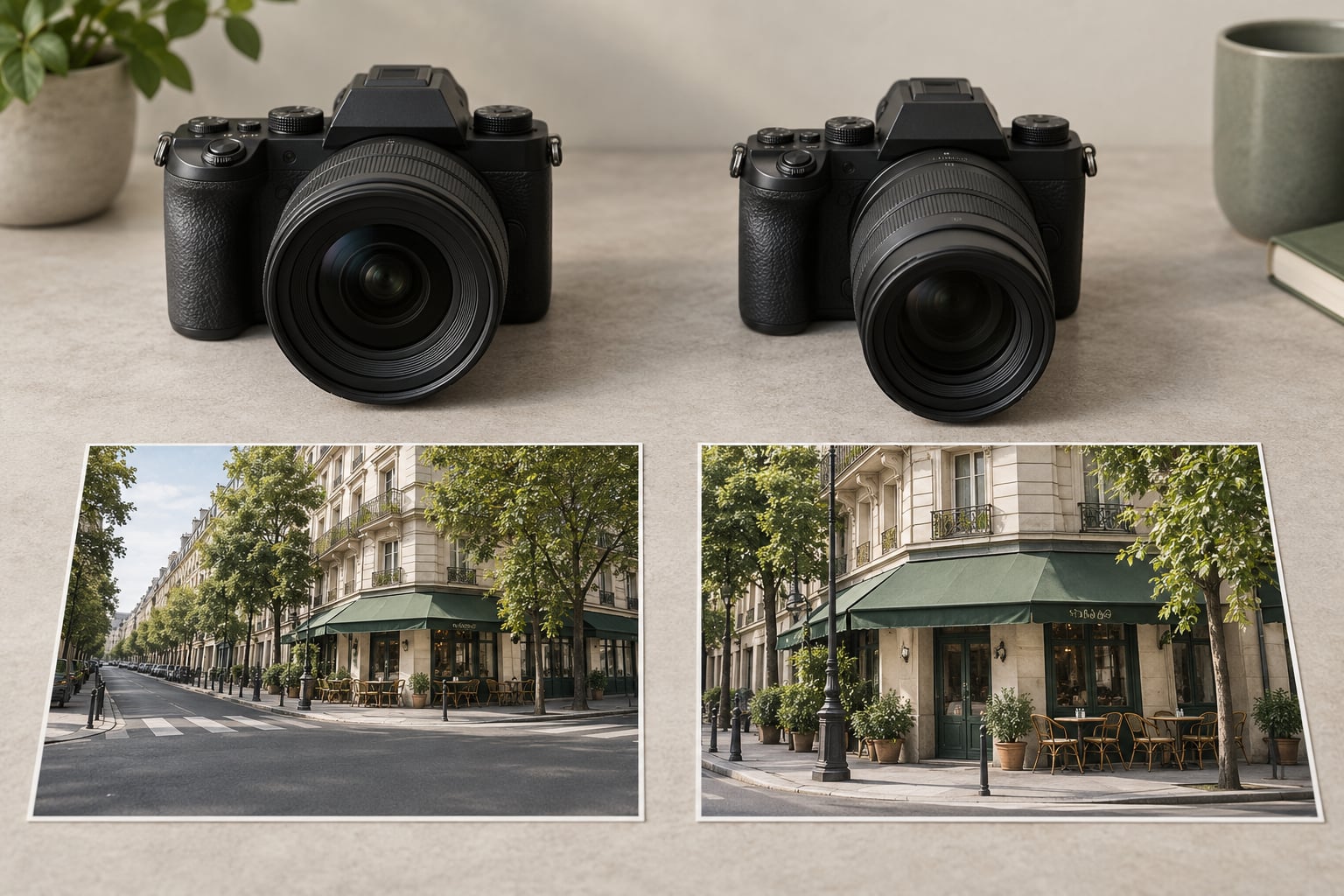
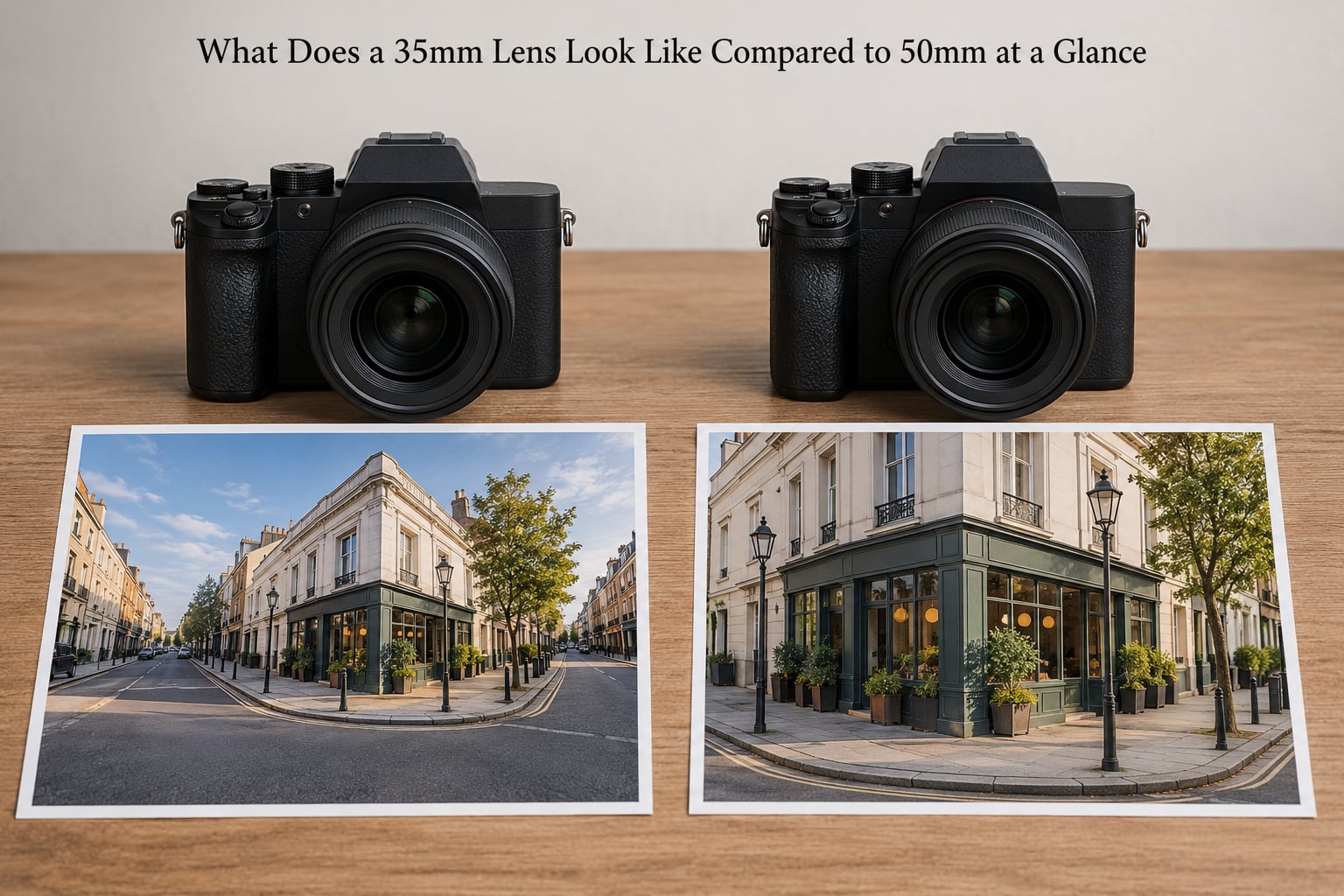
A 35mm lens looks wider than a 50mm: it fits roughly 40 percent more of the scene across the frame, keeps more of the background sharp, and stretches anything sitting near the edges. A 50mm gives a tighter, calmer frame with almost no edge distortion, a background that falls away softly, and a working distance that pushes you to step back. Everything below assumes a full-frame sensor, because the numbers change on smaller ones.
That last caveat matters more than it sounds. Focal length alone does not describe how a frame looks, so here is the short version of the question this answers: what does a 35mm lens look like compared to 50mm in practice, and which one should you actually carry?
Table of Contents
- What Does a 35mm Lens Look Like Compared to 50mm at a Glance
- Field of View: How Much of the Scene Each Lens Includes
- What changes on a crop sensor camera
- Perspective: Why the Lens Changes the Feeling of a Scene
- Subject Size and Composition: Which Lens Fills the Frame
- Depth of Field and Background Blur
- Low-Light and Everyday Handling
- Which Should You Choose?
- Frequently Asked Questions
- Is there a big difference between 35mm and 50mm?
- What does a 35mm lens look like?
- Is 35mm or 50mm closer to the human eye?
- Is a 50mm lens boring?
- Is 35mm or 50mm better for portraits?
- Conclusion: Start With the Scene You Photograph Most
What Does a 35mm Lens Look Like Compared to 50mm at a Glance
| What changes | 35mm lens | 50mm lens |
|---|---|---|
| Diagonal angle of view | About 54 degrees | About 40 degrees |
| Horizontal angle of view | About 38 degrees | About 27 degrees |
| Scene captured at the same spot | Roughly 40 percent more across, close to double the area | Tighter slice, subject twice as dominant |
| Subject size at the same distance | Standard size | About 40 percent larger in frame |
| Working distance | Close in, works in small rooms | Needs room to back up |
| Depth of field | Deeper, more stays in focus | Shallower, background separates |
| Distortion | Noticeable at frame edges, fixable by technique | Mild, easy to live with |
| Strongest for | Interiors, groups, street, travel, context | Portraits, details, small subjects, video |
Two numbers carry most of the visual difference: about 54 degrees of diagonal coverage on the 35mm against about 40 degrees on the 50mm. Hold a 36mm-wide frame at arm’s length and one rectangle is visibly bigger than the other.
Field of View: How Much of the Scene Each Lens Includes
The 35mm lens simply sees more. On a street corner, a 50mm gives you a person plus a slice of wall behind them; the 35mm from the same spot gives you the person, the doorway, the parked bikes and the sky above the roofline. Indoors, the difference decides whether you can get everyone in the frame from where you are standing or whether you end up backing into a door.
Outdoors it works the same way in reverse. Open scenery shrinks under a 50mm, which makes a wide vista feel compressed into a small window; the 35mm keeps the sweep of it. A crop of a 35mm frame can be tightened afterwards, so the extra coverage is recoverable in editing, whereas missing scene is gone for good.
The math is worth sitting with for a moment. The 35mm covers about 40 percent more width, which sounds modest until you realise it works out to close to twice the total area of the frame. Switching from 50mm to 35mm is not a small step. It is roughly the difference between a single figure and the room around them.
What changes on a crop sensor camera
Crop sensor bodies raise the equivalent focal length, so both lenses get tighter. The distortion and the perspective stay tied to the real focal length, which is the part forum users most often get wrong.
| Sensor and crop factor | 35mm behaves like | 50mm behaves like |
|---|---|---|
| Full frame (1x) | 35mm | 50mm |
| APS-C at 1.5x | About 53mm | About 75mm |
| Canon APS-C at 1.6x | About 56mm | About 80mm |
| Micro Four Thirds at 2x | 70mm | 100mm |
So a 35mm on a 1.5x body frames almost like a 50mm on full frame, which is why Nikon users often say the two feel interchangeable in normal light. Indoors the difference persists in a way the arithmetic does not explain, because the wider lens still shows more of a small room and the shallower 50mm framing still forces you toward the wall behind you.
Perspective: Why the Lens Changes the Feeling of a Scene
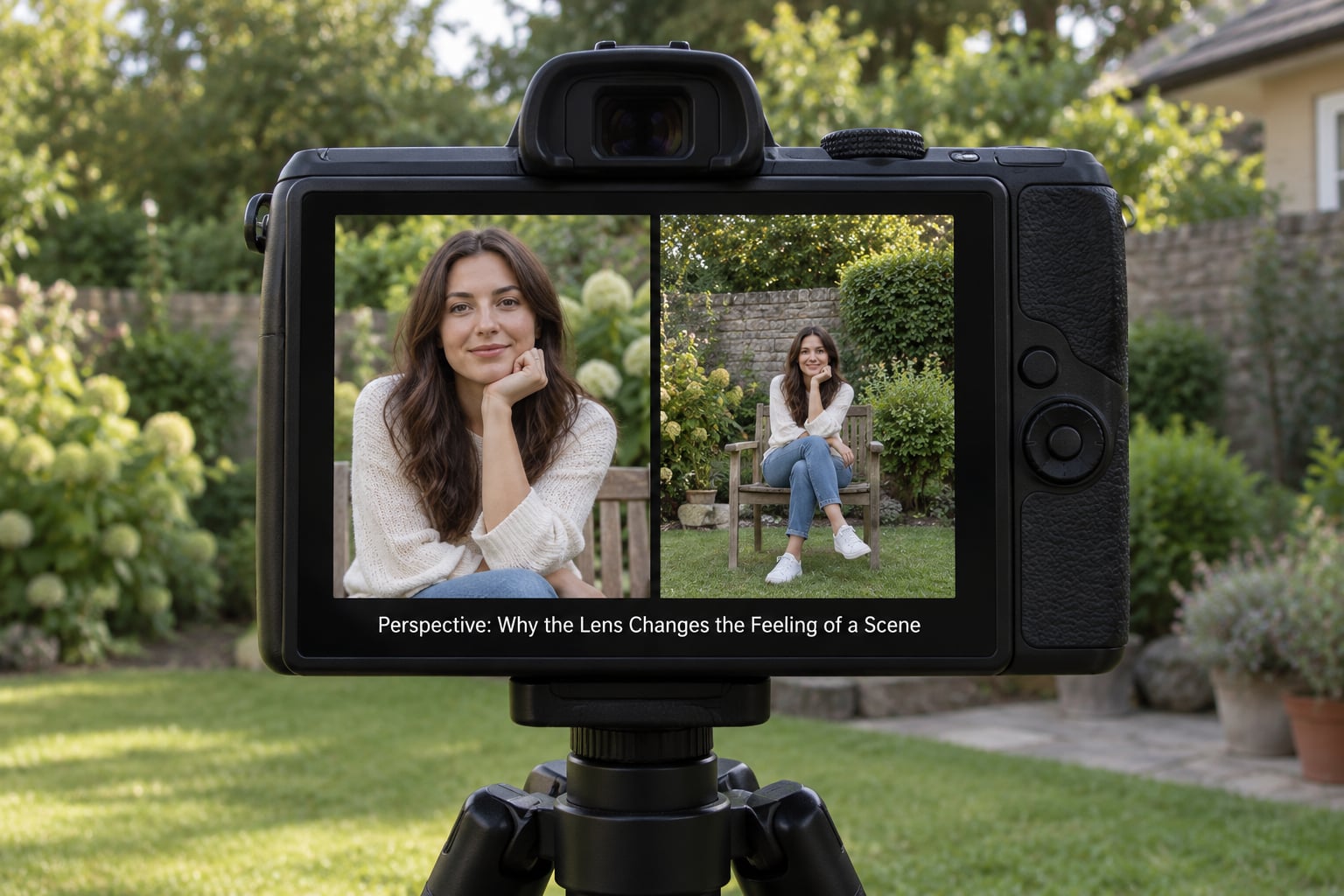
Stand in one spot, take a frame at 35mm, change nothing but the lens, and take another at 50mm. The background will not move and the subject will not change shape relative to it. Perspective is set by where the camera stands, not by how long the lens is.
What changes the feeling is what you do next. Photographers get the compressed look everyone associates with the 50mm by walking backwards, and once they have done it once they rarely go back. The background appears to move closer to the subject because you narrowed your view onto a smaller piece of it from further away.
Both camps claim their favourite matches human vision, and neither is quite right. Your eyes do not take in a 54-degree rectangle; they scan, and the amount they take in depends on where you are looking. A 50mm is closer to what a camera sees when you fixate on one subject, which is why portrait photographers like it. A 35mm is closer to peripheral awareness, which is why street shooters like it.
The same argument plays out differently for video. On a full-frame sensor, 50mm is the normal lens. On a super-35 cinema sensor, which crops harder, the 35mm becomes the normal lens and the 50mm reads long. The number is only meaningful next to the frame it is drawn on.
Subject Size and Composition: Which Lens Fills the Frame
At the same distance from the same person, a subject is about 40 percent larger in the frame on a 50mm. That is the whole reason to step back for portraits: the longer lens lets you fill the frame without walking into someone’s face, which people notice more than any amount of background blur.
The 35mm works the other way. It gives an environmental portrait, where the surroundings describe the person, and it forgives the fact that you are shooting from three metres away in a small flat because the frame does not care how far back the wall is.
The cost is at the edges. A wide lens stretches whatever sits near the corners, so a face placed off-centre gets a longer nose and a smaller skull, and a full body shot crops a leg or exaggerates a foot nearest the lens. Two habits fix most of it: keep the camera level with your subject’s chest or eyes rather than tilting up, and keep faces away from the outer third of the frame by stepping sideways or turning the body instead.
Depth of Field and Background Blur
At the same aperture and the same distance, the 35mm keeps more in focus. That is straightforward physics, shorter focal length means a deeper zone of sharpness at the same f-number.
Compare fairly, though, and the gap narrows. Step forward with the 35mm until the framing matches what you would get from further back on the 50mm, and the two arrive at a similar background softness. Most of the reputation of the 50mm as a portrait lens comes from the extra distance, not the lens itself.
Aperture still sets the character of the blur. At f/1.4 the background melts and out-of-focus highlights turn into smooth discs, while f/1.8 keeps more structure and suits a scene where you want the place to stay readable. Lens design and sensor size also matter, and no two lenses blur identically.
Low-Light and Everyday Handling
In a dim room, the wider lens tells you more about what is happening around the subject, which makes it easier to frame when you cannot see the edges of the frame. The 50mm makes you aim precisely in low light because everything outside the frame is invisible, and it can push you into furniture or a corner where there is no room to back into.
Neither focal length gathers more light on its own. Brightness comes from the aperture and the sensor, so the practical difference at night is about what you can include rather than how bright the picture gets.
That is also the everyday-carry argument. One 35mm covers a walkaround: interiors, street, groups, travel, the kitchen table where the light is poor. One 50mm covers people and details and forces you to move closer, which some people love and some find exhausting. Plenty of photographers end up owning both and treat them as a matched pair.
Which Should You Choose?
Choose a 35mm lens if most of your photography happens where the walls are close: interiors, small groups, café shots, streets where you are moving through crowds, and travel days spent covering places rather than making portraits. It forgives tight rooms and it recovers framing later in editing.
Choose a 50mm lens if your subject is a person and you want them to dominate the frame: headshots, half-length portraits, food, hands, small details, and video where you want a natural-looking angle without leaning in.
Before buying either, test both on the zoom you already own. Lock it at 35mm for a week and shoot only that, then lock it at 50mm for another week. A 15mm difference sounds trivial on paper and is obvious in the hand, but which one feels right depends on your rooms, not on a spec sheet.
Frequently Asked Questions
Is there a big difference between 35mm and 50mm?
Yes, a noticeable one. A 35mm covers about 54 degrees diagonally against roughly 40 degrees on a 50mm, which is about 40 percent more width and close to double the frame area. That extra coverage means more context, more depth of field, and mild stretching at the edges. The 50mm gives a tighter frame, larger subjects, cleaner backgrounds and less distortion.
What does a 35mm lens look like?
A 35mm lens looks wide and busy. It captures the subject plus most of the room or street around them, holds a deep zone of focus so foreground and background stay legible, and bends straight lines near the frame edges. It reads as a documentary or environmental frame, the kind that explains where the person is rather than isolating them.
Is 35mm or 50mm closer to the human eye?
Neither, exactly, because your eyes scan rather than see a fixed rectangle. A 50mm is closest to what a camera records when you fixate on one subject at a comfortable distance, which is why it suits portraits. A 35mm is closer to peripheral awareness and gives the sense of taking in a whole scene, which is why street and travel shooters prefer it.
Is a 50mm lens boring?
It is the least adventurous lens you can carry, and that is the point. With no zoom to hide behind, you decide how the frame looks by walking, which turns ordinary subjects into decisions. Photographers who shoot events and weddings often keep a 50mm on the body permanently for exactly this reason. Boring describes the look, not the results.
Is 35mm or 50mm better for portraits?
For headshots and half-length portraits, the 50mm usually wins, because it makes the subject larger in frame and softens the background. For full bodies, environmental portraits and anything shot in a small room, the 35mm wins, because it fits more in and needs less distance. Keep the camera level and keep faces out of the frame corners when you shoot wide.
Conclusion: Start With the Scene You Photograph Most
What does a 35mm lens look like compared to 50mm? Wider, busier and closer to your subject than it looks from the back of the camera, with edges that stretch if you let them. The 50mm gives a tighter frame, larger subjects, cleaner backgrounds and a natural-looking distance.
Decide by where you shoot most. Tight rooms, groups and moving through a place point to the 35mm. People and details point to the 50mm. Lock your kit zoom at each length for a week and the answer usually arrives faster than any comparison chart can give it to you.