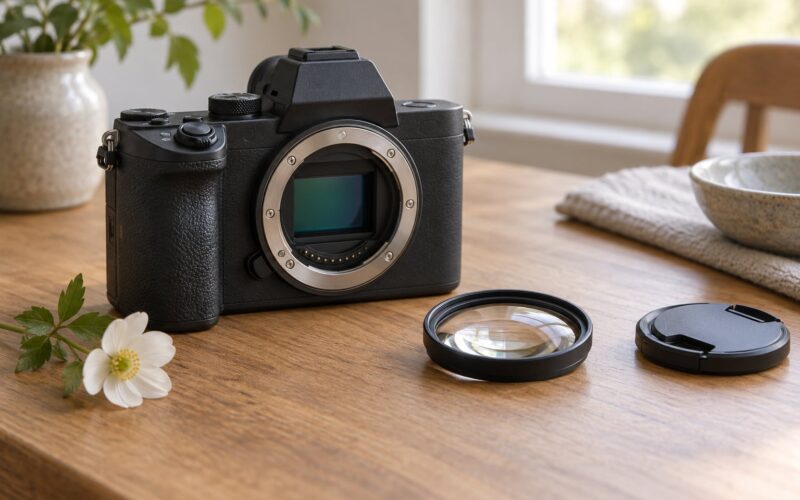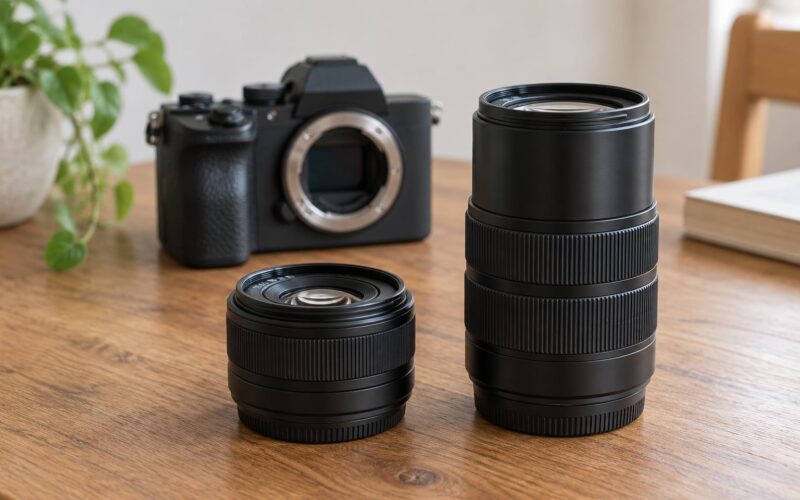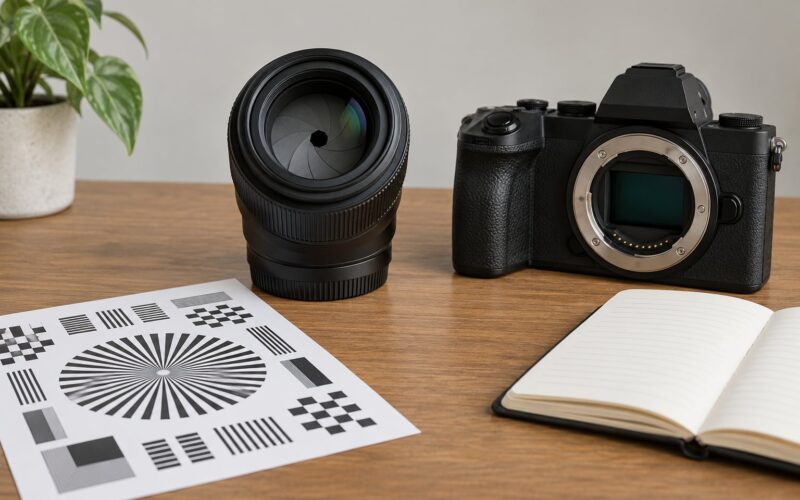
A macro lens is a dedicated lens built to photograph tiny subjects at 1:1 magnification, where the image on the sensor is the same size as the real thing. A close-up filter is a cheap screw-on magnifier that shortens your existing lens’s minimum focusing distance so you can get closer, usually at a fraction of the magnification.
Short version: if macro photography is something you do regularly, or you need life-size reproduction for coins, stamps or jewelry, buy the macro lens. If you are testing whether you enjoy close-ups at all, a close-up filter on a kit lens will teach you the craft for very little money.
I have shot coins with a kit zoom and a filter, then repeated the same shots years later with a dedicated 100mm macro. The gap in corner sharpness and focusing confidence was obvious, but the gap in enjoyment was zero at the start. That is the whole argument, and it is worth reading to the end before you spend anything.
Table of Contents
- What Is a Macro Lens vs Close-Up Filter at a Glance
- What Is a Macro Lens?
- What Is a Close-Up Filter?
- How a Macro Lens Differs from a Close-Up Filter
- What Is a Macro Lens vs Close Up Filter in Image Quality?
- Which Option Is Easier for Beginners?
- How Do You Choose Between Them?
- How Extension Tubes Fit In
- Which Should You Choose?
- Frequently Asked Questions
- Can a close-up filter give the same results as a macro lens?
- Do close-up filters work with mirrorless cameras?
- What magnification do I need for small flowers or insects?
- Is a macro lens better than using a close-up filter with extension tubes?
- Can I focus normally with a close-up filter attached?
- How do I know whether my existing lens is compatible with a close-up filter?
- Conclusion
What Is a Macro Lens vs Close-Up Filter at a Glance
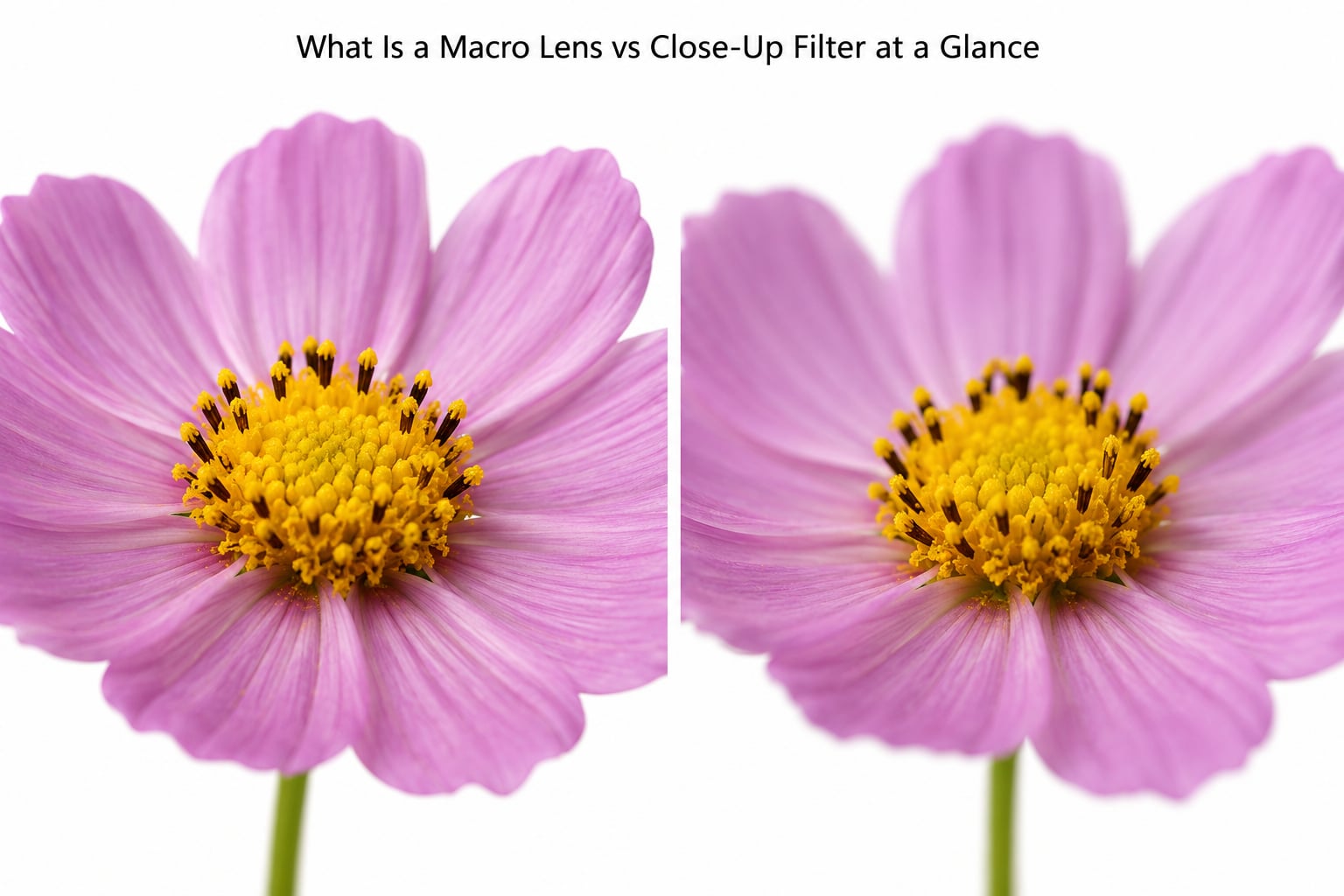
| Criterion | Macro lens | Close-up filter |
|---|---|---|
| What it is | A purpose-built lens with special close-focusing optics | A screw-on convex lens that goes on the filter thread of a normal lens |
| Typical magnification | 1:1 life-size, some models beyond | Around 0.2x to 0.5x depending on diopter and focal length |
| Sharpness across the frame | Even from centre to corner | Sharpest in the centre, softer toward the edges |
| Working distance | Long enough to light small subjects comfortably | Very short, often only a few centimetres |
| Focusing | Autofocus on most, manual on some specialty models | Manual, on a thin band of the focus ring |
| Infinity focus with the filter on | Not applicable | Lost on many lenses, remove the filter for normal shooting |
| Light needed | Modest, because the working distance is generous | Strong light often needed at very close range |
| Other filters you can use | Polariser, ND, filters all fine | Usually only one filter at a time, no room to stack |
| Camera compatibility | Buy the mount your camera uses | Must match filter thread diameter, so lenses above about 77mm are hard |
| Best for | Regular close-up work, insects, product shots, fine detail | Trying out close-ups, static subjects, occasional detail shots |
One row in that table matters more than the rest for beginners: working distance. A macro lens lets you get a light and a subject in the frame together, while a close-up filter leaves you a few centimetres of air between the front element and your subject.
What Is a Macro Lens?
A macro lens is a lens designed to focus from very close and to reproduce a subject at 1:1 magnification. That term is exact rather than marketing shorthand. At 1:1, a 10mm coin cap photographed on a full frame sensor fills 10mm of the frame, matching life size.
The reason it achieves that comes down to the internal element layout. Macro designs use floating groups that shift the focus plane without extending the barrel, and correction for the aberrations that get severe at short distances. That is why they stay sharp wide open and across the frame.
Focal length changes how you work rather than whether you can shoot. A 90mm or 100mm gives you a longer working distance and a narrower field of view, which suits insects and skittish subjects. A 50mm or 60mm gets closer, focuses faster in dim light, and is easier to hold steady, at the cost of a shorter working distance.
Without a macro lens, reaching 1:1 with a zoom means adding extension tubes or a bellows. That works, but the image degrades because you are pushing the original lens off the focal lengths it was designed for.
What Is a Close-Up Filter?
A close-up filter, also called a close-up lens, a diopter filter or a macro filter, is a small convex lens that screws onto the filter thread at the front of your camera lens. It behaves like reading glasses for the lens: it increases the lens’s optical power so the same barrel length can focus much closer to the subject.
Its strength is measured in diopters. A +1 diopter adds a little power, +2 adds more, +3 is the common strong option. The magnification you actually get depends on both the diopter and your focal length, which is where most confusion starts. A +2 filter on a wide-angle zoom produces very little magnification, while the same filter on a 200mm telephoto gives you a useful working magnification.
For a rough estimate, magnification equals the focal length in millimetres multiplied by the diopter and divided by 1000. So a +2 filter on a 200mm lens gives about 0.4x, and a +2 filter on a 50mm lens gives about 0.1x, which is far too little to matter for most subjects.
Cheap close-up filters use a single element, usually moulded plastic, and they add visible softness and colour fringing as the diopter strength climbs. Better ones are achromatic, with two elements bonded together and partially corrected for colour, and they cost several times more.
Another limitation catches people out: many lenses will not focus to infinity with a close-up filter attached, and ones with internal focus may not even reach minimum focus at all. On some zooms, the filter only works at one end of the range.
How a Macro Lens Differs from a Close-Up Filter
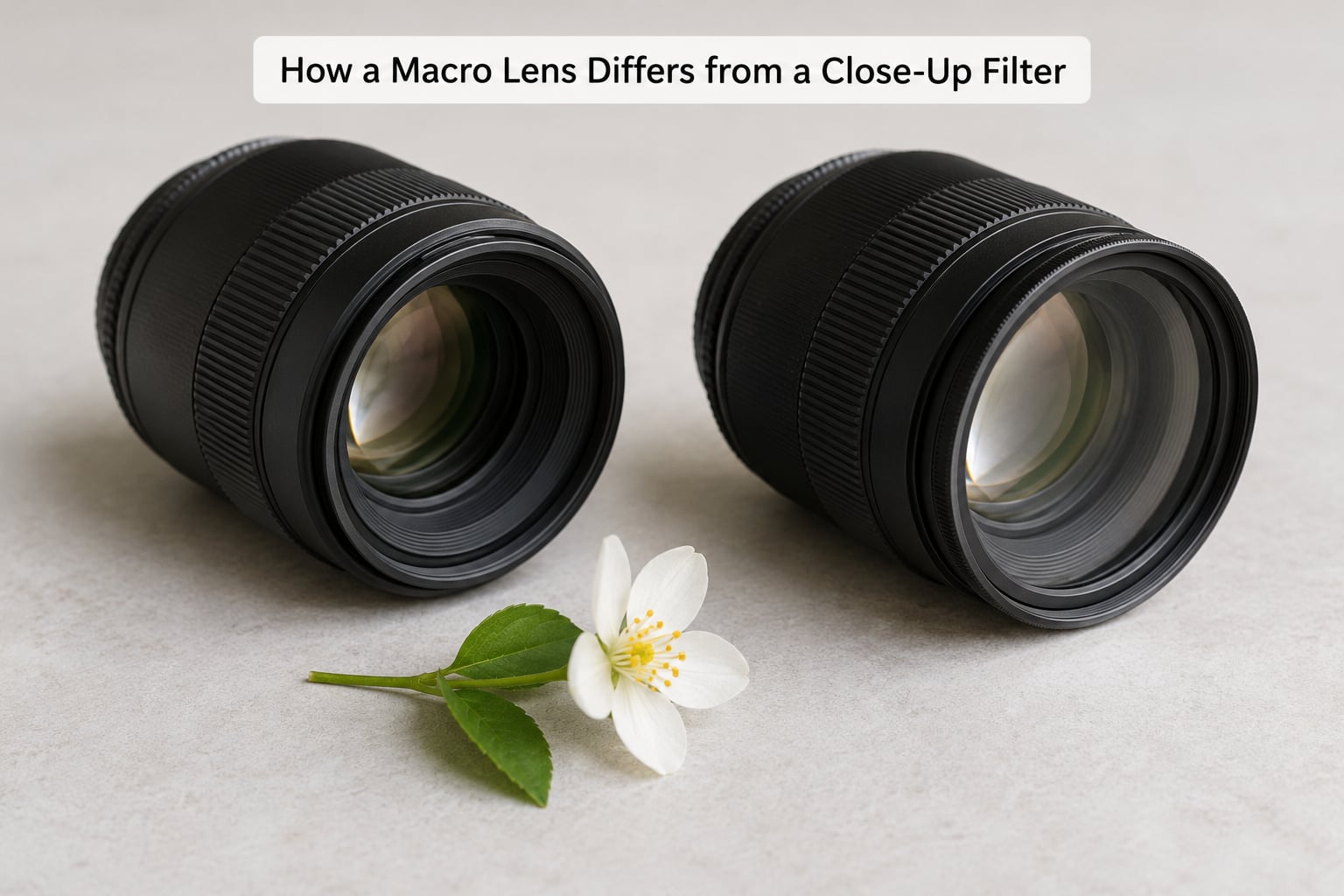
The optical difference is the core of it. A macro lens corrects its aberrations for the magnification range it was built for, so it holds detail from the middle of the frame to the corners. A close-up filter adds uncorrected magnification to a lens corrected for distant subjects, so the extra power mostly lands in the centre and the edges soften.
Focusing follows the same logic. A macro lens focuses through a normal range with a manual or motorised ring, and modern versions autofocus quickly and quietly even close in. With a filter on, the usable focus range collapses to a sliver, focus hunting becomes common, and your hands do most of the work.
Compatibility is the practical difference. A macro lens has to match your camera mount, and that is a firm yes-or-no decision. A filter has to match your lens’s filter thread diameter, which is written on the front ring or the side of the barrel, and that limits you to lenses under roughly 77mm because bigger adapters stop being made.
Convenience splits too. A macro lens is a second body-capable piece of glass that stays sharp at infinity, so you never have to take it off. A filter goes on for the close-up and comes off again, and on lenses that lose infinity you end up unscrewing it every time you switch subjects.
What Is a Macro Lens vs Close Up Filter in Image Quality?
The macro lens wins on edge performance. At 100% on screen, the centre of a good achromatic filter shot can look respectable, but the corners get soft and you may see a dimmed vignette where the filter shades the sensor at short distances.
Colour is the other visible difference. Single-element filters often split highlights into green and magenta fringes, most obvious on shiny subjects like coins, glass and insects. A multi-coated achromatic filter controls this well enough for casual use, but a macro lens holds colour cleanly with the aperture wide open.
It is fair to say a well-made filter on a good lens produces sharp, usable results at modest magnification, especially if you stop down a little. The gap opens up as magnification climbs, as you shoot wider open, or as you demand detail in the corners of the frame.
Contrast and haze also differ slightly. Macro lenses are usually multi-coated against flare, and they shoot through the near-total internal reflection that a filter adds when the lens is close to the subject and light comes from behind.
Which Option Is Easier for Beginners?
The close-up filter is easier to start with, and the macro lens is easier to keep using. Starting is about commitment and cost. A filter is a small accessory that turns gear you already own into something that shoots small subjects, and if you lose interest you have lost almost nothing.
The macro lens asks more of you in the first month. You learn to work with a thin depth of field measured in millimetres, to brace against a tripod, to judge whether the subject is inside the focal plane by eye, and to watch for your own shadow falling across the scene. None of that is hard, but it is a lot at once.
Mirrorless bodies soften the learning curve considerably. Live view magnification and focus peaking make manual focusing with a filter far less painful, because you can see the plane of sharpest focus on the screen and watch it slide as you turn the ring.
On DSLR bodies, live view with magnification works too. What makes life easier is the electronic viewfinder on a mirrorless, since you can compose at close range without squinting and without the viewfinder going dark at very short distances.
How Do You Choose Between Them?
Start with the subject. Static, flat, tolerant subjects like coins, stamps, fabric, food and dried botanicals are ideal filter territory, because nothing moves while you hunt for focus. Insects, bees, butterflies and anything alive in a garden punish the short working distance a filter gives you, so there a macro lens earns its money.
Next, decide how large the result needs to be on the sensor. If a coin needs to fill a good part of the frame edge to edge, or you need two identical frames for comparison or catalogue work, filters often cannot deliver it. Life-size reproduction without a macro lens requires extension tubes and careful technique.
Then check the hardware. Look at the front of the lens for a thread size marking such as 58mm or 67mm. If it is over 77mm, the filter route is effectively closed and your real choice is a macro lens or extension tubes.
Think about frequency as well. Ten close-ups a year is a hobby curiosity and a filter handles it fine. Ten close-ups a month is a body of work, and it deserves glass designed for it.
Finally, be honest about light. Both approaches want more light than most beginners expect, but the filter needs more of it because the working distance is measured in centimetres. A small LED panel or a diffused flash makes a bigger difference than any other single purchase at this stage.
How Extension Tubes Fit In
Extension tubes sit between the body and the lens, adding distance so the lens can focus closer without any extra optics. They keep your existing glass, they cost a modest amount, and they have no filter thread limit.
They cost image quality too. Extension tubes reduce effective light and add contrast loss through repeated internal reflections. Manual focusing with no coupling means you work by hand rather than by autofocus, so a tripod-based workflow matters.
The practical rule: extension tubes for static subjects you have time to focus, close-up filters when you want to keep autofocus and shoot fast, macro lenses when the result has to be sharp edge to edge.
Which Should You Choose?
Buy the close-up filter if you have never done macro work, if your budget is small, or if your subjects never move. A mid-priced achromatic filter on your longest available lens will produce images you are happy to look at, and it is the cheapest way to find out whether this is your kind of photography.
Buy the macro lens if you already know you like close-ups, if you photograph insects or products regularly, or if you need consistent results across a whole series. Pick 90mm to 105mm for outdoor and insect work where working distance matters, and 50mm to 60mm for indoor and product work where light and speed matter more.
Consider neither if your subject is larger than you first thought. A 90mm at 1:1 is astonishing close, and many shots people label macro are really just short portraits or detail crops that a normal telephoto lens handles beautifully.
Frequently Asked Questions
Can a close-up filter give the same results as a macro lens?
Not at the same magnification, and rarely at the same sharpness across the frame. A close-up filter produces usable, sharp results in the centre of the image at modest magnification, especially with an achromatic multi-element filter. A macro lens holds detail to the corners, focuses more easily, and reaches 1:1 reproduction. For casual shots at low magnification the two can look similar on a phone screen.
Do close-up filters work with mirrorless cameras?
Yes. The filter screws onto the lens thread, so the camera system makes no difference. What does change is how you focus. Mirrorless cameras offer live view magnification, focus peaking and an electronic viewfinder that makes manual focus far easier, which matters because a close-up filter leaves only a narrow band of the focus ring usable. Manual focus modes with magnification are the practical way to work.
What magnification do I need for small flowers or insects?
For filling the frame with a typical small flower, something around 0.3x to 0.5x is usually enough, which a strong filter on a telephoto lens can reach. Full-frame insects and details like stamps, seeds and jewellery need closer to 1:1. Working distance matters as much as magnification here, since a skittish insect will not sit still for a photographer with a few centimetres of clearance.
Is a macro lens better than using a close-up filter with extension tubes?
A macro lens gives better image quality and easier focusing because it was designed for the job. A close-up filter on extension tubes is a workable budget route, but you add uncorrected magnification to glass that was built for distant subjects, and light loss and contrast drop as you stack the two. If you want one accessory to do close-ups properly, a dedicated macro lens is the better buy.
Can I focus normally with a close-up filter attached?
Sometimes. Many lenses lose the ability to focus to infinity once a close-up filter is fitted, and some with internal focus design will not reach minimum focus at all. Zooms often only work over a limited part of the range. Check your specific lens before buying, and be prepared to remove the filter for everyday shooting. Macro lenses have no such limitation.
How do I know whether my existing lens is compatible with a close-up filter?
Look at the front rim or the side of the barrel for a thread size marking such as 52mm, 58mm or 67mm. That number is what the filter must match, and step rings are usually not a good fix because they introduce vignetting and softness. Filters above roughly 77mm are rarely made, so very large front elements rule the option out entirely.
Conclusion
A macro lens is a purpose-built tool that reaches 1:1 and stays sharp across the frame. A close-up filter is a budget accessory that shortens the minimum focusing distance of a lens you already own, giving you useful but lower magnification and softer edges.
Before you buy anything, check one thing: the filter thread diameter printed on the front of your lens. If it is under 77mm and your subjects stay still, a close-up filter is a sensible first step. If you photograph moving subjects or need detail edge to edge, go straight to a 90mm or 100mm macro and put a tripod and a small light beside it.