To photograph a neighborhood walk without being creepy, spend your first few walks on buildings, plants and light rather than people, keep the camera visible but low, shoot from public sidewalks, and make the street the subject instead of individual residents. A respectful walk takes about an hour and needs no special permission on public ground.
The awkward part of shooting your own neighborhood is not the law. It is repetition. On a holiday weekend you are a stranger with a camera; on the third evening in a row, you are a familiar face, and familiarity cuts both ways. Photographers have described being called out for shooting flowering cherry trees on their own street, with a neighbour shouting about photographing people’s property, when the trees were the actual subject.
Table of Contents
- What You Need
- Step-by-Step: How to Photograph a Neighborhood Walk Without Being Creepy
- Plan a public route and decide what you will photograph
- Observe the scene before taking photos
- Use wide, context-first compositions
- Ask permission before close shots so your walk never looks creepy
- Keep interactions brief and put the camera away
- Check your images for privacy before sharing
- Common Mistakes
- Standing still and aiming at one house
- Photographing lit windows at night
- Shooting children and vulnerable people
- Returning to the same subject
- Photographing from inside a yard or driveway
- Posting straight to social media
- Frequently Asked Questions
- Is it okay to photograph people on a public sidewalk?
- Can I photograph houses and front yards from the street?
- How do I take natural neighborhood photos without photographing faces?
- What should I do if someone tells me to stop taking pictures?
- Should I photograph children or people through windows?
- How can I check a photo before posting it online?
- Conclusion
What You Need
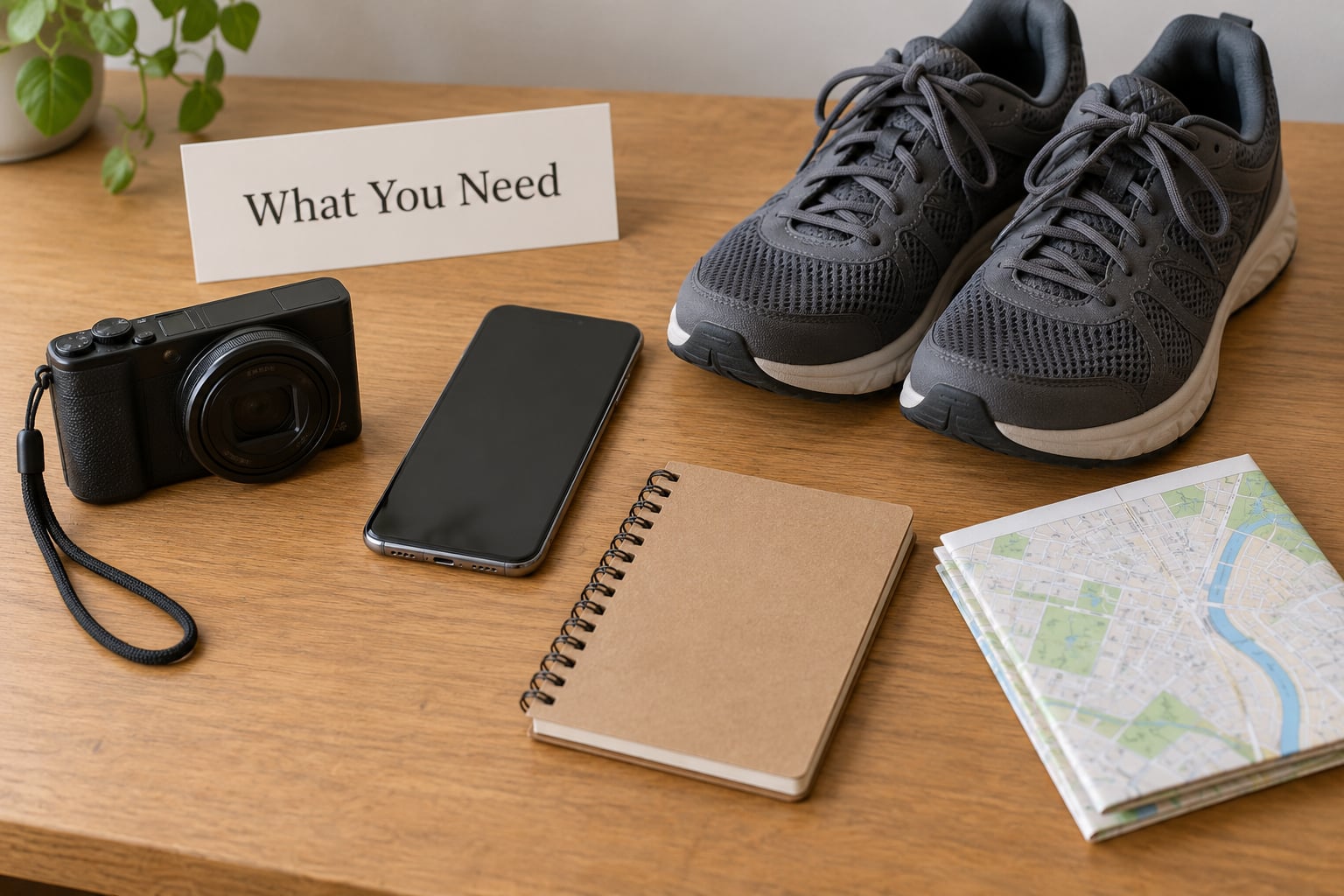
You need very little. Most of what makes a walk look respectful is decided before you leave the house.
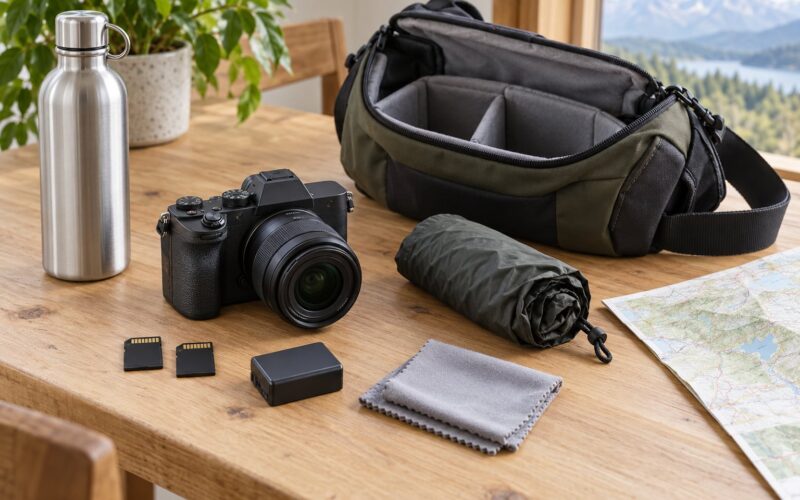
- A camera you can shoot without raising to your eye. A fixed-lens compact, a small mirrorless body, or simply your phone. Anything that requires you to stop, lift the viewfinder to your face and aim deliberately signals surveillance far more than a camera resting at your chest does.
- Comfortable shoes and a planned loop. Twenty to forty minutes of familiar ground beats an hour of unfamiliar streets, because your timing and your route become predictable.
- Settings decided in advance. Set the mode, focus and exposure range before you step outside, so you are fiddling with dials while walking rather than pausing to adjust.
- A narrow theme. One subject per walk keeps you honest. A walk about porch lights, one about hedges, one about the way late afternoon hits brick walls.
- A clear line about people. Decide in advance which categories you will not photograph at all, so the decision is made in calm conditions rather than under the pressure of a good light.
Add one practical item that nobody mentions: your own front door and garden. Photographing the street you live on, including your own property, reads as belonging in a way that a camera pointed at other people’s houses never will.
Step-by-Step: How to Photograph a Neighborhood Walk Without Being Creepy
Plan a public route and decide what you will photograph
Start on public sidewalks, public parks, and streets you would walk without a camera. Private driveways, front gardens behind gates, and anything visible only from inside a property are off limits, regardless of what the law allows.
Then write your theme down in one sentence. Photographing “the neighborhood” gives you no decisions, so your attention drifts to whatever moves. Photographing “how people shelter from rain on this block” keeps you on doorways, umbrellas and wet pavement, where the human element is part of the scene rather than the target of it.
Observe the scene before taking photos
Pause and watch before you raise anything. Notice where the light is falling, what the background looks like from that spot, who moves through the frame and who might be uncomfortable in it. Ten seconds of standing still usually tells you more than a burst of frames taken while walking.
People who photograph strangers describe a simple test: would you be fine with this image existing online, attached to no name, forever? If your honest answer is no, skip it. That feeling is usually right, and it arrives before you have any way to argue with it.
Use wide, context-first compositions
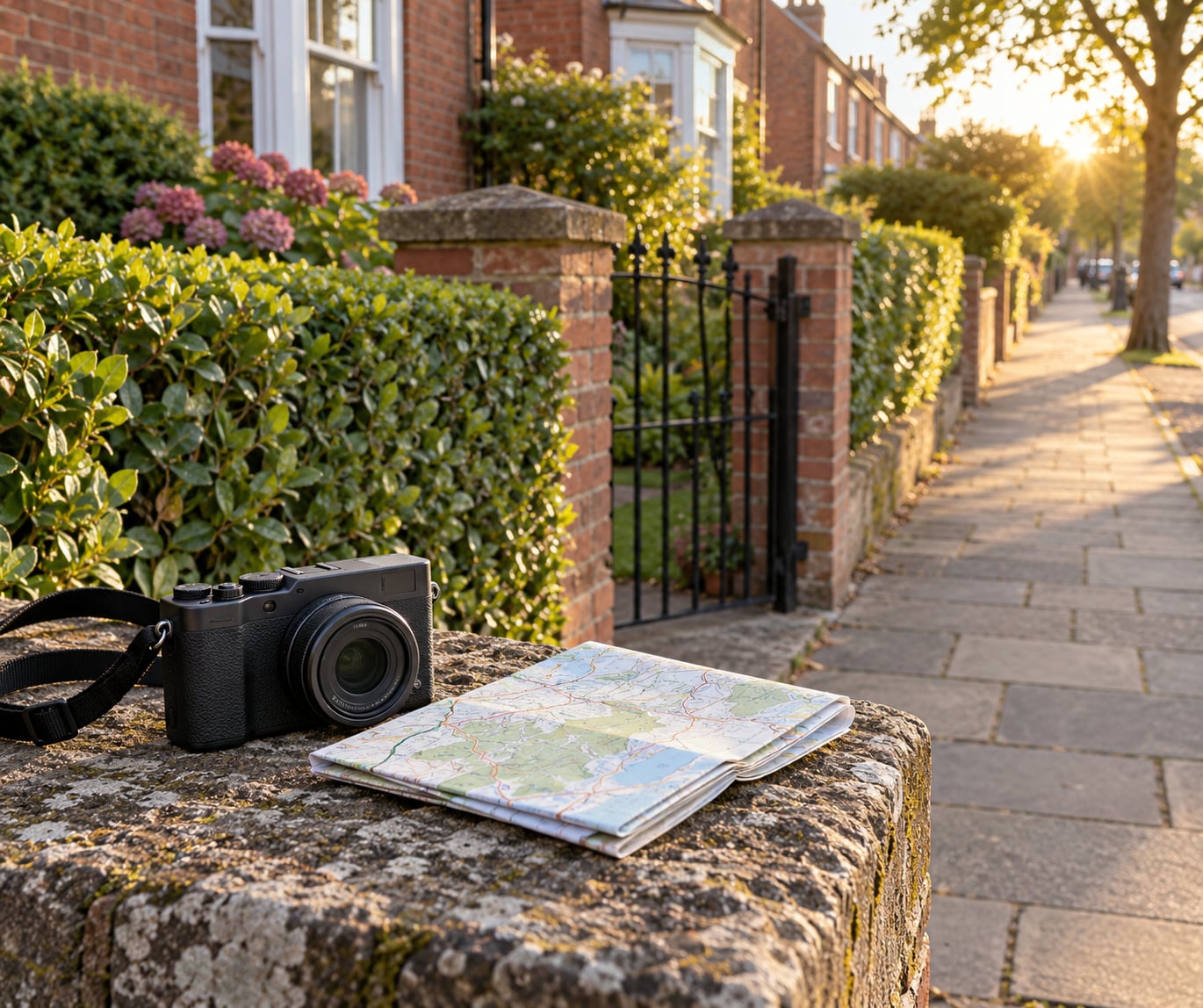
Wide frames are the single most effective tool here. When the frame holds a whole street, a row of front doors, a long hedge line or an empty path with a figure small in it, nobody is the subject of the photograph. The neighborhood is.
Working that way also gives you better pictures. Repeating railings, window bays and drainpipes give you rhythm; puddles and shop windows give you reflections; a low sun raking across a brick wall gives you texture that a close-up of a face never will. Standing back also keeps people at a distance that reads naturally.
A wider lens helps for the same reason. Shooting at 35mm or wider means you can include the surrounding street instead of isolating one person at 135mm, which is the framing that most resembles what someone means by creeping.
Ask permission before close shots so your walk never looks creepy
Ask when a subject is recognizable, close, or aware of you. A short line works better than a speech: “Hi, I’m photographing the street for a project. Would you mind if I took a photo of you?” Then show them the frame on the screen. Handing the camera over for a look does more to defuse suspicion than any explanation.
Photography forums keep repeating the practical boundary that a stranger is usually fine with: take no more than about three frames of the same person, get what you came for, and move on. Repeating shots at someone who has not agreed is what turns a candid frame into a confrontation.
If someone says no, or shrugs in a way that is not a yes, put the camera down. No argument, no lingering, no “just one more”. That is the whole cost of respecting the answer.
Keep interactions brief and put the camera away
Three behaviours do most of the work. Do not follow anyone. Do not block a path, a doorway or a pavement to get a better angle. And after a frame, look away and walk on rather than reviewing the screen while the person is still in it.
If someone does approach you, the scripts are short and worth rehearsing before you need them:
- To a neighbour who questions you: “I’m just out taking photos of the street, I live two streets over. Happy to show you if you’d like.”
- To a person in your frame who objects: “Sorry, I took that without asking. Would you like me to delete it?” Then actually delete it.
- To someone who asks you to move on: “Of course, sorry about that.” No discussion, no photographing the conversation.
Forum consensus is that these encounters cannot always be won, and treating them as a conversation rather than a defence is what keeps them short. One user described wanting to explain himself during the cherry tree confrontation and realising mid-moment that it was not the moment; the fix is to walk on that day and introduce yourself another day, when nobody is angry.
Check your images for privacy before sharing
Review every frame for faces, house numbers, mailboxes, vehicle registration plates, school logos and anything that reveals an interior, then decide what to do about each. Cropping and blurring faces works well. Withholding or deleting works better when a child, a private interior or a lit window is in the shot.
Before uploading, strip location data from your file, and be careful with captions. A caption that names a street or a resident turns an ambient photo into an address. If you took someone’s portrait on request, say where it appeared and offer them a copy.
Commercially, treat anyone recognizable as needing a model release, especially for advertising or stock use. For editorial and personal work the rules differ by country, and if you are anywhere in the European Union the data protection rules around identifiable faces are far stricter than in the US or UK. This is general guidance, not legal advice.
Common Mistakes
Standing still and aiming at one house
A stationary person with a camera pointed at a single front door reads as casing, whatever you are actually shooting. Walk past, keep moving, and photograph the row rather than the unit. Most of the time the composition improves too.
Photographing lit windows at night
Interiors are where a reasonable expectation of privacy is strongest, and a lit window at night shows the inside of somebody’s home. Skip it entirely. If a reflection in a shop window includes a person inside, crop it before it goes anywhere.
Shooting children and vulnerable people
Children playing in a public park are not off limits in the legal sense, and they are off limits in the human sense unless a parent says yes. Do not photograph children, people who appear intoxicated or unwell, and anyone at a private ceremony. Lonely and vulnerable subjects get photographed constantly and almost never benefit from it.
Returning to the same subject
Three frames, one walk, then move on. Photographing someone repeatedly from different angles turns a candid into something closer to pursuit, and people notice.
Photographing from inside a yard or driveway
Even an open gate does not make a private driveway public ground. Stay on the sidewalk. If the only way to get the frame is over a fence, that is the answer about the frame.
Posting straight to social media
Images published with geotags, captions naming residents and unblurred faces turn an awkward moment into a permanent one. Check first, then post. Offer deletion without being asked twice if someone has already asked once.
Frequently Asked Questions
Is it okay to photograph people on a public sidewalk?
Usually yes, in the US and UK, provided you are on public ground and the images are not used commercially in a way that implies endorsement. Rules differ by country and the EU is far stricter about identifiable faces. Legally photographing a person in public is one thing; repeatedly aiming a lens at them, following them or blocking their path is another, and that crosses into harassment regardless of where you are standing.
Can I photograph houses and front yards from the street?
You can photograph the exterior of a house from a public sidewalk, including the front door and garden if they are visible from it. You cannot step onto private property to get a better angle, and a lit window at night showing a lit interior is where a reasonable expectation of privacy clearly applies. Keep houses as part of a wider street composition rather than singling one out as your subject.
How do I take natural neighborhood photos without photographing faces?
Make the street the subject, not the person. Use wide frames, shoot from the hip or with the camera low, include doorways, railings and reflections, and place your subject small within a larger scene. Shooting from behind, using shadow and silhouette, or cropping to the waist all remove the identifying detail that makes people uneasy. Most candid photographers build entire projects around people who are barely recognisable.
What should I do if someone tells me to stop taking pictures?
Stop immediately, say sorry, and put the camera down. Offer to show them the screen and offer to delete the frame without being pushed twice. Do not argue, do not photograph the conversation, and do not keep the frame as proof you were right. If you want to explain, do it later and in person at a calmer moment, when nobody is annoyed at you.
Should I photograph children or people through windows?
Skip both in almost every case. Children in public spaces should only be photographed with a parent’s explicit agreement, and never in a way that lets them be identified or found. Interiors visible through windows, lit rooms at night, and people inside their own homes are private in every practical sense, even when no rule formally says so. There are better frames ten metres away.
How can I check a photo before posting it online?
Zoom in and look for faces, house numbers, mailboxes, registration plates, school identifiers and interior views through glass. Strip location data from the file, and keep captions free of street names, names and anything that locates a home. Blur or crop faces, and delete anything that identifies a child or a private interior. Check on a second screen or phone, where small details are easier to catch.
Conclusion
Start with a public route, one narrow theme, and a walk where the street is the subject and residents are incidental. Keep the camera visible and low, ask before close frames, take no more than about three shots of anyone, and put the camera away when someone says no.
Then review every image before it goes anywhere: blur or crop faces, strip location data, keep captions free of addresses, and delete what identifies a child or a home. Nobody reads a walk as creepy when it looks like it belongs to the person taking it.