The short version: if you want to know how to photograph strangers politely, approach people where they can see you, catch their eye, smile, say one short sentence asking for the photo, take two or three frames, and treat a no as a complete answer. That is the whole polite method, and it takes about fifteen seconds longer than hiding the camera and hoping nobody notices.
Below is the field guide I actually use when I shoot portraits of strangers on the street, at markets and at festivals. The scripts are written out word for word so you can steal them, and the awkward parts — the refusal, the confrontation, the person who hates how they look — get as much space as the ask itself.
Table of Contents
- What You Need to Photograph Strangers Politely
- A camera you can see people are holding
- A focal length that keeps you out of their space
- Quiet settings for a fast, tidy portrait
- A permission card with your contact details
- One sentence of preparation
- Step-by-Step: A Calm, Repeatable Approach
- Read the Setting Before You Raise Your Camera
- Use a Polite Permission Script
- Ask Before Photographing Identifiable People
- Make the Photograph Feel Like a Collaboration
- Close the Interaction Professionally
- Common Mistakes When You Photograph Strangers Politely
- Is It Legal to Photograph Strangers in Public?
- Frequently Asked Questions
- Do I need permission to photograph strangers in public?
- How do I politely ask someone if I can take their photo?
- What should I do if a stranger refuses my request?
- Can I photograph children or vulnerable adults in public?
- Is it okay to photograph people in a public place without asking?
- How do I make a street photograph feel less intrusive?
- Conclusion
What You Need to Photograph Strangers Politely
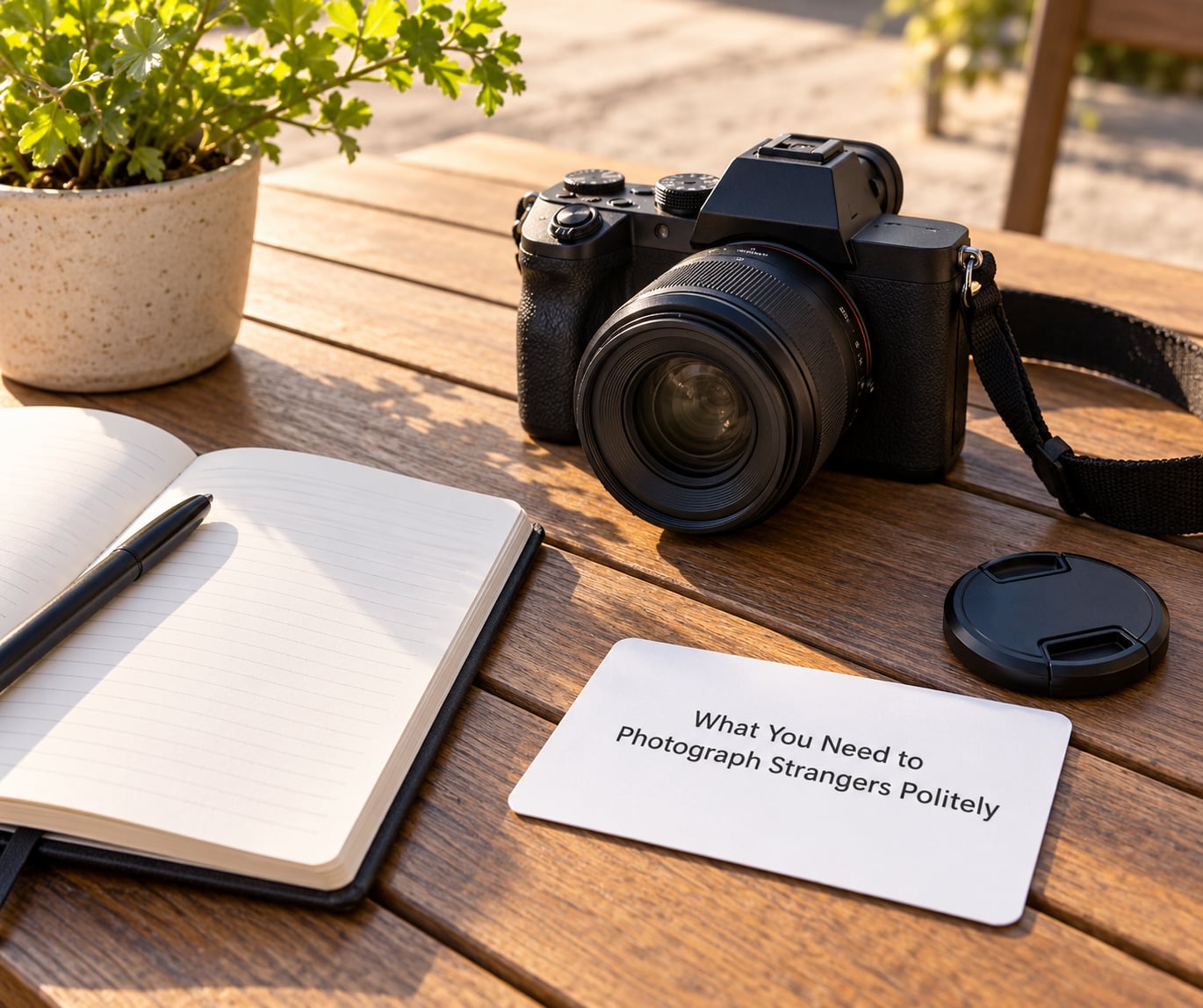
None of this is expensive. It is mostly things you already own plus one thing most street photographers never make.
A camera you can see people are holding
Any camera works, including a phone. What matters is that you are visibly holding it, ideally around your neck or in both hands at chest height, so nobody has to guess what you are doing.
A visible camera does more for how people react than any lens choice. Threads on r/streetphotography keep circling back to the same finding: open posture, eye contact and a smile account for most of whether a stranger is friendly or guarded.
A focal length that keeps you out of their space
A small zoom beats a fixed prime for this work, and the reason is comfort rather than quality. Somewhere around 35mm to 50mm on a full-frame body, you can stand a few paces back and still fill the frame. With a 24mm lens you are forced into their personal space to get a portrait, and the conversation gets awkward before it starts.
Keep the lens on a short or mid focal length when you approach, and extend it once they say yes. Wide angles up close distort noses, and nobody needs a stranger’s nose in their permanent memory of you.
Quiet settings for a fast, tidy portrait
Set the camera before you approach, not while you are talking. A single AF point or a small zone, face or eye detect if your camera has it, a shutter speed around 1/250s to freeze people walking past, and an aperture wide enough for a soft background. Auto ISO will handle the rest as the light changes.
Two or three frames is the target. Holding a conversation while fiddling with dials tells the subject the photograph is a bigger deal to you than they are, and that is a bad look.
A permission card with your contact details
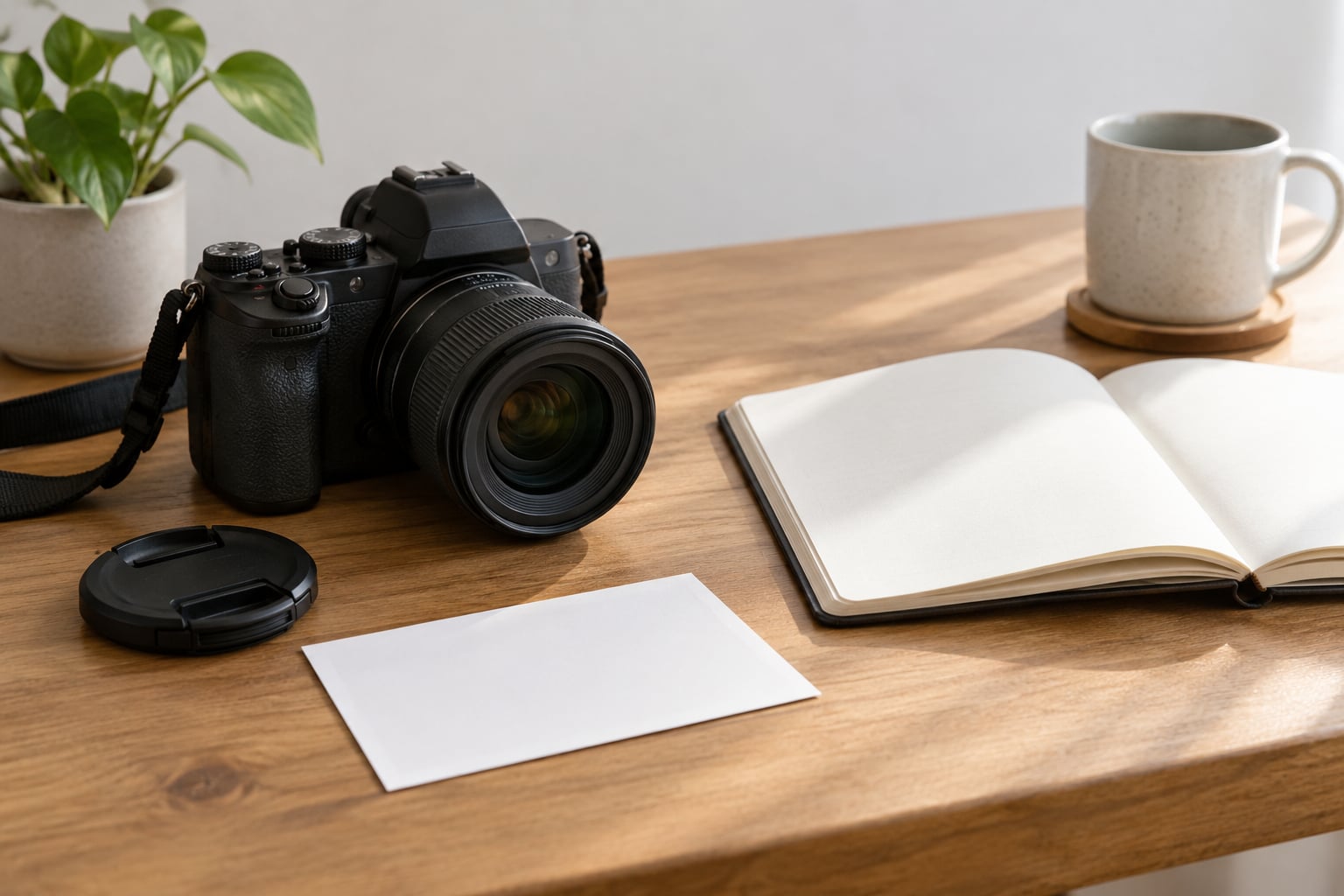
This is the item people skip, and it is the one that turns an awkward moment into a lasting relationship. Print a small card roughly business-card sized with your name, email or phone number, and a QR code that opens a contact page. The whole design can be black text on white card stock.
Some photographers go further and write the frame number on the card before handing it over, so the subject can email you and say delete frame 214 or send me frame 214. If you shoot to card, the frame number lives in the file name anyway. It costs you five seconds and it means a person who feels exposed can ask for the deletion without tracking you down.
A small notebook helps too. Write down the frame number and a note of where and when you met. It feels fussy for two months and then it is the difference between delivering on a promise and forgetting.
One sentence of preparation
Decide in advance what you are actually asking for. A permission to photograph is one thing; permission to publish the image on Instagram or in a print is a bigger thing, and people treat them as separate questions.
Think about which you need. If the answer is both, ask for the photograph first and mention the second part only once they are already smiling and looking at the picture.
Step-by-Step: A Calm, Repeatable Approach
Read the Setting Before You Raise Your Camera
Scan for light, background, foot traffic and mood before you pick a subject. A face lit by a shop window with a clean wall two paces behind is a portrait that takes fifteen seconds. A backlit face against a busy intersection is a portrait that takes two minutes and usually gets refused.
Also read the person. Someone deep in conversation, someone eating alone, someone who looks tired or upset, someone with headphones and a closed posture, or anyone handling something private in a doorway is a bad candidate, however good the light is.
Context matters too. Markets, festivals, shows and demonstrations have higher acceptance rates than an ordinary high street, because everyone there expects to be photographed and people are in a social mood. The same approach that lands well outside a concert will feel intrusive outside a hospital, a school gate, a place of worship or anywhere people queue for welfare services.
Use a Polite Permission Script
Almost every awkward street photography conversation comes down to a photographer improvising under pressure. So stop improvising. Here is the set of lines I use, written to be said out loud without sounding rehearsed.
The greeting and the compliment. “Hi, sorry to stop you. I love that jacket.” Compliments should be about something they chose — clothes, glasses, a hat, a bike, a dog — never about their body. “Beautiful red coat, can I take a quick photo?” arrives at the compliment and the ask in one breath.
The self-introduction and the ask. “Hi, I’m Dave. I take portraits of people I meet on my walks — could I take one photo of you?” One sentence, no apology, no speech. Say your name because it makes you a person rather than a device, and it gives them something to call you.
The retreat line. “No problem at all, enjoy your day.” This matters more than it looks. Most photographers say no to the question and then hover, which turns a polite refusal into an awkward standoff.
The follow-up after the shot. “Here, have a look — this is the one. Would you like me to send it to you?” Then hand over the card. Do not ask for their number; you have yours printed on the card, which removes the awkward part where someone has to give out personal details to a stranger.
Two other variants cover most situations. For a portrait where you want to steer slightly: “I’m doing a series of environmental portraits — could I take one with you standing under the arch?” And for people who clearly do not want to stop: a raised open hand, a smile, and “Photo?” is usually the entire interaction.
When you do not share a language, the gesture protocol still works. Raise the camera in your right hand with the lens pointing at the sky, wave it slightly, then bring it down and point at your subject with a questioning look. The lens-upward position is the key detail, because it reads as harmless everywhere I have used it. Add a smile and a small nod, and most people answer with a smile, a nod or a shrug that tells you everything you need.
Ask Before Photographing Identifiable People
Ask first whenever a face is recognisable and the person is the subject rather than part of the scene. That covers portraits, someone clearly isolated in a frame, and anyone who becomes the focal point of your composition.
Candid frames where people are incidental to the story are different, and this is where street photography genuinely splits into two camps. Run-and-gun shooters argue that permission ruins the genre. Most threads I have read frame the permission-based ask as the respectful default and accept the trade, which is a fair summary of where the argument actually sits.
There are people you should not photograph at all, permission or not. Children, unless a parent or guardian agrees first, and then only with the adult standing comfortably beside them. Anyone who appears vulnerable, intoxicated, distressed, unwell or asleep. Anyone in a private doorway, garden, window or vehicle. And anyone in a religious or ceremonial setting where photography would disrupt what is happening.
Groups and couples are usually easier than a solo stranger, and you ask everyone in the frame, not just the person nearest you. If one person says no, delete the frame. No exceptions, no “but they were fine with it.”
| Situation | Approach | Handling |
|---|---|---|
| Solo adult, open posture | Ask directly, compliment first | Two or three frames, show the best one |
| Couple or group | Ask every person in the frame | One refusal means delete the frame |
| Child | Ask a parent or guardian, never the child | Adult stays in shot or close enough to intervene |
| Elderly subject | Ask, and offer to send a copy | Move closer and slower, speak louder |
| Street performer or musician | Ask between pieces, not mid-song | Offer a print or a donation credit |
| Someone in religious dress or a place of worship | Do not photograph | Walk on |
| Festival or event queue | Ask freely, keep it brief | Hold the spot, step aside after |
| Someone who looks distressed or unwell | Do not photograph | Move on quietly |
Make the Photograph Feel Like a Collaboration
Once someone agrees, you are no longer taking something from them, you are making something with them. A couple of seconds of that shift changes the picture.
Give one short instruction rather than a direction list. “Stand there and look toward the light” or “turn your shoulders slightly” is enough. Offer two framings and let them pick. Keep the session under a minute; if they want to see more, that comes later.
Avoid intrusive framing. Shooting up from below, crouching to an angle that gets under someone’s guard, or filling the frame with a face at a distance they did not agree to are all things people notice and resent.
Show them the frame on the back of the camera straight away. It proves you have not hidden a bad shot, and most people are curious about the result rather than objecting to it. The reluctance I see in forums about showing the screen — that it adds pressure — has rarely matched my own experience.
And put their comfort ahead of the technically perfect image. If they want to leave, hand them the card and go. If they hate how they look, that is not a lighting problem you can argue your way out of.
Close the Interaction Professionally
The end of the interaction matters as much as the beginning. Thank them plainly, offer the card, and tell them in one sentence what they can do with it: “Email me any time for a copy, or to ask me to delete the frame.”
Then actually deliver. Send the picture within a day or two, while you still remember who it was. Most people who ask for a copy never chase you, which means a lot of promises quietly expire. A simple follow-up habit beats any equipment.
If someone asks you to delete a frame, delete it, empty the trash folder, and say that you did. Keep a simple deletion log — date, frame number, contact — so that if the same person sees the image somewhere later, you can confirm it is gone. It is a two-column note and it makes the promise verifiable.
Do not ask for their contact details on the spot. That reverses the power in an awkward way. Let them initiate contact through the card if they want the photo.
What people often ask for, in my experience, is a print rather than a file. Sending a photo is easy; mailing a 4×6 print to a stranger you met on a street is the thing that gets remembered, and it is the thing that produces referrals.
One last piece of administration: build a contact sheet at the end of a session, with frame numbers visible. That turns “I think I photographed you” into a specific request, and it lets you publish only the frames you have cleared.
Common Mistakes When You Photograph Strangers Politely
Photographing first and asking later. This is the mistake that produces the guilt threads and the confrontations. If you want permission, ask first. If you have already taken frames, be straight about it: “I took a couple while I was walking past — would you like to see them, or shall I delete them?”
Blocking someone’s path. Stand to one side so the street stays open for them. Approaching from the front at close range is what makes people tense up.
Chasing a subject after a refusal. One ask, one answer. If the answer is no, thank them and turn away. Following someone down a street after they decline is harassment with a camera.
Taking anyway, or arguing. Nobody has to justify a refusal, and a debate about artistic licence makes everything worse. Delete and move on.
Getting defensive. Stay calm and slightly cheerful. Most confrontations on r/photography came from a person feeling ambushed rather than from anyone doing anything seriously wrong. Lower your voice, do not follow them, and keep walking.
Over-promising on the follow-up. If you cannot send copies, do not hand out the card. People remember a broken promise longer than a missed shot.
Shooting children without asking an adult. No exceptions, ever. If a parent says no, the answer is no.
Is It Legal to Photograph Strangers in Public?
Generally, yes. In most countries you may photograph people in a public place without permission, and there is no general right to privacy that stops you there. In the United States there is no expectation of privacy in public view, and a photographer may publish an editorial image of an identifiable person without a model release.
That changes the moment you use the image to advertise something. In the US, commercial or promotional use of an identifiable person’s likeness generally needs a signed model release, and the penalties come from the person whose likeness was used, not from the photographer facing a general privacy claim. In the UK and across much of the EU, data protection rules bite harder: a recognisable portrait is personal data, and publishing it for editorial or commercial use without consent is harder to defend. Some EU member states have restrictions beyond the general rules.
Rules also differ for people doing purely private activity in a public place, for workers in their workplace, and for anything involving a private building or land. Rules vary by country and change over time, so treat this as general orientation and check your own local rules before publishing something commercially or anywhere near an argument.
Legality is the floor, not the goal. Plenty of things are legal and still rude, and plenty of people are perfectly happy to be photographed and annoyed that you did not ask.
Frequently Asked Questions
Do I need permission to photograph strangers in public?
Usually not for an editorial or personal photo taken in a public place, but asking is what keeps people comfortable. You do need consent for commercial or promotional use of a recognisable face in most countries, which is why many street photographers hand out a card and ask about publishing separately from the photograph itself.
How do I politely ask someone if I can take their photo?
Catch their eye, smile, give one genuine compliment about something they chose to wear or carry, then ask in a single sentence. For example: Hi, sorry to stop you. I love that jacket, would you mind if I took a quick photo of you? Say your name, do not apologise twice, and pause for the answer.
What should I do if a stranger refuses my request?
Say thank you or no problem, and walk away immediately. Do not push back, do not explain why the photo would be good, and do not take the shot anyway. Most people refuse simply because they are not interested, which is a complete answer. Offer your contact card only if it feels natural, then leave them to it.
Can I photograph children or vulnerable adults in public?
Ask a parent or guardian before photographing a child, and keep the adult within reach during the session. Skip anyone who looks distressed, unwell, intoxicated or overwhelmed rather than asking them, since a refusal may cost them more energy than the photo is worth. Treat a parent saying no as final and delete any frames you already took.
Is it okay to photograph people in a public place without asking?
It is generally lawful in public, and candid frames where people are part of the scene are normal street photography. It is courteous to ask whenever someone is the clear subject of the frame or the portrait is the point of the picture. The people most often unsettled by street photography are those who never agreed to be the subject.
How do I make a street photograph feel less intrusive?
Keep the interaction short and open. Stay to one side of the path, work with a moderate focal length instead of pushing in close, give one brief direction once someone agrees, and let them see the frame on the camera. If they dislike how they look, offer to send a copy or delete it the same day.
Conclusion
If you take one thing from this: notice the setting, walk up where they can see you, ask in one clear sentence, and accept the answer straight away. Everything else — the lens, the settings, the card you print — makes the picture better, not the encounter kinder.
The order matters more than the technique. Notice what a person needs, offer them a small say in the frame, and let their comfort outrank the shot. Photographing strangers politely is not about being timid; it is about being a guest in someone else’s public life, and treating the visit accordingly.