Short answer: fall color across the U.S. develops from late August through early November, with the earliest peaks in the high North and Alaska and the latest in the Deep South. Knowing when does fall foliage peak by region comes down to two rules that almost never break. Color arrives first at high elevations in the north, and it arrives last in the low, warm South.
Those dates are averages, though, and the year you travel can run a week early or a week late. I plan foliage trips the same way I plan any weather-dependent shoot: pick a window, then confirm it against live reports inside two weeks of leaving.
Last updated: October 2026
Table of Contents
- When Does Fall Foliage Peak by Region?
- U.S. Fall Foliage Timing at a Glance
- What Determines When Leaves Change Color?
- How Fall Color Progresses Through Each Region
- Northeast and Mid-Atlantic Fall Foliage Timing
- Midwest, South, and Southwest Fall Foliage Timing
- Western U.S. Fall Foliage Timing
- When Does Fall Foliage Peak by Region Right Now? Reading Live Reports and Maps
- If Your Dates Are Fixed, Choose the Region Instead
- Planning a Fall Foliage Photography Trip
- Frequently Asked Questions
- Which U.S. region has fall foliage first?
- Is fall foliage later in the mountains or at lower elevations?
- What does near peak mean for fall leaves?
- Does rain or a warm spell change fall color timing?
- How far ahead should I plan a fall foliage trip?
- Can I predict when fall foliage peaks by region without a forecast?
- Conclusion
When Does Fall Foliage Peak by Region?
Most U.S. fall color develops from late August through early November. The Mountain West and northern New England usually turn first, typically peaking in late September, and the color line then works south and downhill through October. The Deep South and Pacific Northwest lowlands hold on into early November, and some southern species do not finish until late November.
Three things move the date for any one place: how far north or south it sits, how high it is, and what the weather did in September. The species growing there matters just as much, since maples, aspens and oaks each answer cold and daylight differently.
The practical consequence is that “peak fall color” is a moving target, not a date. A reported peak means the majority of trees in an area are fully colored, and the best photographs often land just before or just after that report. If you are shooting rather than sightseeing, plan for the shoulders around the peak, not the peak date itself.
U.S. Fall Foliage Timing at a Glance
These are broad planning windows, not a forecast for 2026. Annual variation of several days in either direction is normal, and any single row can be a week off in a given year.
| Region | Color starts | Typical peak window | Last reliable viewing | Dominant trees | Main timing variables |
|---|---|---|---|---|---|
| Northeast (New England, northern New York) | Late September | October 1-15 | October 20-31 | Sugar maple, red and silver birch, American beech | Elevation, coastal marine layer, hard frost date |
| Mid-Atlantic (Pennsylvania, Mid-Atlantic states, lower New York) | Early October | October 10-20 | October 25-November 10 | Maple, oak, tulip poplar, birch | Appalachian elevation, autumn rainfall |
| Southeast (Blue Ridge, Great Smoky Mountains) | Early October | October 10-20 high country, October 20-31 valleys | November 1-15 | Sourwood, tulip poplar, maple, oak | Elevation band, hard frost in the mountains |
| Midwest and Great Lakes | Late September in the north | October 1-15 north, October 10-20 south | October 25 | Maple, quaking aspen, birch, cottonwood | First frost, lake climates, local microclimates |
| South (Gulf Coast, lower Mississippi Valley) | Late October | November 1-20 inland, later along the Gulf | Late November to December | Oak, sweetgum, tulip poplar, tupelo | Late and species-driven turn, hard frost is rare |
| Southwest (Arizona, New Mexico high country) | October | Late October to mid November | Early December | Cottonwood, sycamore, aspen stands | Monsoon timing, elevation, first hard freeze |
| Pacific Northwest | Early to mid October | October 10-25 | Early November | Big-leaf maple, vine maple, red alder | Early autumn rains, marine layer, wind events |
| Northern Rockies (Montana, Idaho, northern Wyoming) | Early September above 6,000 feet | Late September to October 10 | Mid October | Quaking aspen, cottonwood, willow | Elevation, hard frost, early snow |
| Southern Rockies (Colorado, Utah, southern Wyoming) | Mid September high country | Late September to October 15, later in the valleys | Late October | Aspen groves, oak, cottonwood | Elevation, dry fall weather, cold fronts |
| Alaska | Late August in the Interior | Late September | Mid October | White birch, quaking aspen, balsam poplar | Latitude, rate of daylight loss, hard frost |
| Hawaii | October on the Big Island summits | November | December | Introduced ornamentals, tropical shrubs | Elevation on the Big Island, species choice |
Two patterns in that table are worth internalizing. Western regions finish their season before the East does, because elevation matters more than latitude there. And the South does not really have a fall foliage season so much as a long, uneven taper that starts in late October and can run six weeks.
What Determines When Leaves Change Color?
Leaves turn because of light, temperature and the tree’s own chemistry, not because of a date. Three things have to happen: days must get short enough, nights must get cool enough, and the tree has to stop making chlorophyll. Until then, green pigment covers everything else.
Daylight and chlorophyll. As daylight hours shrink below a species-specific threshold, the tree stops producing chlorophyll and the green fades out of the leaf. The yellow and orange you see at that moment is not new pigment. Carotenoids were sitting in the leaf the whole summer, hidden under the green.
Red and purple are made on demand. Anthocyanins, which produce the crimson and magenta in maples, oaks and dogwoods, are actually manufactured in fall. Cool bright days followed by warm but not freezing nights tend to trigger the strongest reds. Leaves often develop more pigment when autumn days are sunny and the nights do not freeze, which is why a season with early hard frosts often produces duller reds.
Elevation and latitude. Both work by temperature. Going up 1,000 feet is roughly equivalent to driving 400 miles north, and aspen groves at 9,000 feet routinely turn two to three weeks before the cottonwoods in the valley below them. This is the single most useful fact for planning: if you are uncertain about the timing, change your elevation and you have bought yourself another week or two.
Rain and drought. A wet September delays color in some species, because cool wet soil and low light stress the tree before it switches off chlorophyll. A dry September can pull color forward, and drought-stressed trees often turn and drop within a few days of each other, giving you a short, brilliant week rather than a long one.
Storms, wind and warm spells. Wind events can strip a canopy days ahead of schedule. A single warm week in late September can hold color back by delaying the chill the tree is waiting for, then a hard cold front can push an entire region into peak almost overnight. That is why the season feels late and then suddenly arrives.
Color, peak and leaf fall are three different dates. Color onset is when a tree starts. Peak is when the majority of trees in an area are fully colored and the display is continuous rather than patchy. Leaf fall is when that canopy drops, usually one to three weeks after peak depending on species. Red oaks and beech often hold their leaves well past peak, which keeps late October scenes from looking bare even after the map says the peak has passed.
How Fall Color Progresses Through Each Region
Northeast and Mid-Atlantic Fall Foliage Timing
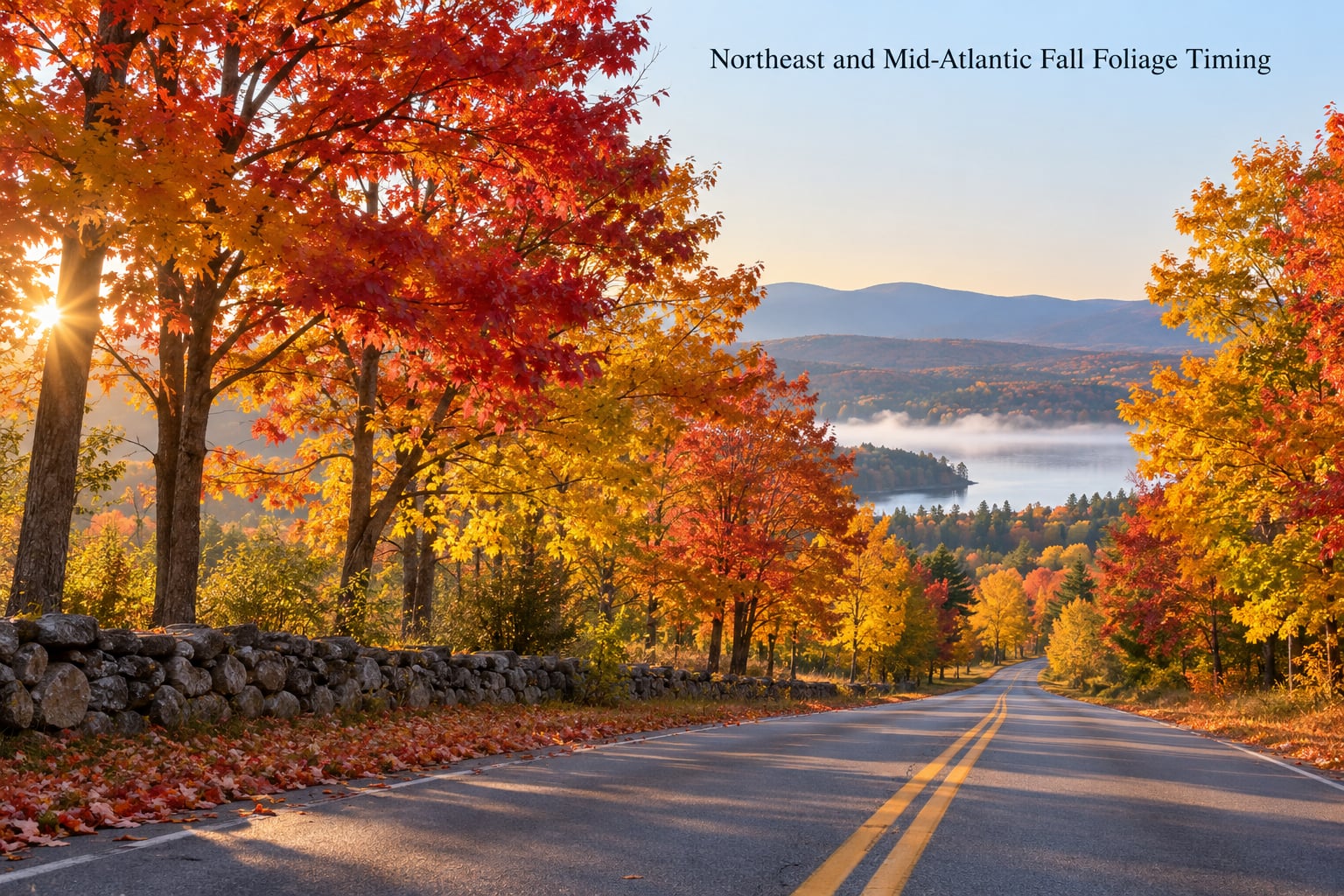
New England typically peaks from October 1 to October 15, starting with the high ground and working down and east. Northern New Hampshire, Maine and the Adirondacks turn in the last days of September, while southern New England and the Mid-Atlantic hold until mid to late October. Pennsylvania’s own state report splits the difference cleanly, with central counties peaking around October 10-20 and the southeastern part of the state running to October 20-31.
The species explain a lot of the texture here. Sugar maples give the saturated red, birches give a fast yellow, and oaks carry color well past the peak date, so the hillsides do not empty all at once. Quaking aspens turn nearly in unison across a stand, which is dramatic and short. For a photographer that contrast matters: the aspens are gone in days while the oaks are still holding.
Coastal locations run late. A marine layer off the Atlantic keeps nights cool but often keeps them from getting cold, and the delay in southeastern New England and coastal Maine can run a week behind the interior. Mountains cool sooner, so ridges and ski-country backroads often hit good color a few days before the towns below them. A long-running commenter on an almanac foliage page put their own ten-year record as the first and second week of October, with a bet around Canadian Thanksgiving, which matches most regional averages.
Regulars on r/newengland and r/upstate_new_york are practical about this. The advice that keeps repeating is to pick a spot with elevation, and to check whether the higher ground is past peak before booking a long drive.
Midwest, South, and Southwest Fall Foliage Timing
The Midwest usually runs earlier in the north and later in the south. Northern Minnesota, Wisconsin and the Upper Peninsula of Michigan start in late September and peak in the first half of October, while Ohio, Indiana and Missouri push into the second half. Around the Great Lakes the season can be staggered by a week between lakeside and inland counties, and the Upper Peninsula is famously split, with the western counties ahead of the rest. On r/upperpeninsula the local correction is consistent: Iron, Gogebic and Ontonagon counties lead, and anyone still using a statewide average to plan a shoot there will arrive early or late by several days.
The South runs later and quieter. Across the Deep South and Gulf states, color is often more yellow and tan than red, and a large share of it comes from a few high-impact species rather than a whole forest turning at once. The season typically begins in late October in the north of the region, peaks in November, and can run into December near the Gulf, where some oaks and tupelos hold on well past the map’s peak date. A red oak holding green leaves under a sky of yellow hickory still photographs beautifully, which is exactly why a leaf-peeping calendar built for New England misreads the South.
Higher ground in the Southern Appalachians behaves more like the North. Along the Blue Ridge Parkway and in the Great Smoky Mountains, ridges between roughly 4,000 and 5,000 feet typically peak in the first third of October, a couple of weeks ahead of the valleys below them, and sourwood adds a wine-red note that no other tree in the region matches. Asheville locals, who live inside that window every year, tend to treat mid October as normal and anything a week earlier as early.
The Southwest rarely has a broad fall color season, but it can have a spectacular short one. Cottonwoods and sycamores along river corridors in New Mexico and Arizona turn after the first real cold snap, usually late October into November, and the change from green to gold can happen within about a week. Remember that a single early freeze can strip the cottonwoods and end the show, so the timing here is a forecast question rather than a calendar question.
Western U.S. Fall Foliage Timing
In the West, elevation replaces latitude as the dominant variable, and it does so decisively. In the Southern Rockies, aspen groves at 8,000 to 11,000 feet are typically in full gold through the last week of September, while cottonwoods and oaks in the valleys below 6,000 feet do not reach peak until mid October. That is a five-week spread inside one state.
The Northern Rockies behave the same way and start earlier. Montana and Idaho aspen stands above 6,000 feet commonly peak in the last week of September, and valley cottonwoods follow in the first two weeks of October. The same pattern shows up in the Sierra Nevada, where valley oaks and black oak in the foothills turn in late October while the high country above the treeline has been bare for a month.
The Pacific Northwest falls in between. Lowlands and river valleys, including the Columbia River Gorge, typically peak from mid to late October, and western Oregon valleys often run about a week behind the coast. Big-leaf maple and vine maple carry the color, and red alder lines wet gravel bars with a softer, earlier turn. California is the widest spread of any single state, with color appearing from September in the high Sierra down through December in the low desert valleys, because the state spans more than 11,000 feet of elevation in a short horizontal distance.
One practical note for the West. Most of these forests are evergreen, so a large fraction of the trees in frame will not change at all. A valley that reads as uniformly green on a map is often full of excellent pockets of color, and knowing which drainage or which grove you are driving to matters more here than anywhere else in the country.
| Elevation band | Typical peak, Mountain West | What turns | What this means for a shoot |
|---|---|---|---|
| 3,000 to 6,000 feet | Mid to late October | Cottonwood, sycamore, valley oak, black oak | Last chance for the season; warm, low light, saturated colors after rain |
| 6,000 to 9,000 feet | Late September to October 10 | Dense quaking aspen stands, willow | Best golden-hour backlight of the year; groves turn and drop fast |
| 9,000 to 12,000 feet | Mid to late September | High-elevation aspen, Engelmann spruce edges | Earliest color; freezing nights and possible snow in the same frame |
When Does Fall Foliage Peak by Region Right Now? Reading Live Reports and Maps
No table can tell you what is happening this week, because a single cold front can move an entire region three weeks early. Live reports are the answer, and they work best when you read the stage scale rather than just the date.
| Stage | What it looks like | What to do |
|---|---|---|
| No color to low | Faint tints in the canopy, mostly green | Book. This is your shooting window in two to three weeks |
| Moderate | Pockets of red and yellow, patchy coverage | Start scouting. Mixed color often photographs better than uniform color |
| High | Most trees colored, some green left | Go now if you can travel flexibly. Add 7 to 10 days for a full canopy |
| Peak | Continuous color, few green leaves left | Shoot. Expect crowds at the famous pull-offs |
| Past peak | Leaves dropping, color on the ground, bare crowns opening | Often the better frame. Backlight and ground color, far fewer people |
Where to look, roughly in order of usefulness. State DNR and forest service foliage reports give county-level detail and are usually updated weekly. National park and national forest ranger updates are more specific about trail and road conditions, which matters if you are carrying a tripod. Volunteer-run trackers fill in the gaps at county level and are often fresher than anything official. Recent photographs on social posts from the exact road or trailhead you plan to use will tell you more than a regional average ever will.
Read the reports with care. Seasonal averages are forecasts. A dated observation from a ranger or volunteer is a fact about one place on one day, and it is worth much more. That is the standard advice that comes out of r/oregon, r/SaltLakeCity and the Colorado boards on tripadvisor.co.uk: cross-check at least two trackers, and prefer the most recent report over the most confident-sounding one.
Then check the weather. A hard cold front, an extended warm spell, a soaking rain, or a strong wind event will each reset the timeline within a day or two. Re-read the reports after any of those. If the last report you read is more than 48 hours old, treat it as stale.
If Your Dates Are Fixed, Choose the Region Instead
Fixed dates change the whole strategy. Instead of trying to find color that will match your calendar, pick the region whose window lines up with it. This is the single most common piece of advice in travel forums, and it is the one most guides leave out.
| If your trip is | Head to | Why |
|---|---|---|
| Late September | Northern Rockies, Alaska, high-elevation Southern Rockies | These are the only places reliably in peak before October |
| First week of October | Northern New England, northern Midwest, high Rockies | Peak is arriving and high ground leads |
| Second week of October | New England, Mid-Atlantic, Great Lakes, Rockies | The widest overlap of the entire season, and the safest bet |
| Third and fourth week of October | Southern Appalachians, Mid-Atlantic, low-elevation West, Pacific Northwest | New England is dropping leaves; the mountains to the south are peaking |
| Early November | Pacific Northwest lowlands, Southwest river corridors, Deep South | The season’s tail end, with fewer crowds and dramatic skies |
The same logic applies within a region. If you only have early October and you want aspen, go high. If you only have late October, go low or go south. Elevation is a substitute for time, and latitude is a substitute for elevation.
Planning a Fall Foliage Photography Trip
Timing a foliage shoot is mostly about choosing a color stage and then giving yourself room. Here is the sequence that works for me.
- Pick a target stage, not a date. Decide whether you want a full canopy, a mix of red and still-green leaves, or a bare canopy with color on the ground. Each stage has a different window, and the mixed stage is often the most forgiving because it lasts longer than either extreme.
- Set the window from the table, then widen it. Take the typical peak window for your region and widen it by a week on each side. That buffer is what absorbs an early or late season.
- Choose two elevations, not one. A valley and a ridge ten miles apart will hand you two different weeks. If you can only afford one, pick the higher one for earlier color or the lower one if you are traveling after the peak.
- Confirm inside two weeks. Read the state and park reports, look at recent photographs from your exact location, and check the ten-day forecast for a cold front or a warm stretch. This is the step people skip, and it is the one that decides whether the trip works.
- Work the shoulders. Arrive a few days before the reported peak for mixed color and thin crowds, and a few days after for leaf fall, backlight and clean compositions. Midday fog in a river valley is more common before and after a rain than during the peak week.
- Plan the light per region. Low sun on shorter days in October gives you more usable golden light than summer does. Fog in river valleys and passes, backlight through thin leaves in the South, and saturated color after rain are all more available in the days around peak than on the peak day itself, when everyone is at the same overlook.
Two smaller things that make a real difference. Weekday early mornings are the only reliable way to get an unobstructed pull-off and room for a tripod, and they are most likely between about an hour after sunrise and mid morning when the valley fog is still burning off. And because a canopy that has already dropped gives you clean sightlines through the trees, the days right after peak often produce frames that are simply not available during the peak itself.
Frequently Asked Questions
Which U.S. region has fall foliage first?
The far North and high elevation lead the country. Alaska’s Interior and the high Rocky Mountains above 8,000 feet typically peak in the last week of September, and northern New Hampshire, Maine and the Adirondacks follow within days. These places turn early because cold nights arrive at high latitude and high altitude, and the season ends just as quickly, so a late trip finds bare branches.
Is fall foliage later in the mountains or at lower elevations?
It is earlier in the mountains. Temperature falls with elevation, and roughly every extra 1,000 feet behaves like moving about 400 miles north. In Colorado, aspen groves at 8,000 to 11,000 feet peak in late September while cottonwoods in the valleys below 6,000 feet do not reach peak until mid October. The same spread of four to five weeks appears across the Northern Rockies and the Sierra Nevada.
What does near peak mean for fall leaves?
Near peak means most trees in the area are fully colored but a few species are still turning, or some color is beginning to drop. Visually it looks more saturated than the peak day itself because you still have strong reds next to bright yellows and a few untouched green leaves. Many photographers prefer it to peak, since the color is complete but the canopy still feels full.
Does rain or a warm spell change fall color timing?
Both do, and neither is predictable from a calendar. A wet, cool September can delay the chlorophyll breakdown in some species, while a dry September can pull it forward. Warm nights in late September hold color back until a cold front arrives, and a hard frost can push a whole region into peak within a day. Wind events strip leaves early and can end the best viewing window well before the map updates.
How far ahead should I plan a fall foliage trip?
Set the destination two to three months out, because popular regions fill up during peak week. Hold the specific dates until about two weeks before you travel, then confirm against state DNR reports, park ranger updates and recent photographs. If your dates cannot move, choose a region whose window already matches them instead of waiting for a specific place to turn on your schedule.
Can I predict when fall foliage peaks by region without a forecast?
Not reliably, and any site claiming an exact date for an entire region is overselling it. You can estimate a window from latitude and elevation, but the only accurate picture comes from recent observations. State and federal foliage reports, ranger updates, volunteer trackers and fresh photographs from the road you plan to drive give you a real answer, usually within a day or two of the event.
Conclusion
Fall color in the U.S. is one long season that starts high in the North around late September, sweeps south and downhill through October, and tails off in the Deep South and the low country of the Pacific Northwest in early to mid November. Every table that claims a single date for a whole state is averaging away the part that matters to you.
So start by naming four things: your region, your elevation, the species you actually want to photograph, and how much flexibility your dates have. Use the table above to set a window, widen it by a week on each side, and then check state foliage reports and recent photographs about two weeks out. Local conditions and a report from the last 48 hours will tell you far more than any fixed annual date.