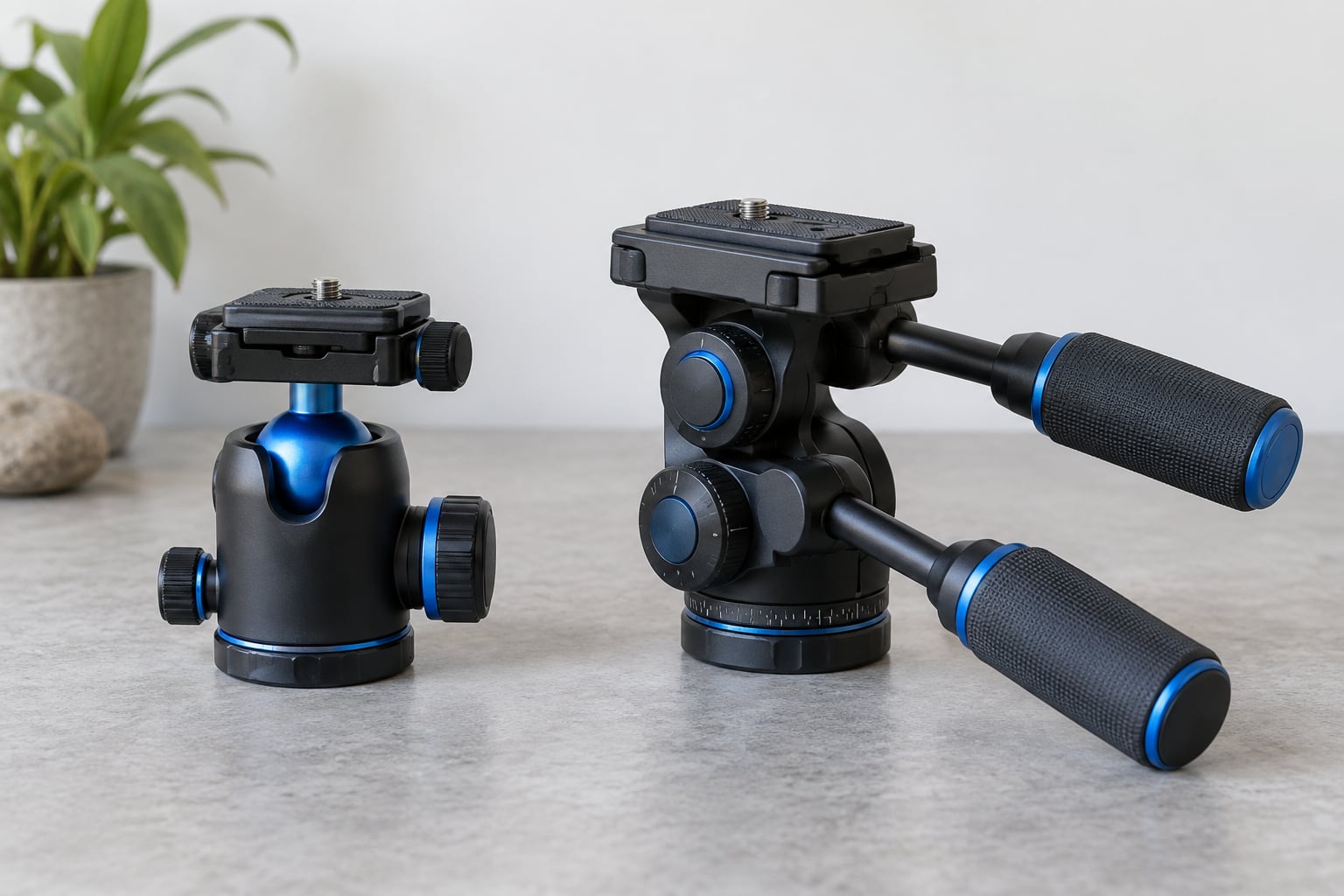
A ball head and a pan-tilt head are the two most common tripod heads, and they solve the same problem in very different ways. A ball head uses one ball-and-socket joint with a single main lock, so you can swing your camera to almost any angle in a couple of seconds. A pan-tilt head, often called a 3-way head, splits that movement into three separately locked axes worked by long handles, which gives you finer and repeatable adjustments at the cost of bulk and setup time.
Neither one is better across the board. If you reframe quickly and carry your kit a long way, the ball head is the easier tool. If you need controlled, repeatable movement for video pans, stitched panoramas, macro work or vertical architectural shots, a pan-tilt head earns its extra size.
Table of Contents
- What Is a Ball Head vs Pan Tilt Head? at a Glance
- What Is a Ball Head?
- What single, double, and triple action mean
- Where a ball head wins
- Where a ball head struggles
- What Is a Pan-Tilt Head?
- Two-way and three-way versions
- How a fluid head is different
- How the Two Heads Move in Practice
- Portrait versus landscape orientation
- Overhead and ground-level framing
- Rapid reframing
- Following a moving subject
- Can you pan with a ball head?
- What Is a Ball Head vs Pan-Tilt Head in Daily Use?
- Landscape photography
- Wildlife and bird photography
- Portrait photography
- Travel and street photography
- Architecture and interiors
- Macro and close-up work
- Astrophotography and long exposures
- Video and vlogging
- Stability, Locking, and Safety Differences
- Creep and vibration
- Load ratings and headroom
- Plates, threads, and swapping heads
- Lenses and balance
- Weight, Cost, and Durability
- Which Should You Choose?
- Frequently Asked Questions
- Is a pan-tilt head better for long exposures?
- Can I use a ball head for smooth panning?
- Is a pan-tilt head the same as a fluid video head?
- Are ball heads suitable for wildlife and bird photography?
- Do I need a ball head if I own a travel tripod?
- Conclusion
What Is a Ball Head vs Pan Tilt Head? at a Glance
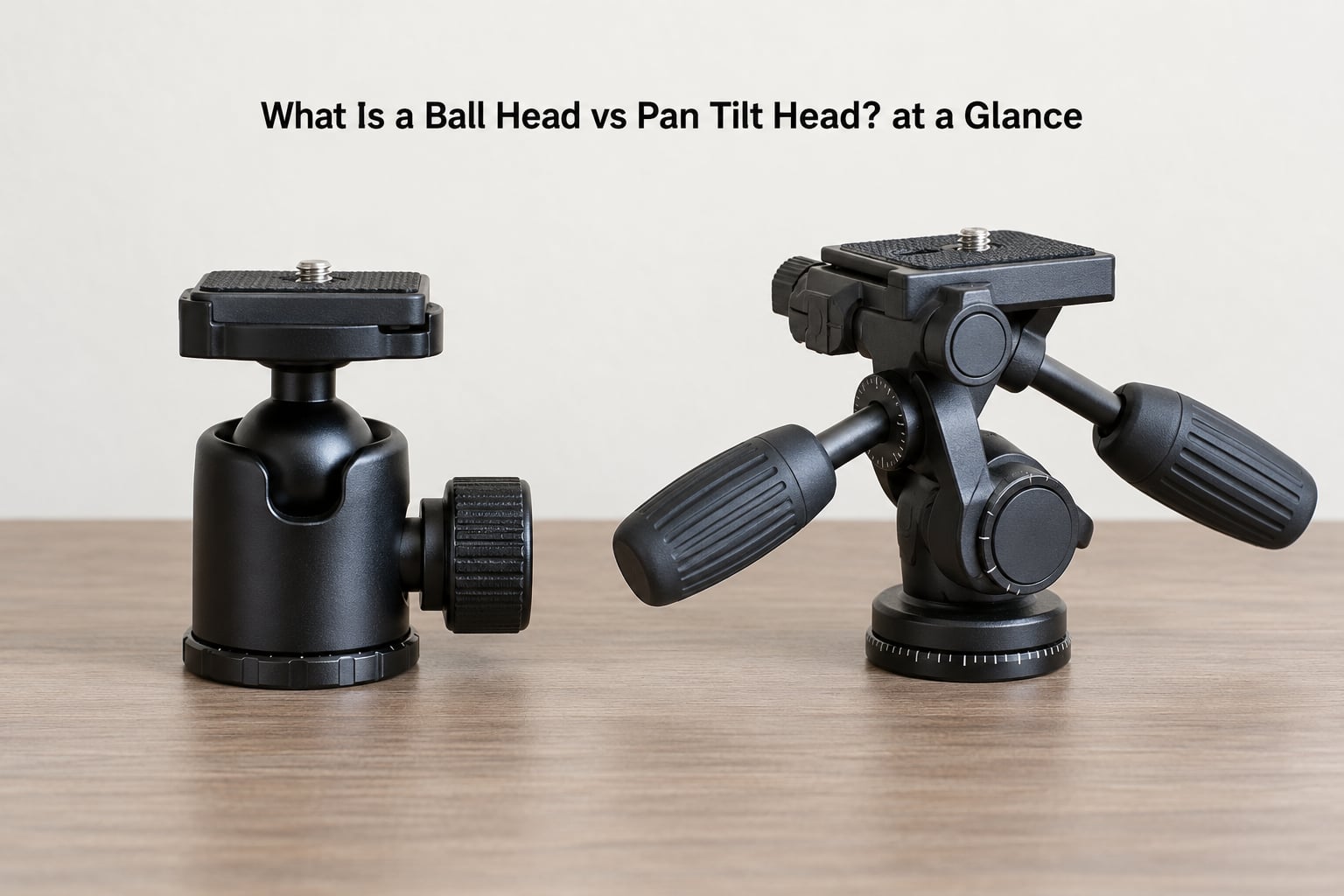
| Criterion | Ball head | Pan-tilt head (3-way) |
|---|---|---|
| Mechanism | One ball-and-socket joint | Three separately locked axes: pan, tilt, swivel |
| Lock controls | One main knob, often plus a pan friction knob | A handle or knob per axis |
| Direction of movement | Any angle, including straight down | Tilt up and down, swivel side to side, pan around |
| Reframe speed | Very fast, one-handed | Slower, axis by axis |
| Fine adjustment | Hard once the setup is heavy or long | Excellent, repeatable moves |
| Level on uneven ground | Depends on the pan base; a separate base helps | Built in, especially on dual-axis models |
| Size and weight | Small and light | Larger, handles add leverage |
| Stiffness for its weight | High | Lower, especially with long handles |
| Video panning | Possible but not smooth | Good, better still on a fluid head |
| Best for | Landscape, travel, street, wildlife, general stills | Video, vlogging, macro, panoramas, architecture, interiors |
The table is the short version. The rows that actually decide it for most people are reframe speed and fine adjustment, and everything else follows from those two.
What Is a Ball Head?
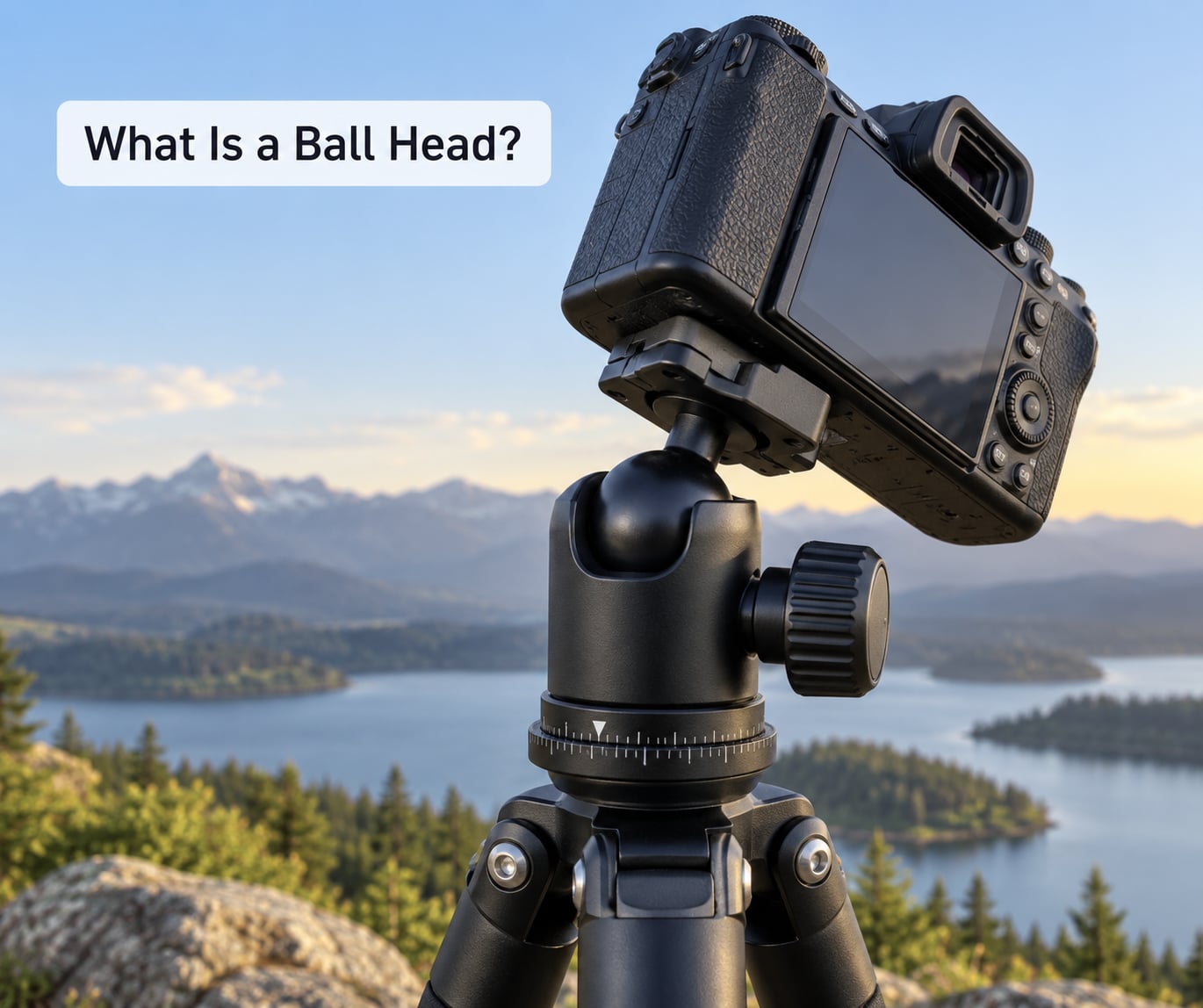
A ball head is a tripod head built around a single ball sitting inside a socket. The ball is the part your quick release plate screws into, and the socket is the cup it sits in. Loosen the main knob and the ball turns freely, so the camera can be swung from landscape to portrait, or dropped to horizontal for an overhead shot, without any separate control getting in the way.
Tighten the knob and the socket clamps down on the ball. That clamp is what holds the camera still, and it is the only thing standing between a heavy lens and a slow downward creep when the locks are loose. Most heads add a second, smaller control for the pan base, which lets you set how freely the head swivels left and right before you even touch the main knob.
What single, double, and triple action mean
The number refers to how many separate movements one knob controls. A single-action ball head has one main knob that locks everything at once. A double-action head splits it into a pan lock and a tilt lock, which is the most common arrangement on mid-range and professional heads. A triple-action head adds a third control, usually a friction or drag setting on the pan axis.
Many manufacturers use these words loosely, which is exactly why the term confuses people. Check the manual rather than the product name, and look at what the knobs physically touch.
Where a ball head wins
The main advantage is speed. One knob, one movement, and you are reframed. That matters when a bird moves, when the light changes, or when you are working alone on a street corner and want the shot before the moment passes.
Ball heads are also compact and light, which is not a small thing if you are carrying gear for hours. Photographers on photography forums make the point constantly: a lighter, smaller head is the difference between a comfortable walk and a slog, and on a long day out the head you carry is the one you will notice.
Where a ball head struggles
Fine adjustment is the weak point. With a long telephoto lens or a heavy body, a small twist of the knob moves the framing point noticeably, and there is no second axis to bring it back the other way. That is why macro shooters and precision work tend to drift away from plain ball heads.
Levelling is the other weak point. The head is only as level as its base, so on uneven ground you either need a levelling base underneath or a head with a rotating base that can be dialled in.
What Is a Pan-Tilt Head?
A pan-tilt head works on three independent axes. Panning is the horizontal rotation at the base, controlled by a long handle. Tilting is the up-and-down movement in the middle, controlled by a second handle. Swivelling is the side-to-side rotation at the top, usually worked by a third handle or knob.
Each axis locks separately, so once you have framed your shot on one axis the other two stay exactly where you left them. That is the reason a pan-tilt head gives you repeatable framing, and it is the reason it is slower: you unlock, adjust and lock each axis in turn rather than making one sweeping movement.
Two-way and three-way versions
A two-way head gives you pan and tilt only. A three-way head adds the swivel axis on top, which is what lets you shoot verticals without rebalancing the camera on its side. For architecture and real estate work, the three-way version is usually the one you want, because the top swivel is what keeps verticals vertical while the legs sit wherever the floor allows.
How a fluid head is different
A fluid head is a pan-tilt head with an adjustable drag system built into the pan axis. Instead of a handle that turns the camera at whatever speed your wrist happens to move, the fluid element meters the motion so the camera pans smoothly from one side to the other.
So a pan-tilt head and a fluid head are not the same thing, even though the mechanisms look similar. A plain pan-tilt handle is for stills and for deliberate repositioning. A fluid drag is for moving video. A two-way fluid head is closer to a pan-tilt head in spirit than to a full three-way fluid head, which usually has only a pan handle and lets the tilt axis float freely for smooth tilting.
How the Two Heads Move in Practice
Portrait versus landscape orientation
On a ball head you unlock, turn the camera ninety degrees and lock again. On a pan-tilt head you loosen the side handle, swing the top axis through ninety degrees and tighten it. Both handle verticals, but the ball head does it with one movement while the pan-tilt head does it with one deliberate, repeatable axis.
Overhead and ground-level framing
A ball head can point the camera straight down or straight up with nothing in the way, which makes low-angle and top-down shots easy. Many pan-tilt heads can be inverted, but not all of them, and on some the tilt range simply stops short. If you shoot flat-lay food, overhead product work or unusual angles, check the tilt range before you commit.
Rapid reframing
This is the ball head’s home ground. Release, move, lock. When the composition is changing every few seconds, fewer controls means more frames caught.
Following a moving subject
Tracking a bird with a ball head means a continuous small correction on the main knob, which at long focal lengths feels like steering. With a pan-tilt head you can lock the tilt axis and work the pan handle alone, which is a much more stable way to hold a subject in the frame. The trade is that the whole head swings with the pan, so your tripod legs and centre of gravity move too.
Can you pan with a ball head?
Yes, but it depends on the head. Most ball heads have a rotating base, so with the pan friction knob backed off the whole head swivels smoothly left and right, and with a separate pan lock you can clamp it in place. What you do not get is metered drag, so a long lens on a ball head tends to judder rather than glide.
Small manual pan handles and geared bases exist to fix that, but if smooth panning is a regular part of your work, that is the argument for a pan-tilt or fluid head rather than an add-on.
What Is a Ball Head vs Pan-Tilt Head in Daily Use?
Landscape photography
A ball head is the usual choice. You are recomposing constantly, the light is changing, and speed matters more than sub-degree precision. If you shoot multi-row stitched panoramas, a levelling base or a head with a good pan base makes the difference more than the head type does.
Wildlife and bird photography
Both work, and the deciding factor is your lens. With shorter lenses, a ball head’s speed helps you respond. With long telephotos, the independent tilt axis of a pan-tilt head gives you more control and less stress on the joints.
Portrait photography
A ball head handles the quick angle changes between landscape, portrait and detail shots. A pan-tilt head is popular for posed work where the same angle repeats across a series and consistency matters more than speed.
Travel and street photography
Weight and size push hard toward the ball head. If you are carrying a kit for a full day on foot, a compact head with a single knob is one less thing to wrestle with at the kerb.
Architecture and interiors
Here a three-way pan-tilt head earns its place. The top swivel keeps verticals parallel when the legs are not level with the building, and separate locks mean you can adjust one axis without disturbing the framing you already set. Real estate work, where verticals and convergence correction matter, is a natural fit.
Macro and close-up work
Small movements are the whole job, and a pan-tilt head makes them without disturbing the other axis. That is why macro shooters tend to drift toward 3-way heads or geared alternatives.
Astrophotography and long exposures
Both hold a camera steady for long exposures if the locks are properly engaged. For wide-field work a ball head with good friction is fine. Once you add a tracking mount or a heavy lens, a stiffer setup with tighter backlash control matters more than the head type.
Video and vlogging
This is the clearest split in the whole comparison. A ball head is designed for stills; it does not give you metered, repeatable motion. For video you want a pan handle and, ideally, fluid drag. Forum consensus on this point is about as consistent as it gets: people who switch from stills to video and stay on a ball head tend to regret it quickly.
Stability, Locking, and Safety Differences
Creep and vibration
Creep is a ball head failing to hold position over a long exposure, and it is almost always a fault or a misuse rather than a design flaw. Too little clamp force and the camera slowly rotates inside the socket. Leaving a small amount of friction on the pan axis while the main knob is fully tight is a common cause.
Vibration behaves differently. Ball heads tend to be stiff for their weight because the load runs straight through the ball and socket. Pan-tilt heads carry the camera on longer arms, and the handles add leverage that can turn a slight wobble under a long lens into a visible shake.
Load ratings and headroom
Every head has a rated payload for the combined weight of camera and lens. With a pan-tilt head you want more headroom than the arithmetic suggests, because the handles put a lever arm between your movement and the camera. Staying well inside the rating also protects the locks, which are the part most likely to wear first.
Whichever head you use, follow the manufacturer limits. Exceeding them does not just risk damage; it makes the locks feel vague and the whole head harder to trust.
Plates, threads, and swapping heads
Most modern heads use an Arca-Swiss style dovetail quick release plate, which is close to universal between brands. The trickier mismatch is the thread that attaches the head to the legs: 1/4-20 and 3/8 inch are both common, and the thread size is not always printed anywhere obvious.
To swap a head, release the head from the legs with the manufacturer or clamp tool, compare the thread sizes and the ball diameter of the new head against the leg manufacturer’s list, then refit and torque it properly. Check the payload rating of the legs as well, since the legs are usually the weaker part of the system.
Lenses and balance
A long lens mounted off-centre puts leverage on whichever axis you are adjusting. A pan-tilt head with a sliding plate makes it easier to bring the lens over the leg; a ball head keeps the camera closer to the socket centre, which is one reason it stays stiff.
Weight, Cost, and Durability
Ball heads are the lighter option, and the gap is wider than the difference in grams suggests. Handles add length as well as mass, and length matters for packing. Photographers who carry gear over long distances consistently put weight and size at the top of their list, which is why so many travel kits ship with a compact ball head.
Pan-tilt heads cost more and weigh more because there is more to build: three axes, three locks, and often two handles plus a base. The upside is that the parts are mechanically simple and individual parts, from clamps to handles, are widely replaceable. A ball head has fewer failure points, but the ball and socket pair is a single critical component.
On price tiers, both head types exist from basic entry models to machined professional units, and the meaningful dividing line is the same in each case: how tight the locks are, how smooth the controls are, and whether the rating covers your heaviest lens with room to spare. Ball heads tend to be cheaper at the top of the range; pan-tilt heads cost more once fluid damping and levelling are added.
Maintenance is mostly cleaning and occasional re-tensioning. Budget ball heads are the ones that develop a sticky pan base or a slipping main knob over time, which is a fitting problem rather than a design failure.
Which Should You Choose?
Choose a ball head if you shoot stills, reframe often, work handheld-style on the tripod, and carry your kit far. Landscape, street, travel, general wildlife and everyday documentary work all suit it.
Choose a pan-tilt head if you need separate, repeatable control. Video and vlogging come first, followed by macro, architecture, real estate, multi-row panoramas and any stills work where the same framing must repeat across a series.
Choose a hybrid head if you shoot both and refuse to carry two. Converting heads switch between ball and pan-tilt behaviour on the same body, and forum users describe them as the speed of a ball head with something closer to geared accuracy. You pay for the versatility and a little weight.
A useful test: think about the last time a shot failed because the camera moved when you did not want it to. If that failure came from a sloppy fine adjustment, you need a pan-tilt head. If it came from being too slow to reframe, you need a ball head.
Frequently Asked Questions
Is a pan-tilt head better for long exposures?
No, not inherently. Both types hold a camera steady for long exposures once the locks are properly tightened, and a ball head is often stiffer for its weight because the load runs straight through the socket. A pan-tilt head helps more with levelling on uneven ground and with setting a repeatable angle, which matters for composites and for deliberate repositioning during a long sequence.
Can I use a ball head for smooth panning?
You can pan with a ball head, but it is not metered. Back off the pan friction knob and the rotating base swivels, and a separate pan lock can hold it in place. What you will not get is the even, controlled glide a fluid drag system provides, so short pans are fine while long sweeping moves tend to judder, especially with a long lens.
Is a pan-tilt head the same as a fluid video head?
No. A pan-tilt head is the stills-oriented head with separate locked axes and rigid handles. A fluid head is built on the same basic idea but adds adjustable drag or damping to the pan axis so the camera moves at a controlled, even speed. A pan-tilt head moves the camera only as fast as your hand, which is fine for repositioning and poor for moving shots.
Are ball heads suitable for wildlife and bird photography?
Yes, and for shorter lenses they are excellent because you can respond in a couple of movements. With long telephotos, the independent tilt axis of a pan-tilt head gives finer correction and less strain on the joints as you track. Either works; match the head to the focal length and to how much you move between frames.
Do I need a ball head if I own a travel tripod?
Only if the head that came with it does not suit you. Many travel tripods ship with a small ball head already, which is the right default because of weight and size. If the bundled head feels vague, creeps under load, or cannot be levelled, replacing it with a better ball head is a cheaper fix than replacing the whole tripod.
Conclusion
There is no universally better tripod head. Ball heads win on speed, size and weight, and they are the right default for most stills work. Pan-tilt heads win on precision, levelling and repeatable control, and they are the right tool for video, macro, architecture and panoramic work.
Start by watching your own last ten shoots: if you were constantly reframing quickly, buy the ball head. If you spent your time nudging a heavy lens into an exact position, or you shoot moving images at all, buy the pan-tilt head. Either way, check the payload rating against your heaviest lens and your tripod legs before you spend anything.