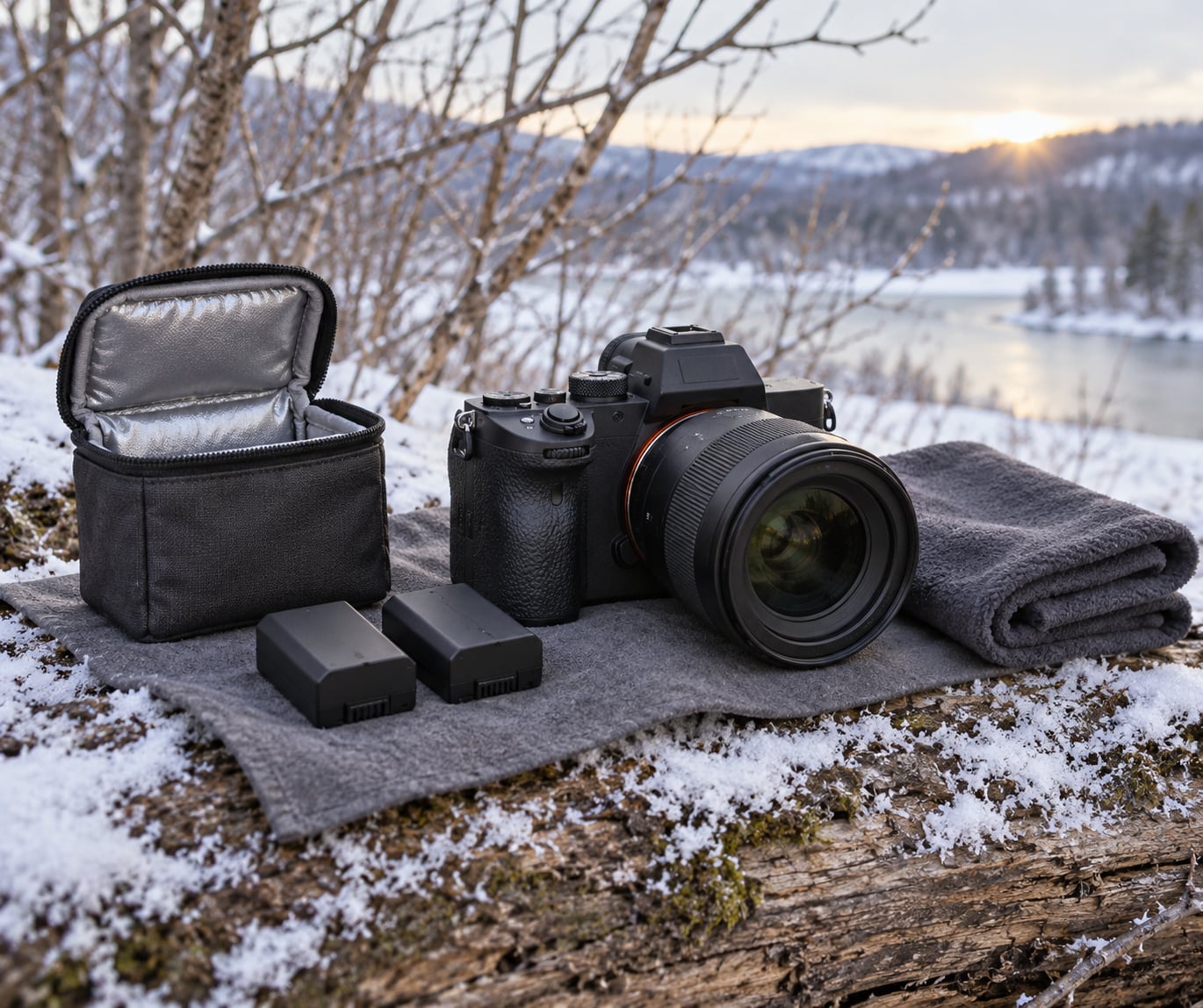
To keep camera batteries warm in cold weather, charge your spares indoors the night before, carry them in an inside pocket or insulated pouch against your body, and swap a warm cell into the camera before the meter drops. Cold slows a lithium-ion cell’s internal chemistry, so the pack reads as empty long before it truly is. Manage the drain outdoors, then let your gear come back to room temperature slowly and sealed.
There is no honest percentage to quote here. A fully charged pack that runs a whole afternoon in September can be flat in a couple of hours at 14F, and that drop is not fixed. How much you lose depends on the battery, the camera, how much of your body heat reaches the cell, and how long you shoot. What you can control is the temperature of the cell at the moment you put it in.
Table of Contents
- What You Need to Keep Camera Batteries Warm in Cold Weather
- Step-by-Step
- 1. Start With Fully Charged Spare Batteries
- 2. Store Spare Batteries Close to Body Heat
- 3. How to Keep Camera Batteries Warm During a Cold Shoot
- 4. Reduce Battery Drain While You Are Outside
- 5. Rotate Batteries and Recondition Them Indoors
- Common Mistakes
- Frequently Asked Questions
- Should I keep camera batteries in my jacket pocket while shooting?
- Can I warm a frozen camera battery with hot water?
- Is it safe to charge a camera battery in the cold?
- What is the best way to store camera batteries overnight?
- Why does my camera battery drain faster in winter?
- Can a USB power bank keep a camera battery warm?
- Conclusion
What You Need to Keep Camera Batteries Warm in Cold Weather
You need very little, and all of it should be sorted before you walk out the door.
- Two or more spare batteries, charged at room temperature the night before. Tamron’s winter maintenance guidance suggests carrying two to three extras for a cold shoot.
- A small insulated pouch or a zip-seal bag that fits in an inside coat pocket.
- A thin insulating wrap such as a small piece of fleece or a neoprene sleeve, wrapped around a cell that is out of the camera.
- A clean, dry cloth and dry hands. Moisture on contacts causes trouble that looks like a battery fault.
- A compatible USB power bank and the correct cable if you plan to charge in the field.
- Optional: a chemically activated hand warmer packet, and a couple of small tape labels for marking cells.
Now the list of things not to use. No flames, no boiling or hot water, no microwave, no hairdryer or heat gun, and no improvised heating pads wrapped around a cell. Camera batteries are not built for that, and the damage shows up months later rather than immediately.
Step-by-Step
1. Start With Fully Charged Spare Batteries
Charge everything indoors, close to departure, and leave the spares at room temperature until the moment you leave. A cell that has been sitting in a cold car all night is not a full cell, whatever the charger said a week earlier.
Charge the cell you are going to use first, top off the spares second. Then stop charging early enough that the pack can sit at room temperature for a while. You will get a steadier reading from the charger, and you will avoid starting a shoot with a cell that just came out of a warm charger into cold air.
If a battery suddenly reports as empty during a shoot, do not assume it is finished. Cold raises internal resistance and the camera’s low-voltage cutoff fires early. Warm that cell in an inside pocket for 15 to 20 minutes and it frequently comes back with real capacity still in it. Shooters on dpreview’s forums describe exactly this swap-and-recover pattern, and it is the single most reassuring thing about cold batteries: the meter lies, the chemistry does not.
What the cold does gets clearer as the temperature drops, and the numbers your manual gives you are usually worth a look before you travel.
- At 32F (0C), batteries and cameras start losing usable capacity, and charging a lithium-ion pack below this point is unsafe. Keep spares in an inside pocket and any hand warmer in an exterior pocket only, away from skin and gear.
- At 14F (-10C), capacity derating is severe and performance may lag noticeably even though the camera still functions. Rotate batteries on a fixed schedule, cut drain features, and carry one more spare than you expect to need.
- Below -10C, many cameras sit outside their rated operating range, so shutter, autofocus and LCD behaviour can suffer alongside the battery. Keep the body under a jacket layer between setups, shorten exposure blocks, and plan for the lowest light of the day.
Check the operating temperature your own camera is rated for. Nikon, Canon and Sony all publish limits, and the operating range covers the body, not just the pack. If your shoot sits outside that range, plan for more spares and shorter shooting blocks.
2. Store Spare Batteries Close to Body Heat
An unheated outside pocket is basically ambient temperature, which is the problem most people miss. Outer jacket pockets are exposed to the same moving air as your face, so a battery in one is cold even when you are comfortable. The value comes from the layer that sits against your torso.
Put spares in an inside pocket, a chest pocket over your base layer, or a small insulated pouch worn under a jacket or fleece. A thin wrap around each cell slows the handover between your body and the battery, so the spare stays usable longer while it waits. When a pouch gets described in field reports as a fanny pack worn under a down jacket, that arrangement is the same idea with more insulation.
Keep the cells dry and the contacts clean. Do not carry them loose where they can roll, scratch or get crushed against a carabiner, and do not force a swollen or dented pack into a tight pocket. If a battery has been dropped hard and its shell is dented, retire it rather than warming it.
3. How to Keep Camera Batteries Warm During a Cold Shoot
The technique that works is coverage, not heat. Cover a cell and it holds whatever warmth it has; apply a heat source and you are managing a burn risk and a condensation problem at the same time.
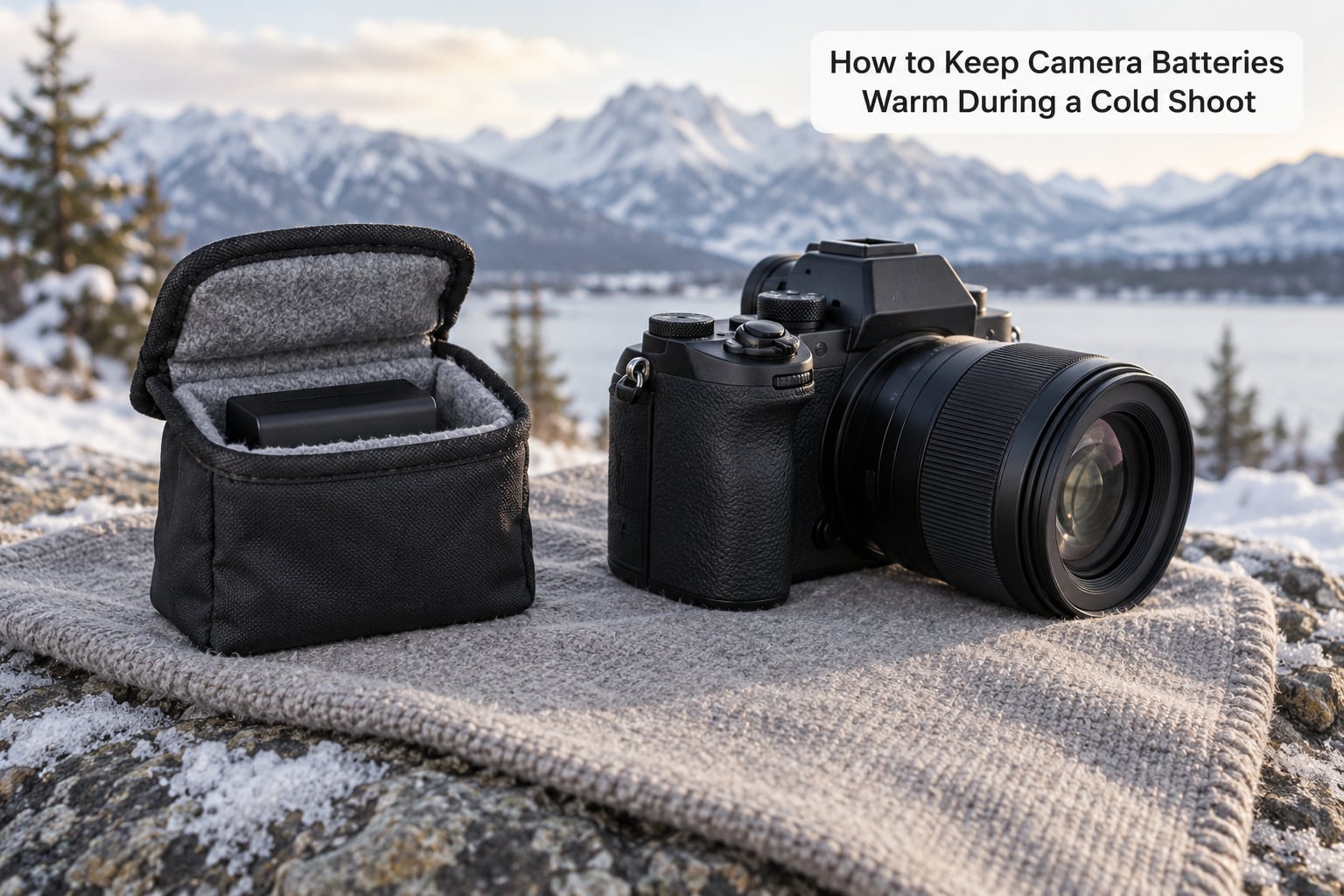
Keep the camera itself under a jacket or rain layer between setups. Between shots, take the body inside your coat, swap in a warm spare, and let the camera sit there for a minute before it goes back out. On a long winter walk this costs you little and buys you a lot.
A hand warmer packet is useful, but only in an exterior pocket, away from skin and away from the camera. Those packets can reach about 165F, hot enough to burn skin and far above any camera’s operating range, and the air they warm produces its own condensation as it does it. The Carleton production office is blunt about this: taped to the camera body, a warmer does more harm than good. They are handy for keeping your fingers functional between shots, and for trail camera work where your hands and the batteries want the same warmth source. For an aurora night or a snow scene, the warmer keeps you shooting, and that is the real benefit.
Give a cell 15 to 20 minutes in an inside pocket after it leaves the camera. Fifteen minutes often restores enough for a long sequence, and a full 20 minutes before reuse is the safer bet when you are on a night shoot with no second chance.
4. Reduce Battery Drain While You Are Outside
Warmth only buys back what you do not waste. Every feature you switch off is charge you keep for the shot you actually care about.
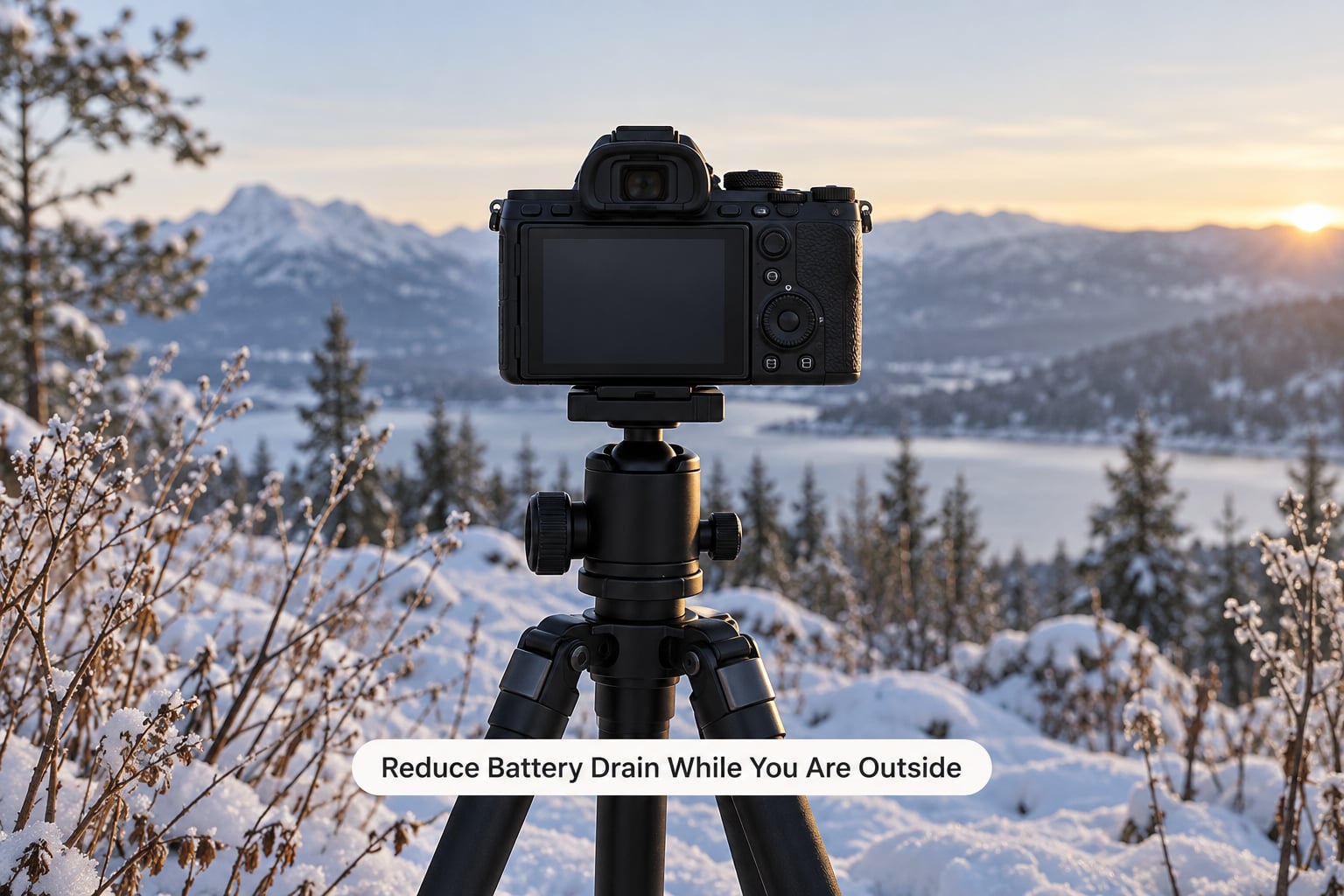
Turn off wireless, GPS and app pairing before you walk out, not at the first rest stop. Dim the rear screen and disable any always-on display. Batch your image review instead of checking after every frame, since the screen and the autofocus motor are two of the heaviest power draws on any body.
Limit burst shooting to the moments you need it. If you are working static scenes on a tripod, turn image stabilisation off for those frames, since it keeps driving the lens group. If you are shooting movement, leave it on and accept the drain, because missed motion is worse than a spare battery.
Shoot in blocks. Sit somewhere sheltered, make your frames, then put the camera away to warm rather than leaving it powered on in the wind between compositions. In practice this is the biggest single saving on a cold walk, and it costs you nothing but patience.
5. Rotate Batteries and Recondition Them Indoors
Rotation is the method that turns warming from a trick into a routine. Shoot with a warm cell, swap a warm cell in, then send the used one back to a warm pocket to recover.
Swap on a schedule rather than on panic. If a battery gives you a normal day’s worth of frames in the cold, change it at roughly half of that. Two cells per body in rotation, three if you are out overnight, keeps every pack cycling through warm and cool instead of sitting exhausted.
Keep the used cell in its own pouch, apart from the fresh spares. Label cells with tape if you are swapping in gloves in the dark, so you can tell at a glance which ones are warm and which are resting. This is a habit that pays for itself the first time you avoid putting a half-dead pack back in at 5am.
When you head back inside, seal the camera and the batteries in a bag before you open anything, and let the whole thing come to room temperature on its own. Opening a cold bag in a warm room dumps humid room air onto cold metal and glass, and that moisture is what does the damage. Photographers shooting in arctic conditions report wrapping gear in large bags overnight so the whole kit warms up gradually.
Back at base, let cells reach room temperature before charging them. Once they are there, charge them normally and note the cycle. Batteries that live in the cold and the heat tend to age faster than those kept at a steady temperature.
Common Mistakes
Most cold-weather battery problems come from one of six habits.
- Charging a sub-zero battery. Never charge a pack straight from a cold car or a cold bag. Bring it up to room temperature first. Below 0C, lithium-ion charging is unsafe whatever the charger claims to support, and a trickle charger does not change that.
- Sealing a cold battery into a warm pocket. This is the trap. A frozen cell in a heated jacket pocket warms faster than the air around it, condensation forms inside the pack or on the contacts, and the margin between the two temperatures is exactly the condition that causes damage. Let cold gear warm slowly, sealed, on its own.
- Direct heat. No microwave, no hot water, no hair dryer, no heater vent, no radiator. The point of warming a battery is to bring it to about the temperature of your hand, and everything above that is risk without benefit.
- Leaving spares in an outside pocket. If the pocket is unheated, it is ambient temperature and your warm-spare system is doing nothing. Inside pocket, or a pouch under a jacket.
- Waiting for the battery meter. In the cold, the meter reaches its low-voltage cutoff long before the pack is empty. Swap on schedule, not on the warning icon.
- Opening cold gear indoors too fast. Seal first, then wait. A big bag left closed for an hour or two does more good than any towel you wrap around a cold body.
A few extra notes. Shooters on r/fujifilm report that some cold failures trace back to substandard third-party packs rather than the cold itself, so if your spares behave badly, test one body with a genuine cell before blaming the weather. Drones and action cameras are a separate problem: their packs are often kept in a heated case in a vehicle, which is the right instinct, but they should reach flight temperature before they go in the air. And for anyone shooting Antarctica or a long expedition, the Canon USA community threads show the same simple fix surfacing again and again: the battery goes under a layer against the body and stays there.
Frequently Asked Questions
Should I keep camera batteries in my jacket pocket while shooting?
Yes, an inside pocket or an insulated pouch worn under a jacket is the standard advice, and Nikon’s cold-weather guidance recommends keeping a spare in an inside coat pocket and swapping as needed. Avoid an unheated outer pocket, which sits at ambient temperature and warms nothing. Keep cells dry, away from keys and carabiners, and let them sit in the pouch rather than crushing them.
Can I warm a frozen camera battery with hot water?
No. Hot water and other direct heat can damage a lithium-ion cell, and the temperature involved is well above what the battery is designed for. Body warmth is the safe method: put the cell in an inside pocket for 15 to 20 minutes. You will usually get usable capacity back, because a cold battery that reads as dead is often only cold.
Is it safe to charge a camera battery in the cold?
No. Charging a sub-zero lithium-ion pack is unsafe, whatever charger type you use, including a trickle charger. Bring the battery up to room temperature first and let it settle there before charging. Most manufacturers set a charging limit around 0C or 32F for this reason, and charging below it risks plating and permanent capacity loss.
What is the best way to store camera batteries overnight?
Store them cool and dry, not warm. Charge them at room temperature, then keep them in the camera or in a dry case indoors at a stable temperature. A cold battery sealed into a warm pocket creates condensation, which is worse than the cold. If you must store them in a vehicle, use an insulated case rather than relying on cabin heat.
Why does my camera battery drain faster in winter?
Cold slows the electrochemical reaction and raises the battery’s internal resistance, so a cell delivers less current at the same voltage. The camera reaches its low-voltage cutoff sooner, the meter drops fast, and the pack can read as empty while charge remains. The exact loss varies by battery, body and shooting style, so there is no universal cold-weather drain percentage to plan around.
Can a USB power bank keep a camera battery warm?
A power bank warms a battery only while it is charging, and you should not charge a sub-zero cell. It is still useful as part of a field setup: bring the battery to room temperature indoors, top it up from the bank, then return it to an inside pocket for the next block of shooting. Watch the bank’s output and cable, since charging speed depends on both.
Conclusion
Start with the first move, because it does most of the work: charge two or three spares at room temperature, put them in an insulated pouch in your inside pocket, and swap one in while it is still warm rather than when the meter complains.
From there it is habits. Cut the features you are not using, rotate on a schedule, keep hand warmers in an exterior pocket where they cannot touch skin or gear, and never charge a cell that came in from the cold. Seal your bag before you come inside and let everything warm up slowly.
That is how to keep camera batteries warm in cold weather without improvising anything dangerous. The cold is manageable; the meter is not.