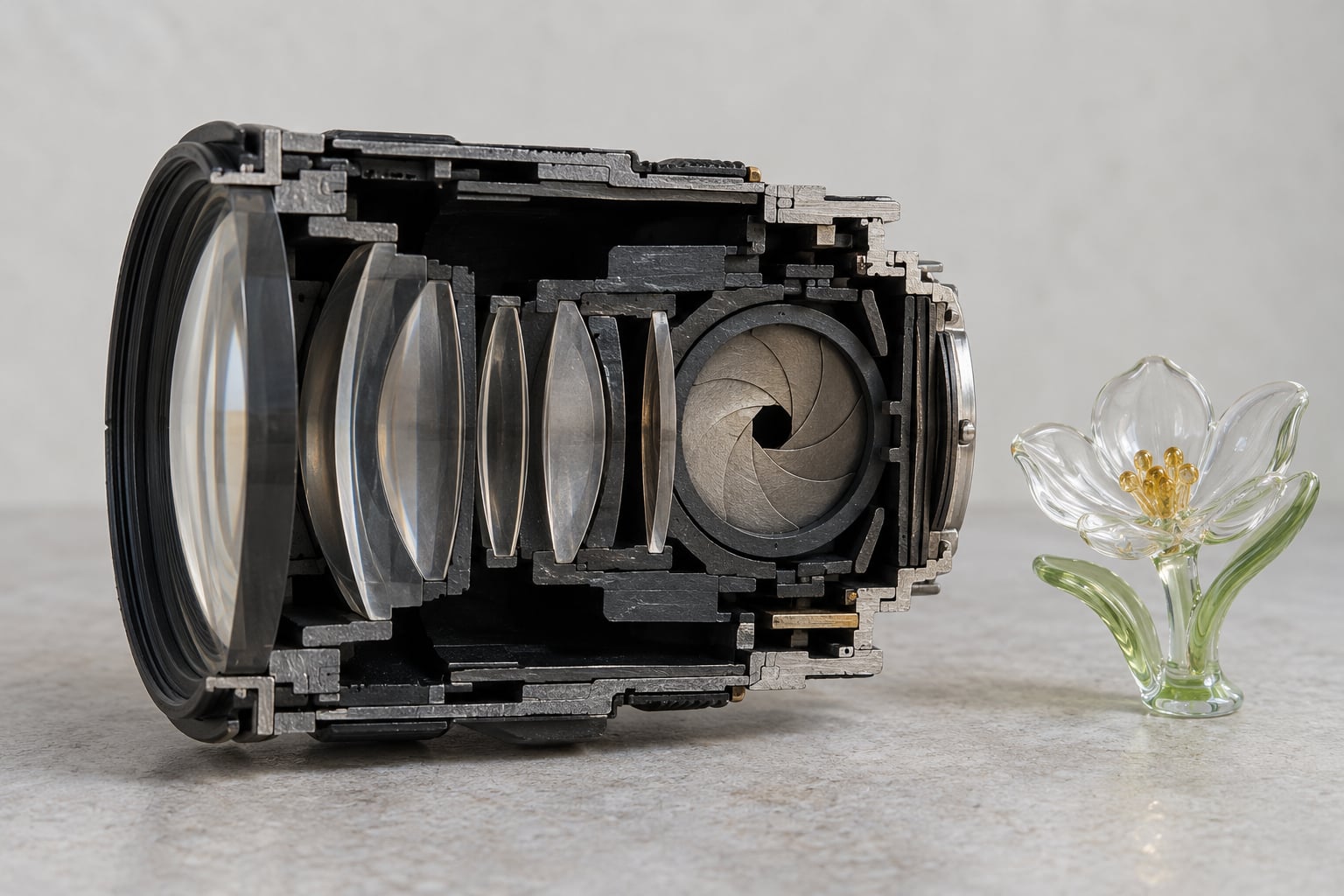
Aperture is the adjustable opening inside your camera lens that controls how much light reaches the sensor, and it also decides how much of the scene stays sharp. Here is what is aperture explained simply: it is one of three settings that set brightness, and the f-number printed on your lens tells you how wide that opening gets.
Most beginners meet aperture as a row of numbers on a lens barrel and a dial on the camera, with no idea which way is better. Nothing about f/2.8 or f/11 tells you what happens to the photo, so the numbers just look like a code to crack.
Table of Contents
- What Is Aperture in Photography?
- How Does Aperture Affect Light and Depth of Field?
- What Do the f-Numbers Mean?
- Where you find the f-number on your lens
- Which Aperture Should You Use for Different Photos?
- How Do You Choose Aperture on a Camera?
- Aperture, ISO, and Shutter Speed: What Changes?
- Simple Aperture Examples to Try
- A flower close-up at f/2.8
- A garden scene at f/8
- A dim indoor gathering at f/1.8
- Frequently Asked Questions
- What is aperture explained simply?
- Is a wider aperture always better?
- What aperture is best for flowers and portraits?
- Does changing aperture affect the photo’s brightness?
- What is the difference between f/2.8 and f/8?
- Should beginners use aperture priority or manual mode?
What Is Aperture in Photography?
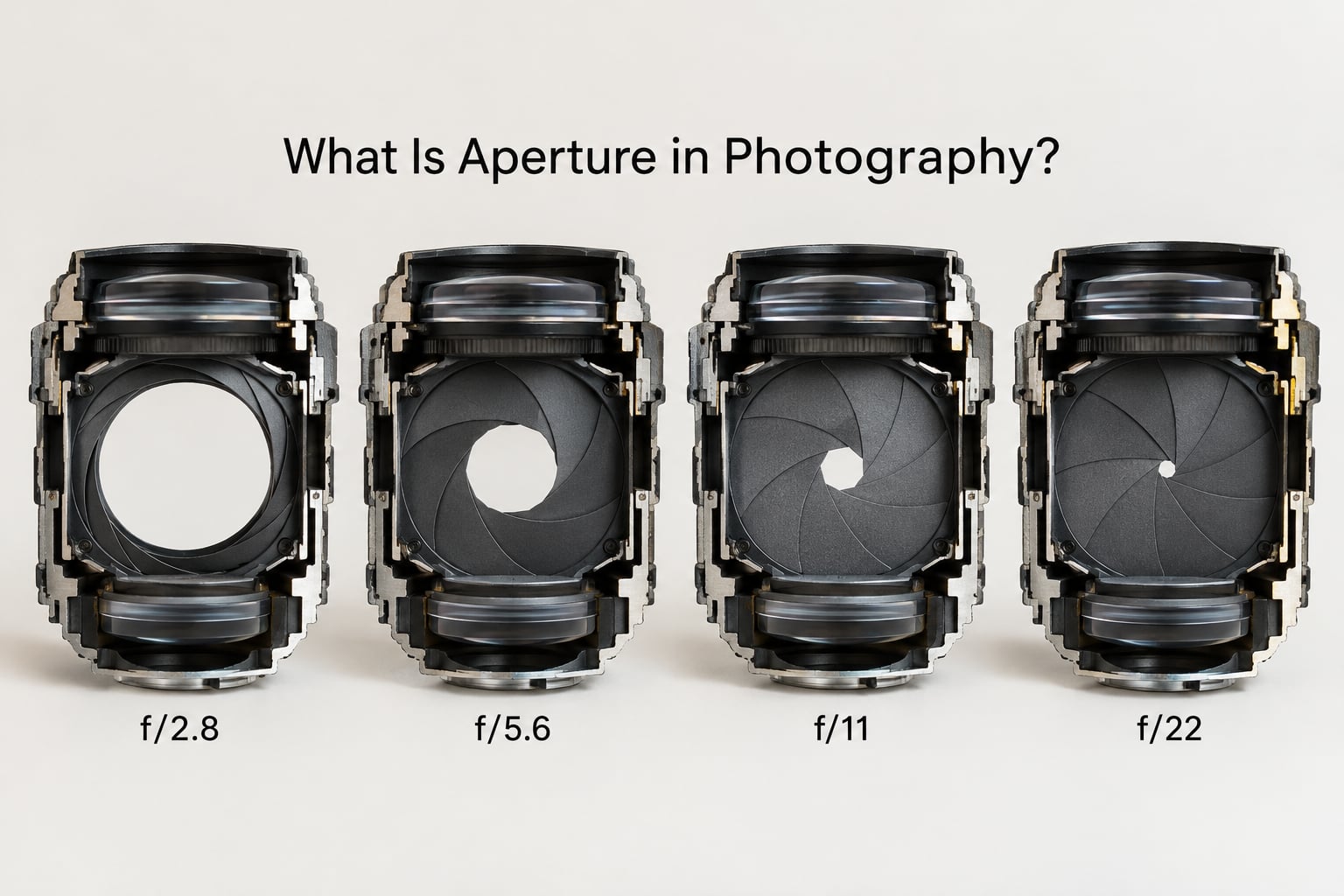
Aperture is a hole inside your lens that you can open wider or close down. A wider hole lets more light through to the sensor and blurs the background; a narrower hole lets less light through and keeps more of the scene in focus.
Physically it is a set of thin overlapping metal blades, usually called the aperture or diaphragm, sitting inside the lens barrel between the glass elements and the sensor. Turn a ring on the lens, or press a button and spin a dial on the body, and those blades slide across each other to reshape the opening into a different-sized circle.
Hold a hand in front of your eye in a dim room and then open it wide in daylight. That is what you are doing to the sensor, except you get to choose when.
How Does Aperture Affect Light and Depth of Field?
Aperture changes two things at once: how bright the photo comes out, and how much of the scene appears in focus. Everything else about the picture depends on those two effects.
At f/1.8 the blades sit wide apart. Light floods through, so the camera can shoot at a fast shutter speed or a low ISO, and only a thin slice of the scene is sharp. Shoot a flower at f/1.8 and the background turns into a soft wash of colour while the petal edges hold detail.
At f/11 the blades close into a small circle. Less light arrives, so you need a slower shutter speed, a higher ISO, or both, and far more of the scene is sharp from foreground to background. Shoot the same garden at f/11 and the path, the hedge and the sky all read clearly.
That second effect has a name: depth of field, the range of distance in front of the sensor that looks acceptably sharp. A wide aperture gives shallow depth of field, a narrow one gives deep depth of field.
What Do the f-Numbers Mean?
The f-number is the opening measured as a fraction. Aperture diameter equals focal length divided by f-number, so on a 50mm lens at f/2 the opening is 25mm across, and at f/4 it is 12.5mm across.
That maths produces the most common beginner mix-up. The f-number is not the size of the opening. A bigger number means a smaller hole, which is why f/1.8 is called a wide aperture and f/16 a narrow one.
The scale runs in thirds: f/1.4, f/2, f/2.8, f/4, f/5.6, f/8, f/11, f/16, f/22. Each step is either half or twice the light of the step before, and each step is called a stop.
| f-number | Light vs f/1.4 | Depth of field | Typical use |
|---|---|---|---|
| f/1.4 | Full | Very shallow | Dim rooms, blurred backgrounds |
| f/2.8 | One quarter | Shallow | Portraits, flowers |
| f/4 | One eighth | Moderate | Groups, street scenes |
| f/5.6 | One sixteenth | Deep | Everyday shooting |
| f/8 | One thirty-second | Deep | Landscapes, architecture |
| f/11 | One sixty-fourth | Very deep | Landscapes, night sky |
| f/16 | One one-hundred-and-twenty-eighth | Very deep | Daylight scenes needing reach |
Where you find the f-number on your lens
Read the largest number first. A kit lens marked 18-55mm f/3.5-5.6 is wide open at f/3.5 when zoomed to 18mm and f/5.6 when zoomed to 55mm, and you can narrow it down from there in the third-stop steps above.
A fixed-aperture lens always opens to the same number. A variable lens opens wider at the short end, which is why a 24-70mm f/2.8 stays at f/2.8 across the whole zoom while a 24-70mm f/3.5-5.6 slows down as you go longer.
Which Aperture Should You Use for Different Photos?
Start from the shot you want, not from the smallest number your lens offers. This table is a sensible starting point rather than a rule.
| Situation | Start here | Why |
|---|---|---|
| Single portrait | f/1.8 to f/2.8 | Blurred background separates the face |
| Family or group photo | f/4 to f/5.6 | Keeps a row of faces sharp |
| Flower or insect close-up | f/2.8 to f/4 | Makes one subject pop |
| Garden or wide scenery | f/8 to f/11 | Front-to-back sharpness |
| Sports and running pets | f/2.8 to f/4 | Blades let a fast shutter stay usable |
| Indoor or evening light | f/1.4 to f/2.8 | More light means less noise and blur |
| Night sky | f/2.8 to f/4 | Collects starlight, needs a tripod |
Push past about f/11 and something gives back. Diffraction softens fine detail, which is why many lenses look their sharpest two or three stops down from maximum aperture rather than at their widest.
How Do You Choose Aperture on a Camera?
On most cameras the mode dial does the deciding. Turn it to A on Nikon, Sony, Fujifilm and Canon, or to Av on Canon and Pentax, and the dial you turn now sets the f-number instead of the shutter speed.
Three steps cover almost every camera body:
- Set the mode dial to aperture priority.
- Turn the front or rear dial until the f-number on the screen reads what you want.
- Check the shutter speed and ISO the camera chose. If the shutter speed drops below about 1/125 for a person walking, open the aperture one stop or raise ISO.
Lenses with an aperture ring let you set it directly by hand. Switch the body to M for manual mode, turn the ring to the number you want, then set shutter speed and ISO yourself once the picture is bright enough on the screen.
On a phone, aperture is fixed. A phone advertised as f/1.8 always shoots at f/1.8, which is one reason phone portraits blur the background while your camera at the same number might not.
Aperture, ISO, and Shutter Speed: What Changes?
Aperture, shutter speed and ISO are the three settings that together decide exposure, which is why photographers call them the exposure triangle. Each one changes brightness, and each one changes something else as well.
| Setting | Controls | Side effect |
|---|---|---|
| Aperture | How much light the lens lets through | Depth of field |
| Shutter speed | How long the sensor is exposed | Motion blur in the photo |
| ISO | How much the camera amplifies the signal | Noise and grain in the shadows |
Because all three control brightness, you can trade them off. Open up one stop and you can halve the shutter speed or halve ISO and keep the same exposure, which is the whole trick behind shooting in low light.
At the same f-number, a full-frame and a crop sensor camera collect the same light. What changes between them is depth of field: the smaller sensor gives you more of the scene in focus at that same number, which is why phone and crop cameras blur less.
Simple Aperture Examples to Try
These three shots cover most of what beginners want to know, and you can do all of them with the lens you already own.
A flower close-up at f/2.8
Fill the frame with a single bloom, switch to aperture priority, and dial in f/2.8. The petals stay sharp and the bed behind them softens. If the sun is low, raise ISO rather than closing down to f/8, because closing down destroys the effect you came for.
A garden scene at f/8
Stand at the edge of a path and shoot into the middle distance at f/8. Foreground and far plants both hold detail, and the camera can pair f/8 with a shutter speed fast enough to hand-hold. Around f/8 sits close to where most lenses are sharpest.
A dim indoor gathering at f/1.8
Point a fast lens wide open at a group indoors. The wide opening collects enough light to hold a usable shutter speed, so people do not smear, and the dim background falls away. Watch the shutter speed and ISO on the screen as you open up.
Frequently Asked Questions
What is aperture explained simply?
Aperture is the adjustable opening inside a camera lens, built from thin overlapping metal blades, that controls how much light reaches the sensor. A wider opening gives a brighter photo and a blurrier background; a narrower one gives a darker photo and keeps more of the scene sharp. Its size is written as an f-number such as f/2.8.
Is a wider aperture always better?
No. A wide aperture is useful for low light, fast shutter speeds and soft backgrounds, but it leaves only a thin slice of the scene sharp, and lenses are often sharpest a couple of stops down from maximum. For groups, architecture and garden views, f/5.6 to f/11 gives a more useful result than the widest opening available.
What aperture is best for flowers and portraits?
Start at f/2.8 and check the result. That keeps your subject sharp while the background falls out of focus, which is the look most people are after. Move to f/4 or f/5.6 when the subject sits among other details you want readable, and avoid going narrower than f/8 or the background starts competing again.
Does changing aperture affect the photo’s brightness?
Yes. Each full stop, such as f/2.8 to f/4 or f/5.6 to f/8, halves the light that reaches the sensor, so the same shot comes out half as bright. Your camera’s meter notices and helps by suggesting a slower shutter speed or a higher ISO, which keeps the exposure roughly where it was.
What is the difference between f/2.8 and f/8?
f/2.8 is a wide opening and f/8 is a narrow one, and the gap between them is three full stops, so f/8 passes about an eighth of the light of f/2.8. In exchange for that loss, a shot at f/8 keeps far more of the scene sharp. So f/2.8 for a blurred background, f/8 for scenery that reads sharp throughout.
Should beginners use aperture priority or manual mode?
Aperture priority, marked A on most cameras and Av on some, is the better starting point. You pick the f-number and the camera handles shutter speed and ISO. Move to manual once you want to lock all three for repeatable shots, such as a run of landscapes or a tripod session where the exposure should not drift.
Start with one habit: turn the mode dial to A, set f/2.8 for a portrait or flower, and f/8 for a garden or street view, then watch what the camera does to the shutter speed. Aperture makes far more sense once you watch it change the other two settings, and that loop takes about ten minutes to learn.