Most beginners should start with a zoom lens, because you have not yet worked out what you like to photograph. A prime lens pays off sooner if you already know you want portraits, street shots or indoor work where a wide aperture matters. That is the short answer, and the rest of this guide explains why.
The confusion is understandable. Both lens types take the same pictures in the right hands, and the gap between them has shrunk enormously. What really separates them is how much decision-making they hand back to you.
So here is the honest version of the prime vs zoom lens for beginners question: neither type makes you a better photographer. One asks you to move, the other asks you to plan.
Table of Contents
- Prime vs Zoom Lens for Beginners at a Glance
- What Is the Difference Between a Prime and a Zoom Lens?
- Prime vs Zoom Lens for Beginners: Focal Length and Framing
- A quick prime focal length cheat sheet
- Prime vs Zoom Lens for Beginners: Image Quality
- Prime vs Zoom Lens for Beginners: Low-Light Photography
- Prime vs Zoom Lens for Beginners: Size, Weight, and Portability
- Prime vs Zoom Lens for Beginners: Price and Value
- Which Should You Choose?
- Frequently Asked Questions
- Which lens is better for beginners, prime or zoom?
- Why use prime lenses over zoom?
- Is a prime lens sharper than a zoom lens?
- What are the drawbacks of using a prime lens?
- Can you still zoom with a prime lens?
- What camera lenses should a beginner have?
- Conclusion
Prime vs Zoom Lens for Beginners at a Glance
If you want the whole decision on one screen, this is it. Read across each row and ask which column describes the shooting you actually want to do.
| Category | Prime lens | Zoom lens |
|---|---|---|
| Focal length | One fixed length, such as 50mm | A variable range, such as 18-55mm |
| Flexibility | Fixed frame; you move to change the shot | Recompose in place at any length in the range |
| Best aperture available | Often f/1.8 or f/1.4 | Usually f/2.8 on a fast zoom, f/5.6 on a kit zoom |
| Background blur | Easy to get, even at 50mm | Harder at the short end of the range |
| Sharpness | Very good wide open; suffers from diffraction when stopped down | Varies by design; modern zooms hold up well |
| Size and weight | Usually small and light | Larger and heavier, especially fast zooms |
| Cost of covering everything | You buy two or three lenses | One lens covers a wide sweep |
| Learning effect | Forces you to work within limits | Removes framing decisions, frees up attention |
| Weakest point | You will miss shots you cannot reframe | The slow end struggles indoors |
| Best for | Portraits, street, indoor and low light | Travel, family, events, sports, scenery |
What Is the Difference Between a Prime and a Zoom Lens?
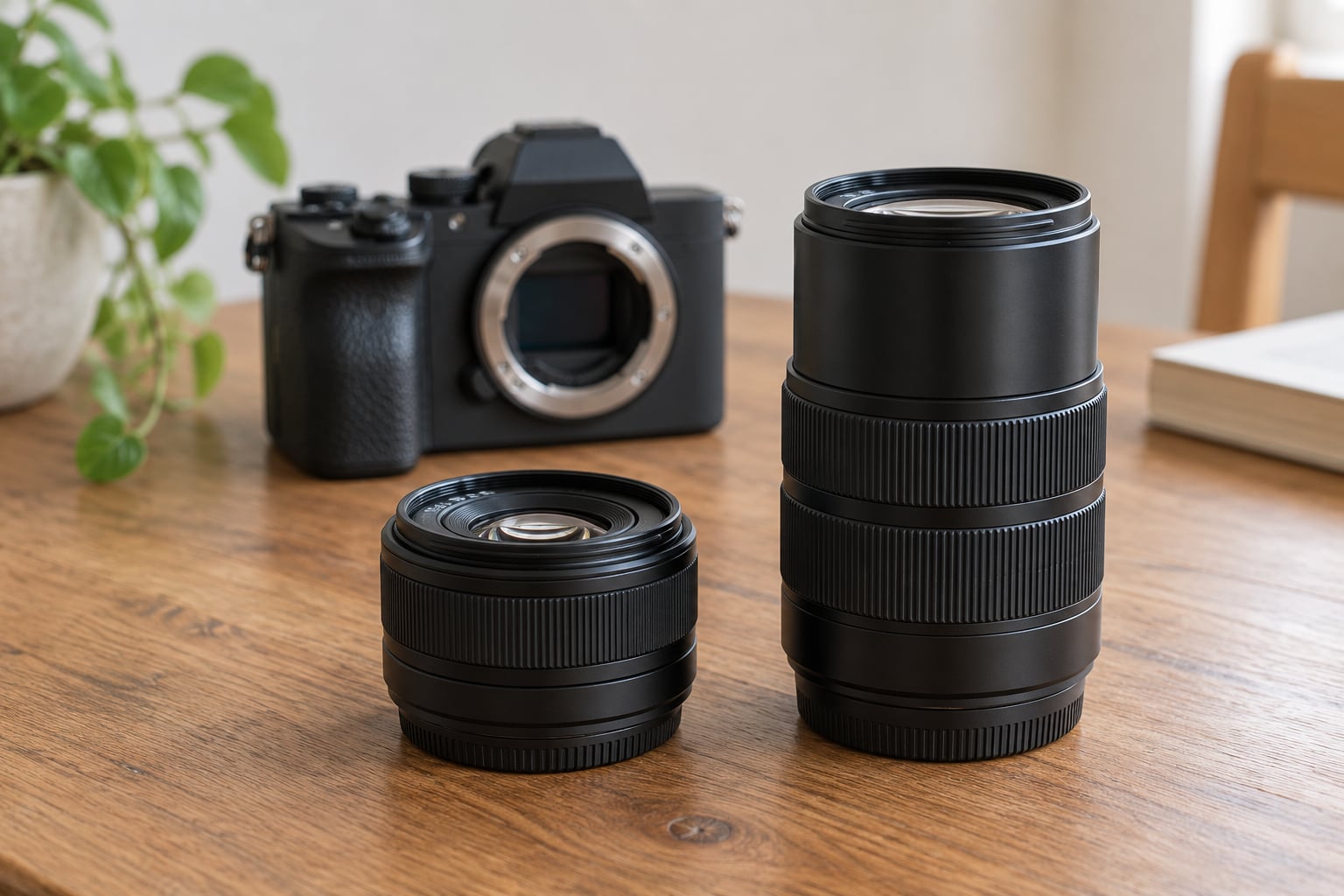
A prime lens has a single fixed focal length. A zoom lens covers a range of focal lengths in one barrel. That is the entire mechanical difference, and everything else flows from it.
A prime uses fewer moving groups of glass, which is why fast primes tend to be small and affordable. A zoom shifts internal elements to change its effective focal length, so changing the shot happens with a twist of the barrel rather than a step backwards.
Focal length decides how much of the world fits in the frame. A short length like 24mm takes in a room. A long length like 85mm narrows down to a face. Field of view is just the amount of scene a given focal length captures.
Zooming does not change perspective, by the way. Zooming in from 24mm to 70mm on the same spot keeps the same angle to your subject; your subject simply fills more of the frame. Perspective changes when you physically move. That myth causes more arguments than it should.
Prime vs Zoom Lens for Beginners: Focal Length and Framing
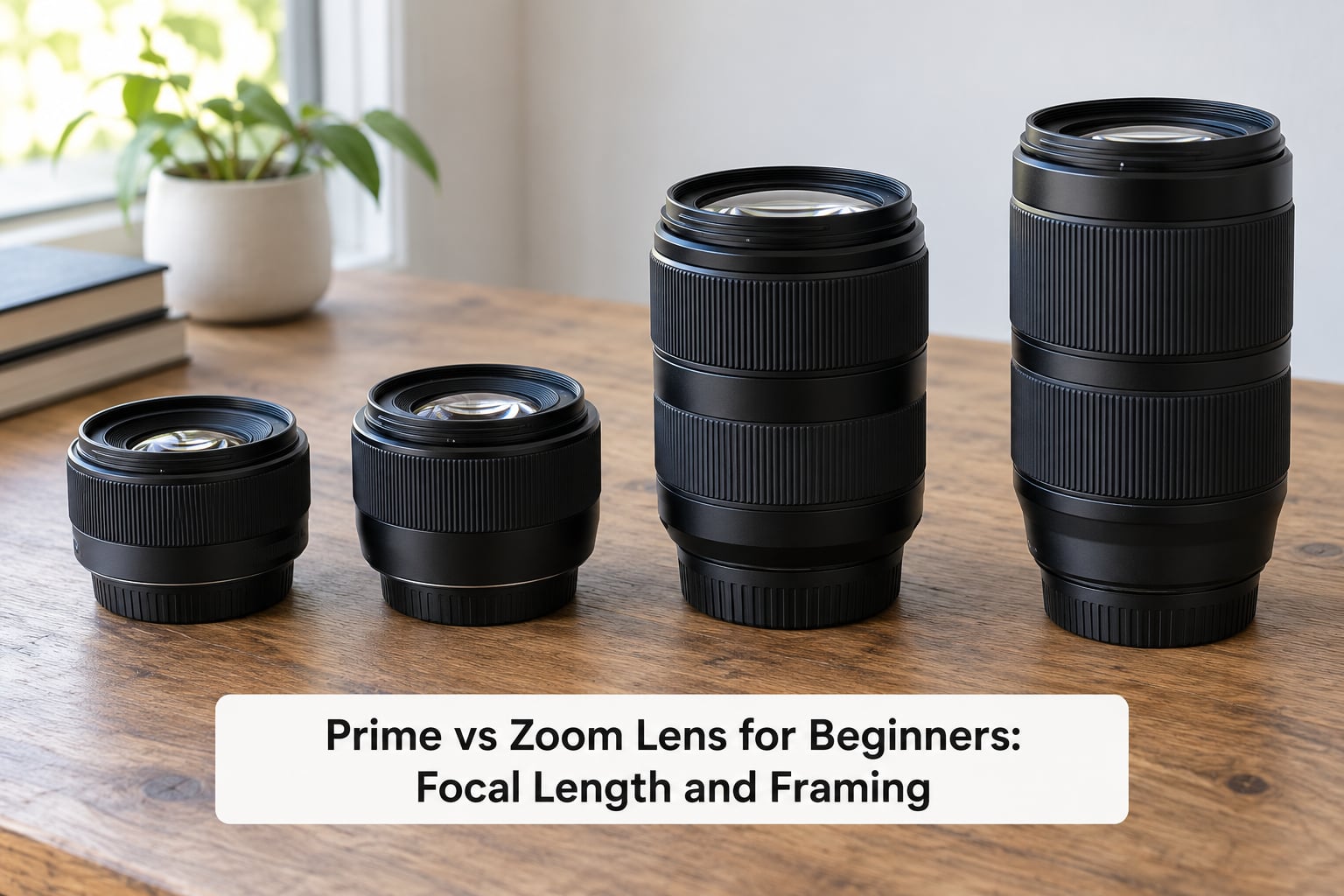
This is the decision that matters most, and it is not about picture quality at all. It is about how many times you will stand in one spot trying to make a composition work.
With a zoom you pick the length, then the frame. With a prime the frame is chosen for you, so your only options are to move closer, move further away, or accept the shot. Beginners who shoot unpredictable subjects usually find the zoom far less frustrating.
On a crop sensor body, multiply the focal length to work out what it feels like on a full frame camera. An APS-C camera with a 1.5x multiplier turns a 50mm prime into the equivalent of a 75mm view. Canon’s multiplier is 1.6x, and Micro Four Thirds sits at 2x. This is the single biggest reason beginners get surprised by a lens they thought they knew.
A quick prime focal length cheat sheet
Three lengths cover most of what a beginner wants to shoot. On a full frame camera:
- 35mm keeps the surroundings in the shot. Good for street, small groups and cramped interiors. It sits closest to what your eyes notice.
- 50mm is the natural one. It handles everyday scenes, family photos and travel without exaggerating faces or hiding backgrounds.
- 85mm flatters portraits and compresses backgrounds. On a crop sensor it behaves like a 135mm, which is much tighter than the number suggests.
Community advice tends to follow a simple heuristic: a prime is great when you know what, where and when you will shoot, and a zoom wins when those things are not in your control. That is why working event and wedding photographers keep a telephoto zoom on the body even after owning several fast primes.
Prime vs Zoom Lens for Beginners: Image Quality
The honest answer is that a prime lens is not automatically sharper than a zoom lens. Modern zoom optics are excellent, and the gap mostly shows up at the extremes of each zoom’s range.
The real difference is the aperture, not the glass count. Because a prime usually opens wider, you get a clean, bright frame without leaning on a high ISO. That is what beginners notice first, and it is a bigger quality jump than any amount of corner sharpness.
Second is geometry. Primes tend to show less barrel or pincushion distortion, less colour fringing at the frame edges, and less vignetting, because fewer elements are bending the light. Wide zooms bend light the most, which is why the corners of a 16-35mm can look softer and darker than the middle.
The catch to the sharpness story is diffraction. Air itself bends light, and at very narrow apertures like f/11 or f/16 every lens softens. Stop a modern prime all the way down and it lands in the same place as a good zoom. The difference mostly disappears at small apertures, which is exactly where scenery and product shooters work.
So if a shop tells you a prime is sharper because it is a prime, that is marketing shorthand rather than physics. Judge any lens on its own test results, and buy the body that fits your hands first.
Prime vs Zoom Lens for Beginners: Low-Light Photography
Low light is where lens type matters most, because the aperture decides how much light reaches the sensor before the camera does any work.
The f-number is a fraction of the focal length. A 50mm f/1.8 lens has an opening about a tenth the width of a 50mm f/5.6 lens, and lets in roughly three full stops more light. Three stops is the difference between a usable evening frame and a blurred mess, and no amount of editing brings back detail that never arrived.
A typical kit zoom opens to f/3.5 at one end and f/5.6 at the other. Shoot a birthday cake indoors at f/5.6 and you will need a slow shutter, a raised ISO, or both, and both bring their own problems. A fast prime lets you keep the shutter quick enough to freeze movement while the ISO stays low enough for clean files.
The second advantage is background blur. A wide aperture gives a shallow depth of field, so your subject separates from the background. That blurred backdrop, sometimes called bokeh, is the look beginners usually picture when they imagine a good lens, and it comes mostly from the aperture rather than the focal length.
For indoor sports, evening street work and night photography, a fast prime is the better first purchase. For daylight scenery and family gatherings outdoors, aperture rarely becomes the limiting factor and a zoom’s range matters more.
Prime vs Zoom Lens for Beginners: Size, Weight, and Portability
Size and weight get underestimated, then regretted on the fourth hour of a walking trip. A prime is usually the smaller bag, and that is a real benefit rather than a minor one.
Here is the catch. Covering the same range with primes usually means carrying two. A 35mm and an 85mm on a crop sensor body can weigh about as much as one 24-70mm zoom, and you still cannot zoom between them without a lens change in the rain.
For travel, that trade goes either way. Hikers and walkers usually value the weight saving and shoot at one or two focal lengths anyway. Anyone covering a wedding, a school event or a whole day of family photographs will thank a zoom every single time, because the range replaces the panic of changing lenses between shots.
Small primes also just feel pleasant to carry. Pocketable 35mm and 40mm lenses are the reason so many people bring a camera on days they would otherwise leave it at home.
Prime vs Zoom Lens for Beginners: Price and Value
Every camera usually ships with a kit zoom, usually an 18-55mm at f/3.5-5.6. Beginners often assume this lens is a compromise to be escaped. In many cases it is genuinely capable, and replacing it early is money spent for the wrong reason.
What a kit zoom does not do is open wide. That single limitation drives most of the prime lens buying advice floating around photography forums, and it is a legitimate reason to spend, just not the only one worth considering.
Value depends on what a lens has to cover. One zoom that handles 18mm through 200mm does the work of three lenses, and three lenses cost three times as much, weigh three times as much, and need three times the bag. Two primes that cover your actual subjects usually cost more per lens but far less in total once you notice you never use the third one.
The features that genuinely justify paying more are a wide maximum aperture, weather sealing for wet conditions, and image stabilisation when you shoot static subjects by hand at slow speeds. Everything else is a preference, not an upgrade.
Before buying, work out your three most common subjects. Whatever lens covers those is the one that pays for itself. Many beginners buy a fast 85mm portrait lens and then spend a year photographing parties and wide vistas with it.
Which Should You Choose?
Match the lens to the subject list rather than to a rule. The community shorthand holds up well: primes when you know your subject, zooms when you do not.
Start with a zoom if you shoot travel, family events, school sports, weddings, or anything where the subject can be small one moment and far away the next. It is also the safer choice if you are still deciding whether photography is for you.
Start with a prime, or add one, if you concentrate on portraits, street photography, indoor food, concerts or night work. Any fast 35mm or 50mm gives you the aperture and the background blur that these subjects reward, and it fits in a pocket.
For wide scenery and general vistas, work out the widest angle you actually need first. Ultra-wide primes exist and are excellent, but a wide zoom covers more ground before you have decided what you like.
For video and vlogging, favour a zoom with stabilisation and a constant aperture across its range. Primes change apparent focal length while focusing, which shows up as unwanted wobble in a moving shot, and a fixed aperture keeps exposure steady as you frame.
If you want both, a sensible second-lens path is the kit zoom you already own plus one fast 50mm. That covers short and long subjects, keeps indoor work usable, and costs less than assembling a set of primes you might not use.
Video vloggers and smartphone shooters often ask whether one lens is enough. If your subjects stay at a predictable distance and the light is decent, one lens really is enough. Everything beyond that is insurance against the days when the light drops and the subject moves.
Frequently Asked Questions
Which lens is better for beginners, prime or zoom?
A zoom lens is better for most beginners, because you can reframe without moving and you are still learning which subjects you enjoy. A prime makes more sense once you know you will shoot one type of subject often, especially portraits, street or indoor work where a wide aperture helps. If you can only buy one thing to start, use the zoom that came with the camera.
Why use prime lenses over zoom?
Primes are usually smaller, lighter and wider open than zooms, so they give you brighter frames, cleaner files at moderate ISO and strong background blur in a compact barrel. They also remove the decision of focal length, which forces you to move and compose, and that tends to sharpen composition skills faster. Many photographers find they make better pictures simply because they stop fiddling with the barrel.
Is a prime lens sharper than a zoom lens?
Not automatically. Primes tend to be sharper wide open because they can be built with a wider aperture, but modern zoom lenses are optically excellent and hold up well across most of their range. At narrow apertures like f/11 or f/16, diffraction softens every lens, and the difference largely disappears. Judge each lens on its own measurements rather than its type.
What are the drawbacks of using a prime lens?
The main drawback is missed frames. If a decisive moment happens at a distance your lens cannot cover, you cannot reframe and you will lose the shot. Covering a range of subjects also means buying two or three lenses, which costs more and weighs more than one zoom. Some modern primes also focus more visibly and shift focal length slightly while focusing, which matters for video.
Can you still zoom with a prime lens?
No, not optically. A prime lens has one fixed focal length, so the size of the frame only changes when you move closer or further away. This is called zooming with your feet, and for portraits, food and detail work it can produce better compositions than twisting a barrel. What you gain is perspective control; what you lose is the ability to reframe in place.
What camera lenses should a beginner have?
Start with the kit zoom that came with the camera, since it covers wide to short telephoto and costs nothing extra. Once you know your subjects, add one prime, most often a fast 35mm or 50mm for low light and portraits. Two lenses cover most beginners for years. Buy a second body lens later only after you have shot enough to know which focal length you actually reach for.
Conclusion
Start with the lens that matches your three most common subjects and nothing else. If those subjects move around and change distance, a zoom is the right first buy and you already own one. If you shoot people, indoors or after dark, add a fast 35mm or 50mm prime and learn what a wide aperture does for your pictures.
Technique, light and where you stand will matter more to your photographs than whether your lens zooms. Shoot often with whatever is on the camera, and the right second lens becomes obvious fairly quickly.