Photographers rarely fall out of love with photography all at once. It usually creeps in: the same walk, the same lens, the same frames you already made last October. That flat feeling has a name, and how to get out of a creative rut in photography is less about waiting for inspiration than about taking one input away — the subject, the constraint, the pace, or the audience you shoot for.
This is a seven-step reset you can run in a single afternoon. Every step has an assignment and a way to tell whether it worked, so you can stop when something clicks instead of grinding through a list.
I’ve been stuck more than once, and the pattern holds: the frames I dislike are almost always the ones made on autopilot. Updated for 2026, this is the reset I give friends who say they’ve run out of things to shoot.
Table of Contents
- What You Need
- How to Get Out of a Creative Rut in Photography: Step-by-Step
- 1. Name the kind of rut you are in
- 2. Reduce the number of decisions
- 3. Photograph something nearby under a new rule
- 4. Change your editing starting point
- 5. Study a subject instead of chasing new locations
- 6. Borrow a constraint from another medium
- 7. Finish with a small shareable project
- Common Mistakes
- Mistake 1: Waiting for inspiration to arrive
- Mistake 2: Changing your equipment constantly
- Mistake 3: Judging your images in the first hour
- Mistake 4: Copying whatever is trending
- Mistake 5: Making the exercise too ambitious
- Frequently Asked Questions
- How long does it take to get out of a creative rut in photography?
- What should I photograph when I have no ideas?
- Do I need new equipment to become more creative?
- How do I know when to take a break from photography?
- How can I stop comparing my photos with other photographers?
- A Gentle Place to Start
What You Need
You need less than you think. Grab the camera you already own, choose one location you can reach without planning, and set aside 60 to 90 minutes.
- The camera you already own — any body, any lens. A phone counts.
- One familiar location within a short walk of home.
- The editing tool you already use, or a paper notebook if you’d rather not open software.
- A time limit: 90 minutes for the full reset, or 30 minutes if you only do step 3.
That is the whole list. Buying a second body or a specialty lens is not part of this process, and gear shopping tends to delay the real work by weeks while feeling productive. Across photography forums the most repeated practical advice is blunt: carry the camera in your hand, not in the bag. Friction is what stops people shooting, so remove it first.
How to Get Out of a Creative Rut in Photography: Step-by-Step
The order matters. Diagnose before you prescribe, shrink the decision load before you go out, and only then start changing the work itself.
1. Name the kind of rut you are in
Advice rarely lands until you can say what is actually wrong. Most photographers are stuck for one of five reasons, and they need opposite treatments.
- Lack of ideas. You would happily shoot, but nothing appeals. This one responds to a new subject, not more effort.
- Lack of momentum. The camera stays in the bag. This responds to a smaller, easier session.
- Fear of a bad frame. You shoot less so you can’t fail. This responds to rules that make almost everything a keeper.
- Technical overthinking. Every outing turns into a gear decision. This responds to a preset kit and one lens.
- Comparison. You scroll before you shoot and feel behind before you raise the camera. This responds to fewer inputs, not more shooting.
Say the answer out loud in one sentence, then keep it in view for the session. Knowing how to get out of a creative rut in photography starts here, because a motivation block and an ideas block look identical from the outside and need opposite fixes.
Specificity does more work than encouragement. In one r/AskPhotography thread on exactly this question, the top answer was to shoot something completely different: the photographer had just spent a fortnight documenting a friend making cinnamon rolls and donuts, and said it broke the streak. No new lens, no trip, no course.
2. Reduce the number of decisions
Before you leave, lock four things: the camera settings, the lens, the walking area, and the clock. Then decide nothing else until you stop.
Most of my own stalls came from this. Changing focal length four times in ten minutes means you never stay still long enough to watch anything, and watching is the actual job. A fixed 50mm, aperture and ISO set on a fire walk along the same three blocks is enough.
3. Photograph something nearby under a new rule
Make 20 images of one subject within 400 metres of your front door, under a single constraint. Any one of these works:
- Vertical frames only — no horizontal shots allowed at all.
- Reflections only — windows, puddles, shop glass, car paint.
- One light source — every frame lit by the same lamp, window or open doorway.
- A tighter limit — nothing wider than your longest normal lens.
What to look for: how the same subject rewards a second and third angle. Almost everyone is surprised by how much variety one object holds when the frame is boxed in a certain way. You will know it worked when frame 20 is more considered than frame 4, and when you can name the rule you broke on purpose.
4. Change your editing starting point
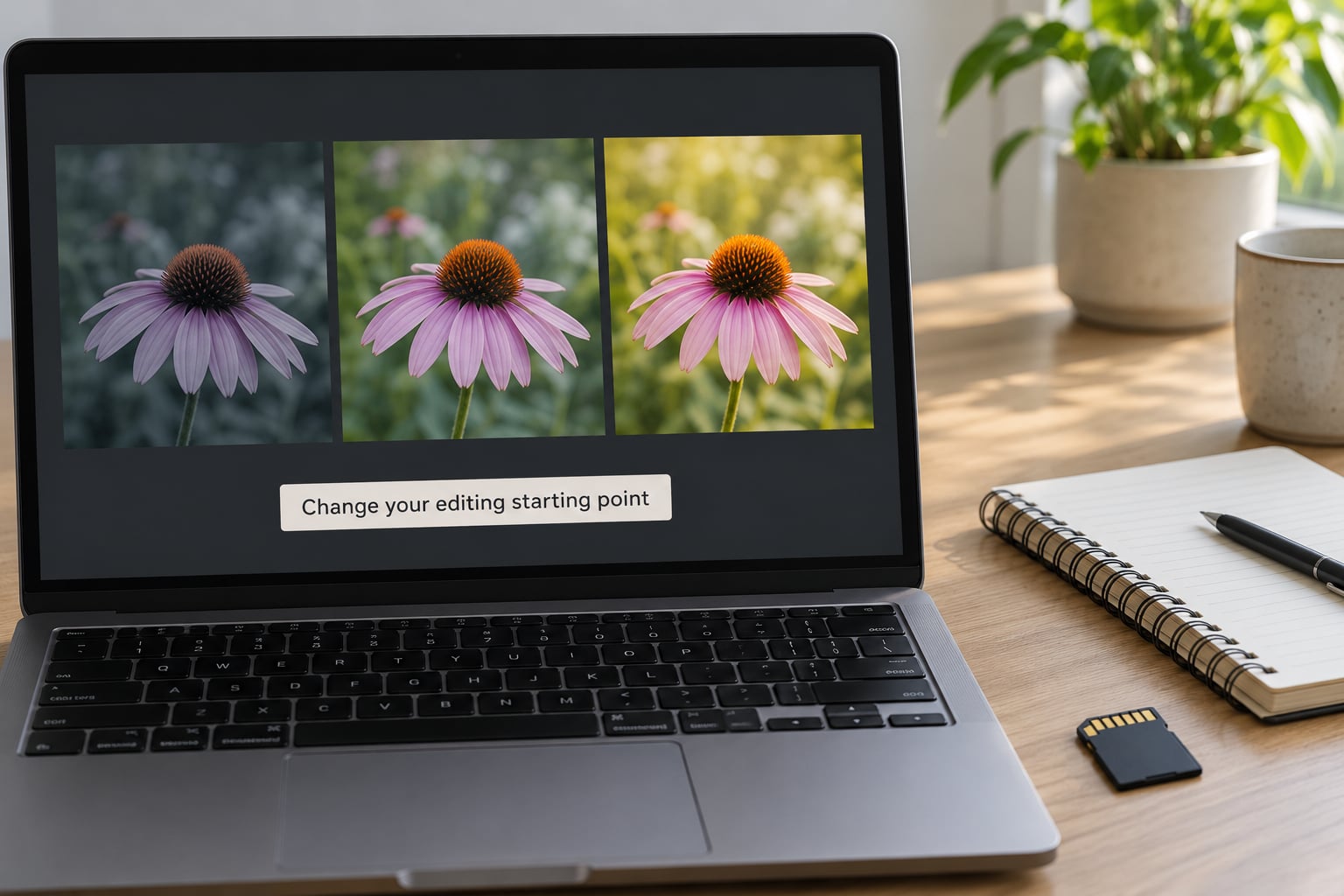
Open one image you already like and build three versions of it that start from different places: monochrome, a much tighter crop, and a warmer white balance. Twenty minutes, no presets.
This separates two jobs that usually get tangled — fixing a technical flaw versus making a creative decision. Editors describe the same boredom as a rut in its own right, and the cure is starting raw each time instead of applying the same grade you always apply.
Write one line about each version: what it emphasises and what it gives up. That note is the useful artefact, not the file.
5. Study a subject instead of chasing new locations
Go back to one place you have shot before and return to it at a different hour. Photograph it three times across a week — early, midday, dusk — and record what changed each visit: the light, the foot traffic, the shadows, the objects someone left behind.
Repeat visits turn a location into a subject with a history, which is far more interesting than a checklist of new spots. This is also the cheapest cure on the list, since the scouting is already done. If your only problem is “nothing appeals”, familiarity is usually the missing ingredient rather than the opposite.
6. Borrow a constraint from another medium
Take a rule from a medium you do not work in and photograph under it. A limited palette becomes a colour hunt through one neighbourhood. Repeated shapes become a search for circles, arches and rectangles in shopfronts. A narrative sequence becomes three or four frames that tell the order of an event.
Borrow the structure, not the look. Photographing in a style you have borrowed produces work that imitates someone else, which is its own dead end. Take the constraint and make something only you would have made with it.
Sometimes the borrow runs the other way. If your hands have forgotten what making feels like, spend a week away from the camera entirely — drawing, cooking, embroidery, collaging. Creators who write about this call it becoming a beginner again, and the beginner status is the point: nobody expects output from you, so you can make freely and badly. A nature photography forum thread put it plainly, asking photographers to reconnect with why they shoot in the first place.
7. Finish with a small shareable project
A session alone rarely changes a habit. Give the work an edge: a five-image sequence, a seasonal diary of one block, or a ten-image mini-series of your neighbourhood.
Keep the finish line hard. Five images and done, ten and done. A defined stop is what lets a project end, and ending is what makes starting the next one possible. Then set a next action in writing — one sentence, dated, small enough that you would feel silly not to do it.
Accountability does the rest. One person who will ask to see the images, or one external deadline such as a club critique night or an open submission, turns a private intention into something with consequences.
Common Mistakes
Mistake 1: Waiting for inspiration to arrive
Inspiration is usually a by-product of making, not a precondition for it. Waiting produces long gaps; making produces short ones. Fix: book a 30-minute session and give it an assignment before you sit down.
Mistake 2: Changing your equipment constantly
New gear feels like progress and produces images identical to the last ones. Worse, the hunt for the upgrade delays the shoot by weeks. Fix: commit to one body and one lens for 30 days and forbid yourself shopping.
Mistake 3: Judging your images in the first hour
Fresh frames look thin because you have not edited or spaced them yet. Fix: review nothing for 24 hours, and choose 20 images to compare rather than scrolling all of them.
Mistake 4: Copying whatever is trending
Trends are other people’s solutions to other people’s problems, and borrowing the surface leaves you with nothing to say. Fix: keep the structure, discard the look, and pick a subject only you have access to.
Mistake 5: Making the exercise too ambitious
A 30-image project due next month is not a reset, it is another deadline. Fix: size the project so it can be finished in one evening.
Two habits help more than any single trick. Review a small, fixed number of images rather than an archive, and put the camera where you can reach it — by the sofa, in the car, on the kitchen table. The photographers who get unstuck fastest are usually the ones who shoot boring things nearby with total seriousness.
Frequently Asked Questions
How long does it take to get out of a creative rut in photography?
Most ruts loosen within a week of consistent short sessions, though the lasting change usually takes longer. One good afternoon with a new constraint often produces the first spark, and a fortnight of regular shooting restores the habit. If several weeks of genuine effort change nothing, the cause is usually fatigue rather than a creative block, and it needs rest or a different kind of work.
What should I photograph when I have no ideas?
Photograph one nearby subject under a rule: vertical frames only, reflections only, or a single light source. Twenty frames of one object within a few hundred metres of home will teach you more than any search for inspiration, because most of what we call running out of ideas is running out of angles. Keep a running list of dull subjects too, such as laundrettes, stairwells and bus shelters.
Do I need new equipment to become more creative?
No. Constraints do the work that gear shopping promises, and they cost nothing. A single fixed lens, one familiar location and thirty minutes will surface more ideas than a new camera body. If you are waiting for equipment before restarting, that waiting is usually the rut itself. Upgrade later, when a specific limitation is actually blocking a specific image.
How do I know when to take a break from photography?
Take a break when the dread before a session outweighs the pleasure after it, when rest and recreation stop feeling restorative, or when photography leaks into other parts of your life uninvited. A short planned pause is healthy and easier to return from. If the flatness has spread to everything you do, or you cannot feel pleasure from things you used to enjoy, talk to a doctor or therapist rather than treating it as a prompt problem.
How can I stop comparing my photos with other photographers?
Comparison is fed by inputs, so change the inputs rather than trying to change your feelings. Unfollow the accounts that reliably make you feel behind, stop scrolling before a session, and judge your work against your own archive from six months ago instead. Reviewing twenty of your frames monthly is far more useful than an hour of browsing, because it shows you the progress that daily viewing hides.
A Gentle Place to Start
If nothing else today, do this: pick one subject within a five-minute walk, set a 30-minute limit, and make 20 frames under a single rule — vertical only, or reflections only. Choose one frame at the end and write a single line about what to try next.
That is the whole method behind how to get out of a creative rut in photography: one subject, one rule, one small finished thing. Do it this week rather than when you feel inspired, because inspiration tends to turn up about ten minutes after you start.